.jpg)
By Mihar Dias (C) October 2024
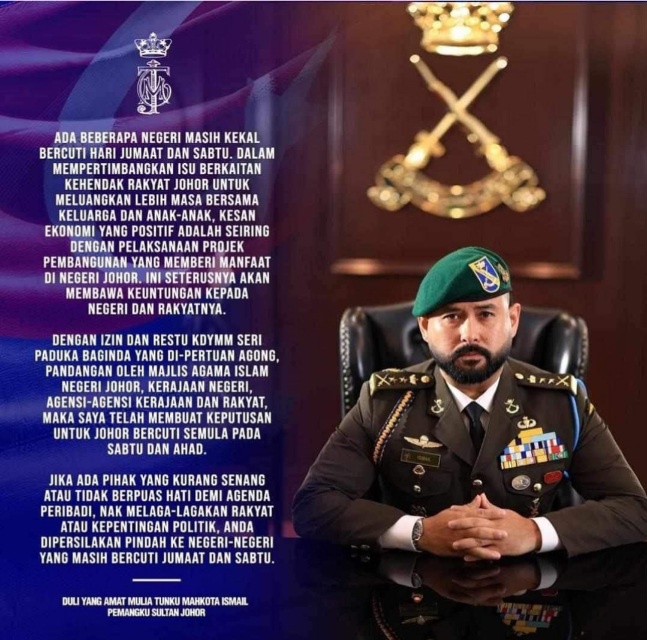
The recent decision by the Regent of Johor, Tunku Mahkota Ismail, to revert the state's weekend to Saturday and Sunday has sparked a lively debate.
His Highness announced this change after considering the desires of the people, particularly for the sake of family time, and with the approval of Sultan Ibrahim and the Johor Islamic Religious Council. He also highlighted the positive economic impact this shift would bring, aligning with the state's developmental projects.
In his remarks, Tunku Mahkota was unequivocal: those who are dissatisfied are free to move to states that continue to observe the Friday-Saturday weekend, such as Terengganu, Kelantan, or Kedah.
As His Highness rightly noted, Malaysia is a free country. While his statement might seem blunt, it carries a deeper message about the unity and identity of Johoreans, or Bangsa Johor.
It’s worth noting that Johor has always been a state with a strong sense of identity and pride, symbolised by the concept of Bangsa Johor. This concept isn’t just a label; it represents a deep bond between the people and the state’s royal family, uniting Johoreans across different ethnicities and religions. To live in Johor means to embrace this identity and to align oneself with the values that the state's leadership promotes. In this case, if you are a Johorean, you adhere to the weekend that reflects the state's vision for its future.
While some may feel inconvenienced by the change, it is essential to look beyond personal preferences and consider the larger picture. Johor is a state with booming economic prospects, especially given its proximity to Singapore, its growing industrial sector, and ambitious development projects. A shift to Saturday and Sunday weekends can better align Johor with national and international businesses, increasing economic efficiency and boosting productivity.
It’s also important to respect the fact that this decision wasn’t made in isolation. It took into account consultations with various stakeholders, including government agencies and religious authorities. The move is clearly not just about convenience but about creating a more cohesive, family-oriented, and economically progressive society.
For those who disagree with the decision, the option is clear: there are other states that follow different schedules. However, leaving Johor over a disagreement about weekends raises an important question: can one still call themselves Bangsa Johor after abandoning the state over such a minor issue? The bond between Johor and its people goes beyond the days of the week—it is about shared values, history, and loyalty to the royal family.
By suggesting that dissenters are free to leave, Tunku Mahkota Ismail isn’t dismissing their concerns but rather reminding everyone that being part of Bangsa Johor means embracing decisions made for the collective good, not just individual preferences.
Ultimately, this change is about adapting to the future while preserving Johor’s strong cultural identity. As the Crown Prince emphasised, the shift will benefit not just the economy but also the social fabric of the state, allowing families more time together and strengthening the bond between Johoreans. Moving forward, the challenge for Johoreans is to rally behind their leadership, embrace the changes, and continue building a prosperous and united state.
Mihar Dias is a content creator under the Newswav Creator programme, where you get to express yourself, be a citizen journalist, and at the same time monetize your content & reach millions of users on Newswav. Log in to creator.newswav.com and become a Newswav Creator now!
The User Content (as defined on Newswav Terms of Use) above including the views expressed and media (pictures, videos, citations etc) were submitted & posted by the author. Newswav is solely an aggregation platform that hosts the User Content. If you have any questions about the content, copyright or other issues of the work, please contact Newswav.

