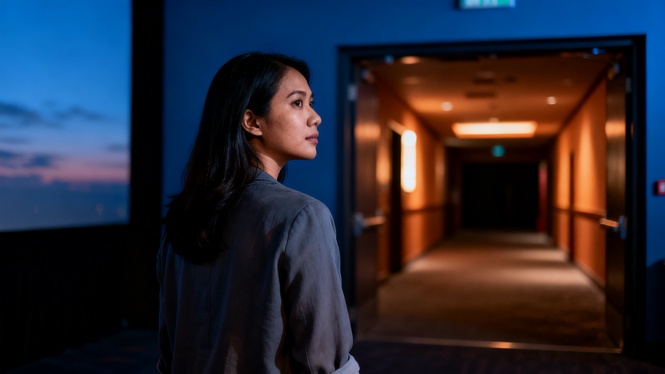
A dark cinema. A dimly lit corridor. An unfamiliar room after the lights have gone out.
For most people, their eyes adjust within moments. But for someone with retinitis pigmentosa (RP), seeing in low light may take much longer or may not happen effectively at all. Over time, other changes can emerge, including difficulty seeing to the side and frequently bumping into objects.
Because these symptoms often develop gradually, they may be mistaken for ordinary changes in eyesight. RP, however, is a group of inherited genetic conditions that affect the retina, the light-sensitive layer at the back of the eye.
As the retina becomes damaged, people may develop night blindness and progressive loss of peripheral vision (side vision). There is currently no single cure for all forms of RP, but early assessment, regular monitoring and the right support can help patients protect their remaining vision and stay independent.
According to Dr Tara Mary George and Dr Daphne Teh of Sunway Medical Centre, Sunway City, RP can begin and progress differently in each person.
The first clue may appear after sunset
“RP is not a single disease, but a group of inherited retinal conditions where the retina does not function properly from the beginning,” explains Dr Tara.
The retina acts like the eye’s information centre. It receives light and converts it into signals, which travel to the brain and are interpreted as vision.
In RP, genetic changes disrupt this process. The rod cells (specialised light-detecting cells in the eyes) are often affected early. These cells help people see in low light and contribute to peripheral vision.
This is why difficulty seeing in the dark can be one of the earliest signs.
“A common clue is when someone struggles to navigate in a dark room, such as the cinema. When lights go off, most people’s eyes adapt quickly but someone with RP may take much longer or not adapt well at all. As the condition progresses, patients may start to have tunnel vision and bumping into things as everything on the sides is dimmed out,” Dr Tara shares.
Night-vision problems do not necessarily mean a person has RP. Several other eye conditions can cause similar symptoms. However, persistent difficulty seeing in the dark or changes in side vision should not be ignored or addressed by simply buying new glasses.
An eye specialist can investigate the cause and recommend the appropriate tests.
One condition, many different experiences
RP does not follow one predictable pattern. Some people develop symptoms during childhood, while others only notice a problem in adulthood.
The age at which symptoms begin and the rate at which they progress can depend on the specific genetic change involved. “If more critical parts of the retina are affected, the symptoms appear sooner and are usually worse. In milder cases, vision changes may only become noticeable in adulthood,” Dr Tara explains.
The condition can also be inherited in different ways. It may affect several members of a family, but it can also appear in someone with no known family history. Therefore, not having relatives with RP does not rule out the diagnosis.
Genetic counselling may help patients and families understand how the condition may be inherited. Genetic testing may also identify the specific gene involved, although not every person will receive a definitive genetic result and not every gene change currently has a targeted treatment.
A confirmed genetic diagnosis may be useful when considering certain research studies or mutation-specific treatments. These options are not suitable for everyone.
For Dr Daphne and Dr Tara, early detection is important not only for monitoring the eyes, but also for helping patients plan ahead and access practical support.
Looking beyond a routine eye test
Identifying RP usually involves more than a standard vision check. Doctors may begin by reviewing the patient’s symptoms and family history before carrying out specialised examinations.
A visual-field test measures how much a person can see around them. An optical coherence tomography, or OCT, scan provides detailed images of the retina and can help doctors monitor changes over time.
In some cases, an electroretinogram, or ERG, may be used to measure how the retina responds to light. Access to ERG testing may be limited in some areas of Malaysia, so patients may need to be referred to a centre that provides the test.
“If you have ongoing night vision problems or difficulty seeing from the side, don’t just update your glasses. It is important to see an eye specialist for a proper assessment,” Dr Tara advises.
A diagnosis can be difficult to absorb. Yet care does not end when the diagnosis is confirmed. Regular follow-up appointments can help doctors track changes, manage complications and provide advice as a patient’s needs evolve.
“We monitor patients regularly to track progression and treat any complications that arise,” Dr Daphne says.
Some patients may develop cataracts or swelling in the macula, the central part of the retina responsible for detailed vision. These problems may be treatable, although treating them does not remove the underlying genetic cause of RP.
Small changes can make daily life safer
Simple adjustments can have a significant effect on daily life.
Brighter and more evenly distributed lighting may make it easier to move around the home. Keeping walkways clear, using contrasting colours on steps and reducing night driving can also improve safety. Decisions about driving should be based on professional advice and local regulations.
Low-vision rehabilitation can provide further support. This may include training in the use of magnifiers, advice on adapting the home or workplace, and orientation and mobility training.
“Patients who adapt early tend to cope better in the long term,” says Dr Daphne.
Early support can also help patients remain engaged in education, employment and social activities instead of waiting until everyday tasks become overwhelming.
Technology puts more tools in reach
For many people with RP, technology is becoming an important part of staying independent.
Digital magnifiers can enlarge print. Text-to-speech software can read documents aloud. Smartphone applications may help users identify objects, read signs or receive descriptions of their surroundings.
“There are apps today that use artificial intelligence to describe surroundings or read text aloud in real time. These can be life-changing, especially when introduced early,” Dr Daphne notes.
These tools can be valuable, but they are not infallible. Their accuracy can vary, and users should consider privacy, cost and reliability. They should complement, rather than replace, professional care and formal rehabilitation. When safety is involved, users may still need help from a trained professional or another person.
Emotional support matters just as much as practical assistance.
“Many people worry that an RP diagnosis means losing their independence. However, with the right support, many patients continue to study, work, and lead fulfilling lives,” she emphasises.
Families, teachers and employers can help by discussing reasonable adjustments and allowing patients to use visual aids or accessibility tools. The support required may change as vision changes.
Looking ahead without losing sight of today
For someone newly diagnosed with RP, uncertainty is often the most difficult part. Research into gene-based treatments and other therapies is continuing, but these approaches do not apply to every form of RP.
Some treatments are still under investigation. Others are designed for specific genetic changes and may be available only under particular regulatory approvals. Patients should speak with their eye specialist about whether genetic counselling, testing, rehabilitation or a relevant research study may be appropriate.
They should also be wary of products promoted as cures without reliable evidence.
Both specialists stress that knowledge, preparation and support can make a meaningful difference. Patients and families can start by learning about the condition, attending follow-up appointments, making the home safer and seeking help early.
RP may change the way a person sees the world. It does not have to define what they can do. With appropriate medical care, rehabilitation, technology and support, many people with RP can continue to learn, work and take part in the activities that matter to them.
The medical information of this article was contributed by Dr Tara Mary George, Consultant Ophthalmologist and Medical Retina & Uveitis Specialist, and Dr Daphne Teh, Consultant Ophthalmologist and Medical Retina & Uveitis Specialist from Sunway Medical Centre, Sunway City (SMC).
The post When the World Goes Dark: How This Eye Disease Can Severely Affect Night and Side Vision first appeared on PP Health Malaysia (PPHM) | 10POINTS Evidence-Based Health News.