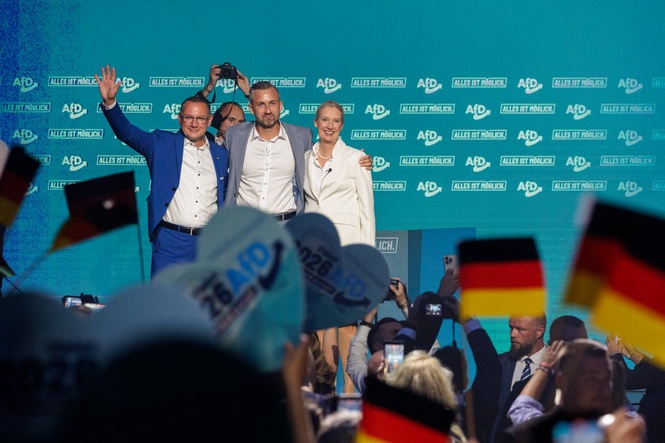
The far-right Alternative for Germany (AfD) party has won an historic victory in state elections in the east of the country, delivering a fresh blow to Friedrich Merz’s ailing government and paving the way for the party to trial its radical policies.
The anti-immigration, pro-Russia AfD won nearly 44% of the vote in Saxony-Anhalt, official results showed, falling short of an absolute majority with 39 of the 83 seats, while support for Merz’s CDU slumped to just 17.2%.
Both France and Poland reacted to the election results with alarm, while Russia’s presidential envoy Kirill Dmitriev hailed an “historic win for the pragmatic AfD”.
The AfD was only formed in 2013 but is already the country’s most popular party at the national level. It has sought to secure a foothold for advancing its agenda, which includes heavy restrictions on immigration, better ties with Russia, and leaving the euro.
Leadership in Saxony-Anhalt could see sweeping reforms around migration, education, culture and family, offering a preview of the AfD’s plans for the country ahead of the 2029 national elections.
Alice Weidel, co-leader of the party at the national level, presented Sunday’s result as a milestone and said her party aimed to win at least 40 per cent in the upcoming federal elections.
What is the AfD?
The party Alternative for Germany (AfD) was first set up in 2013, with its initial manifesto focusing solely on dissolving the Eurozone and opposing bailouts for countries struggling with the debt crisis.
Founded by breakaway members of the conservative CDU party, it was initially dubbed a “party of professors” and veered away from harsh anti-migrant sentiment, crafting a reputational shield against accusations of extremism.
However, a series of leadership changes saw the party veer further into a hardline territory marked by its anti-migrant and anti-Islam stance, and rooted in nativism, following successes in regional elections.
Earlier this year, the party revealed some of its proposals for governance in a lengthy ‘programme’ for Saxony-Anhalt, detailing plans to clamp down on immigration, restore ties with Russia and support families of German origin.

The party outlined plans for a task force to expedite deportations, while the children of refugees would be placed in separate classes at schools.
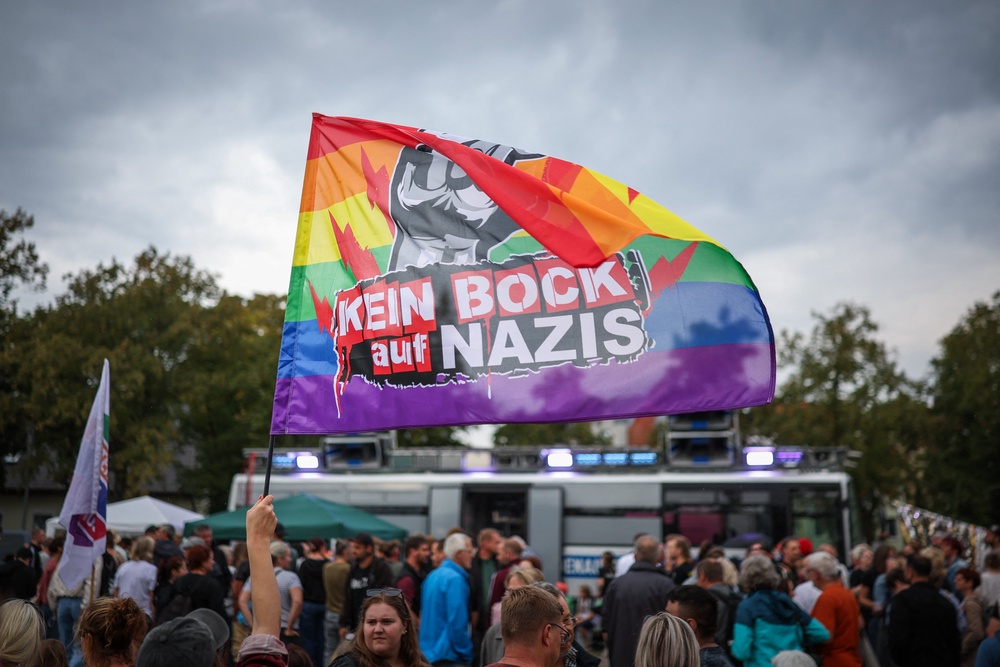
They also said schools would be banned from flying rainbow flags, with the national flag raised daily instead. Schoolchildren would follow a curriculum built around a ‘patriotic cultural policy’ and be expected to sing the national anthem at school events.
An AfD state government would advocate for removing war refugee status for Ukrainians in Germany as long as the conflict remains concentrated in eastern Ukraine, arguing they should seek refuge in western Ukraine.
Since 2023, Germany’s domestic intelligence agency BfV has listed AfD as a suspected extremist organisation which requires surveillance, while classifying its youth wing Young Alternative as extremist.
The country’s mainstream parties have all refused to work with the AfD as part of a Brandmauer, or ‘firewall’, against the far-right. But none currently appear to be able to muster the popular support to defeat the party on their own.
What has AfD said about Islam and Nazism?
While it ostensibly began as a ‘party of professors’, by the time of the 2017 election - which saw the party enter the Bundestag for the first time with 12.6 per cent of the vote - AfD’s manifesto was claiming that “Islam does not belong in Germany”.
The party said that Germany’s Muslim population posed “a great danger to our state, our society and our system of values”.
The more recent proposals for Saxony-Anhalt promised an AfD state government would exhaust “all legal avenues” to limit Islamic expression.
The AfD dismisses accusations of extremism as scaremongering and an insult to the party's millions of supporters. But party members have shown sympathy for Germany’s Nazi past.
Bjorn Hocke, AfD’s leader in the eastern state of Thuringia, has twice been fined by a court for using the banned slogan “Alles für Deutschland” (Everything for Germany) during public speeches, which was engraved on the daggers of Nazi SA Stormtroopers.
Mr Hocke, whose branch won in state elections last September – marking the first such far-right victory in post-war Germany – has also described Berlin’s Holocaust Memorial as “a monument of shame”, and has called for a “180-degree turn” in how Germany remembers its past.
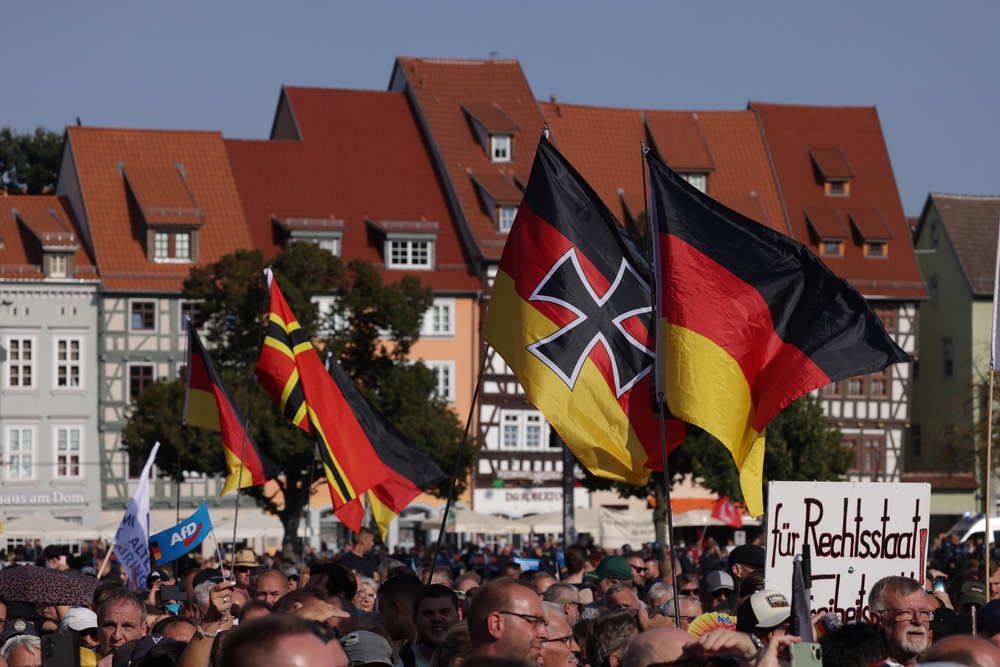
Alexander Gauland, an AfD co-founder and former leader, has claimed that Germans should “have the right to be proud of the achievements of the German soldiers in two world wars”.
The AfD’s rhetoric on immigration has also increasingly tested the boundaries of Germany’s post-war society.
Mass protests broke out in early 2024 amid calls from parliamentarians to ban the party, after a bombshell investigation exposed a secret meeting with far-right extremists in Potsdam to discuss the mass deportation of foreigners and “non-assimilated” Germans should the AfD win power.
But while AfD politicians initially denied the reports as a smear, the party began actively campaigning for “remigration” – deportations – just weeks later.
How has support for AfD grown?
Despite the efforts of the mainstream parties to contain the rise of the AfD, the party has gone from strength to strength in recent years.
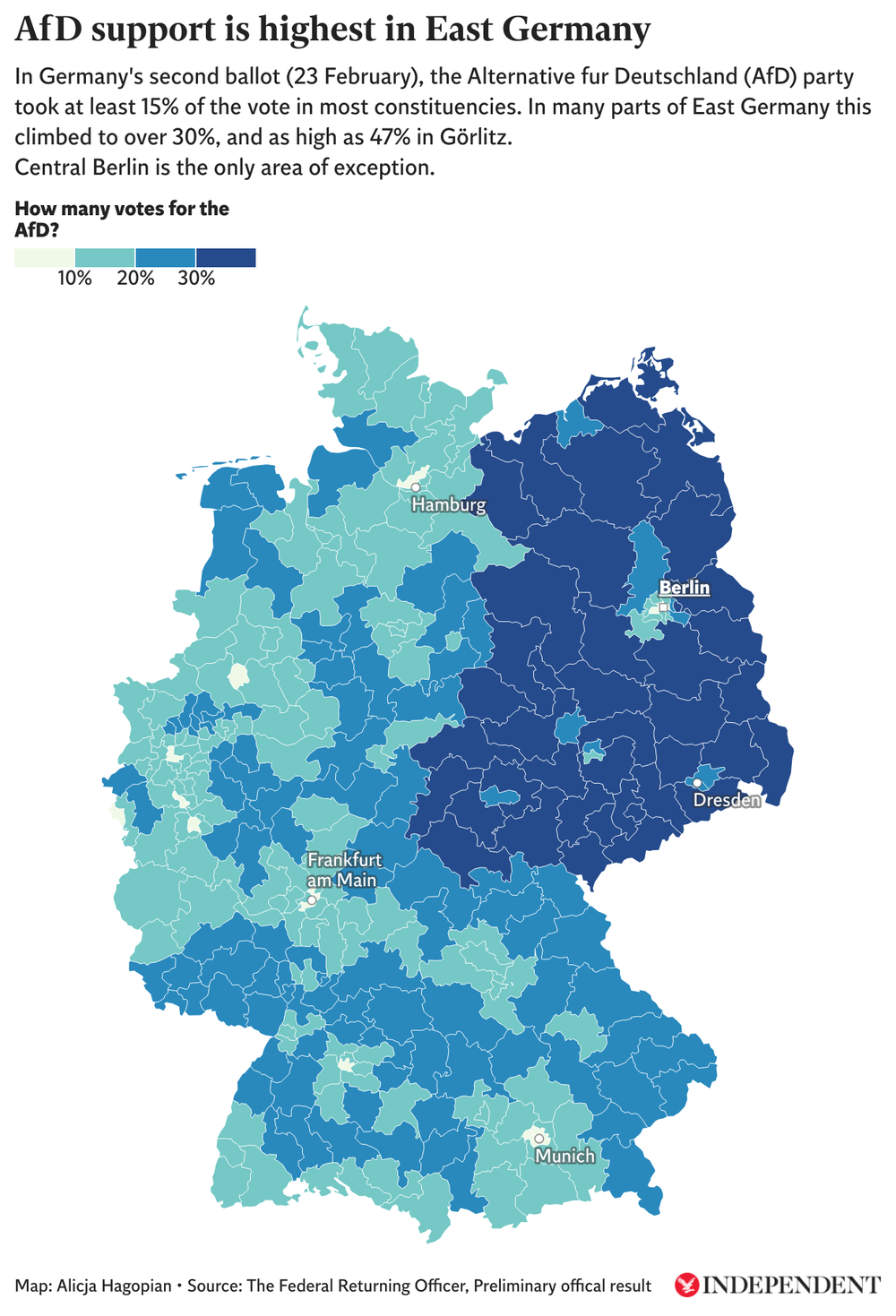
The party won just 4.7 per cent of the vote in their first federal election in 2013. That had climbed to 12.6 per cent by 2017, before falling to 10.4 per cent in 2021, and then doubling to 20.8 per cent last year.
At the state level, victory in Saxony-Anhalt this weekend illustrates the simultaneous drop in support for Merz’s party on the centre-right, which has led the state for 24 years.
The AfD claimed 43.8 per cent of the vote, more than double its showing five years ago. Turnout was very high at 77.8 per cent and the party appeared to have won over many people who did not vote last time around.
Once previously the party won a state election in neighbouring Thuringia but did not end up governing, as a CDU governor took power with a minority government.
CDU state candidate Sven Schulze attributed part of his party's poor performance over the weekend to developments in Berlin, where Merz — the most unpopular chancellor in German history — is struggling to revive Germany's sluggish economic growth.
Merz faces more state elections in the coming weeks and into next year, though he hopes his mix of reforms and higher spending in some areas will revive growth in Europe's largest economy.
The euro was little changed in Monday trade but analysts are closely monitoring the surge in support for far-right parties across Europe, noting that the AfD wants to take Germany out of the common currency.
Read MoreAfD party's landslide win in eastern Germany tests country's 'firewall' against the far right
Police probe fire at Berlin power station amid series of attacks on grid
Far-right AfD’s shock election win threatens to upend German politics
At Venice, Ellen Burstyn reflects on playing Marilyn Monroe and a lifetime in movies
Paris trial opens in Federico Martín Aramburú killing, 4 years after fatal shooting
Ukraine live: Trump’s envoys confronted over holding talks with ‘war criminal’ Putin