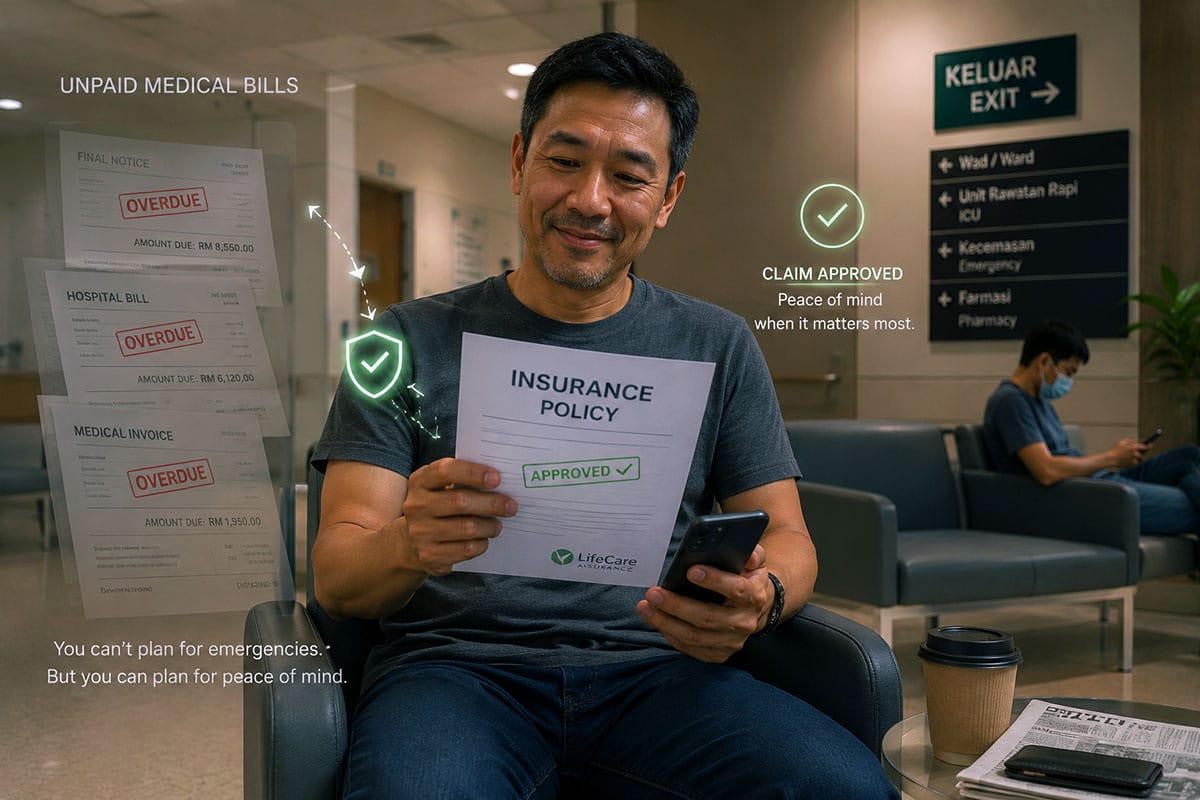
Nobody trusts it until the hospital bill arrives. Then everyone understands completely.
The word "insurance" in Malaysia carries a strange dual reputation. Half the population thinks it is a scam run by pushy agents who will not stop calling. The other half, usually people who have actually had to file a claim during a genuine emergency, will tell you it might be the single most important financial product they own.
Both groups are describing the same industry. And weirdly, both are partly right.
Nobody Buys Insurance Until Someone Reminds Them Why
Malaysia's insurance numbers tell an uncomfortable story. According to the Life Insurance Association of Malaysia, the headline penetration rate sits around 56%, but once you strip out people holding multiple policies, the real figure drops to about 41%. That means fewer than half of all Malaysians actually have any form of life insurance or takaful protection.
On the medical side, things look even thinner. Only 22% of the population currently holds an individual medical insurance policy, which means the overwhelming majority of Malaysians would be paying private hospital bills entirely out of pocket if something serious happened tomorrow.
The reasons people avoid insurance are consistent everywhere you look: affordability pressures competing with daily living costs, low awareness of what coverage actually provides, and a cultural instinct that treats insurance as optional rather than essential. There is also, frankly, a trust problem. Skepticism runs deep, and some of that skepticism is earned.
When Premiums Become the Villain
If insurance has an image problem in Malaysia right now, medical premium increases are the main character in that story.
Medical inflation hit 15% in 2024, nearly triple the rate of general inflation, driven by rising treatment costs, expensive medical technology, and an ageing population needing more care. Insurers responded the only way they know how: passing the cost onto policyholders. Reports surfaced of premium hikes ranging from 30% to 70%, with one particularly stark case involving a cancer patient whose premium jumped 262% in a single adjustment.
Between January 2024 and June 2025 alone, 340,000 Malaysians surrendered or stopped their medical insurance because the monthly premium had become unaffordable. Think about what that actually means. These were not people who decided insurance was pointless. These were people who wanted protection and lost the ability to pay for it, right around the time in life when they likely needed it most.
Bank Negara Malaysia eventually stepped in, capping most premium increases at 10% annually until the end of 2026 and pausing adjustments entirely for policyholders aged 60 and above for a year. A new base MHIT plan is also being introduced from 2027, offering simpler, more affordable coverage as an alternative for people priced out of their existing plans. Regulation is catching up. Slowly.
The Claims Nightmare That Fuels the "Scam" Perception
Here is where the scam accusation actually earns some legitimacy.
A CodeBlue survey of more than 850 specialists across private hospitals in Malaysia uncovered what it bluntly called a pattern of "Deny, Delay, Revoke" practices from insurers. Ninety-nine percent of surveyed specialists reported insurer interference with their clinical decisions. Ninety-nine percent had patients who experienced insurance-related problems in the past year. Nearly three-quarters had patients forced to switch to public hospitals because of insurance denials or delays, often mid-treatment.
The specific tactics described are genuinely unsettling. Coverage denied by citing unrelated pre-existing conditions. Guarantee letters revoked after a procedure has already happened. Insurers demanding unnecessary tests while simultaneously refusing to pay for tests doctors actually need. For families paying premiums faithfully for decades under the belief that the coverage will be there when it matters, discovering these gaps at the exact moment of a medical crisis is close to the worst possible way to learn about them.
This is precisely where the "insurance is a scam" narrative comes from. Not because insurance itself is a con, but because a segment of the industry has behaved in ways that make policyholders feel deceived exactly when they are most vulnerable.
And Then There Is the Moment It Actually Works
Here is the part that gets lost in all the frustration: when insurance functions the way it is supposed to, it is genuinely life-changing.
A heart attack, a cancer diagnosis, a serious accident, these are the moments insurance exists for. When a guarantee letter is honoured, when a hospital bill running into tens of thousands of ringgit gets absorbed by a policy instead of a family's savings, the entire calculation flips instantly. Nobody who has had insurance actually save them during a genuine emergency walks away calling it a scam. They walk away understanding, often for the first time, exactly why the premium was worth paying.
This is the fundamental tension at the heart of insurance as a product. It is invisible and easy to resent every single month it is not needed, and it is the single most important financial decision you ever made in the one month it is.
My Take
I used to have personal life insurance and stopped due to financial constraints. I know exactly how that decision looks from the outside, and I also know exactly how it feels from the inside when money is tight and a monthly premium is one of the easiest things to cut. It is not laziness or carelessness. It is triage.
But my best friend suffered a sudden heart attack, and because he had insurance, the medical and hospitalisation bills were covered. Watching that unfold up close changed how I think about coverage completely. It is no longer an abstract expense to me. It is the difference between a family absorbing a health crisis financially or drowning in it on top of everything else.
I will also say, I have avoided insurance agents for years because of how pushy the follow-up calls and messages can get. That reputation is not undeserved. But here is the distinction I have landed on: I do not trust the sales approach, but I do trust the product itself. Those are two completely separate things, and conflating them is exactly how people talk themselves out of protection they genuinely need.
If a friend told me they were thinking of cancelling their insurance because it feels like a waste of money every month, I would tell them plainly: don't. Nobody knows when an emergency is coming, which is the entire point of insurance. The regret does not come from the years you paid a premium and nothing happened. The regret comes from the one time you cancelled it right before you needed it most. If the policy is also linked to investment, it does even more work for you over the long run, quietly building toward retirement while sitting there as protection in the meantime.
Once I am financially stable again, getting proper coverage back in place for my entire family is near the top of my list. Not because an agent convinced me to. Because I have already seen, up close, what it looks like when it works.
Kamarul Azwan (k.azwan@gmail.com) is a content creator under the Newswav Creator programme, where you get to express yourself, be a citizen journalist, and at the same time monetize your content & reach millions of users on Newswav. Log in to creator.newswav.com and become a Newswav Creator now!
The User Content (as defined on Newswav Terms of Use) above including the views expressed and media (pictures, videos, citations etc) were submitted & posted by the author. Newswav is solely an aggregation platform that hosts the User Content. If you have any questions about the content, copyright or other issues of the work, please contact creator@newswav.com.