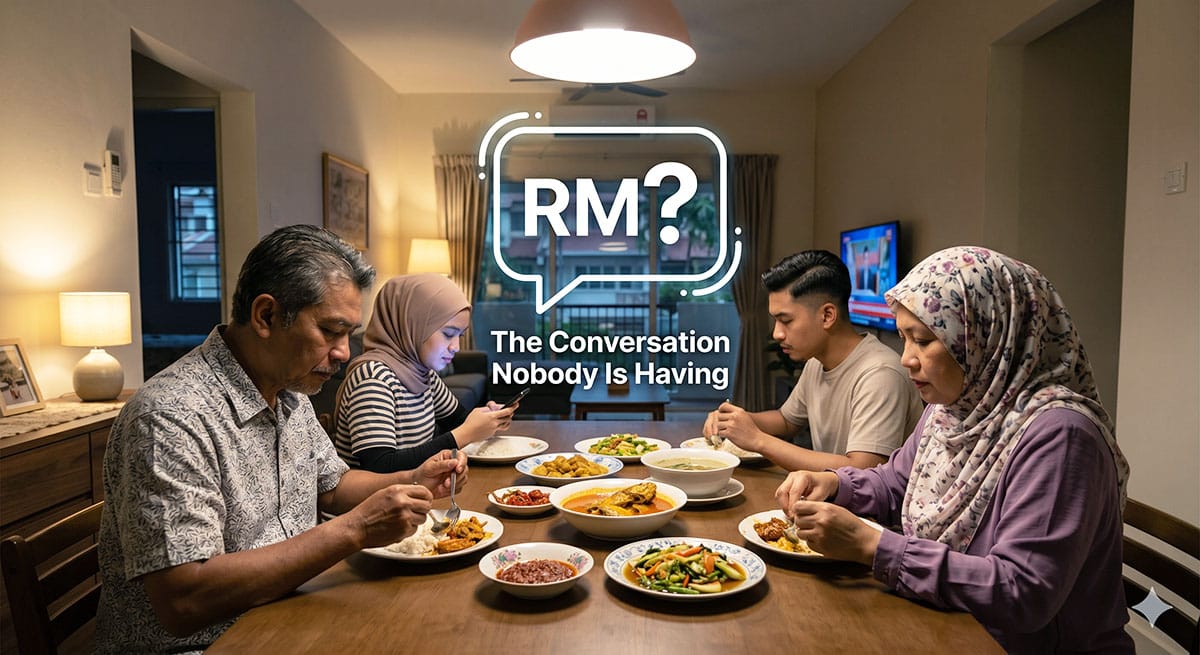
Most Malaysian families never talk about money. That silence has a price nobody sees coming.
Here is a question most Malaysian families will never ask at the dinner table.
How much do you earn?
Not because the answer is secret. Not because the question is rude. But because somewhere between the nasi and the lauk, there is an unspoken agreement that money is not something you discuss openly. Not with your parents. Not with your siblings. Sometimes not even with your spouse.
And that silence, as comfortable as it feels, is quietly costing us more than we realise.
The Inheritance We Never Asked For
Most of us did not choose this. We inherited it.
Growing up, most Malaysian children were raised in households where money was managed by parents who kept the full picture to themselves. Not out of malice, but out of instinct. Parents who grew up during harder times often developed a protective habit of shielding their children from financial reality, assuming they would not understand it, or not wanting to burden young minds with adult anxieties.
So children grew up with a vague sense that money existed, that sometimes there was more of it and sometimes less, and that it was not polite to ask too many questions about it. That habit of silence got carried forward into adulthood, into marriages, and eventually into how the next generation is being raised.
My own parents were like this. Money was managed quietly between them and I was never brought into that conversation growing up. What I knew about our household finances was mostly inferred rather than told. It was just how things were done.
When I had my own family, I made a deliberate choice to do it differently. When my children ask for something I cannot afford, I tell them plainly. Not with guilt or shame, but matter-of-factly. Money is not easy to come by. We have to be patient and make choices. They understand it. They do not throw tantrums or put on a long face. They accept it because they have been taught that money is a real, finite thing that requires management rather than a magical resource that appears when needed.
That change did not happen by accident. It happened because I decided the silence my parents kept was not a tradition worth preserving.
Why We Stay Silent
For many Malaysian families, the reluctance to discuss money openly comes from a cluster of feelings that are difficult to untangle.
Pride is a big one. Admitting financial difficulty to a sibling or a parent can feel like admitting failure, particularly in a culture where your financial status reflects not just on you but on your family name. If one sibling is earning significantly more than another, an honest salary conversation can quickly turn into a source of inferiority, judgment, or quiet resentment on both sides.
Malaysia's financial literacy landscape is improving, with the National Strategy for Financial Literacy 2026 to 2030 placing new emphasis on family-level financial conversations and education. And yet the data shows that most Malaysian households still do not discuss money openly across generations. The workshops and roadshows help. But they cannot fully undo decades of cultural conditioning that equates financial privacy with dignity.
Fear of judgment runs alongside pride. If your parents find out you are in debt, will they worry unnecessarily? If your siblings discover you are struggling while they are doing well, will they offer help you do not want, or worse, advice you did not ask for? Better, many Malaysians decide, to just say "okay je" and manage the burden alone.
I do the same thing with my friends and my mother. My wife knows the full picture. My children know the general shape of it. But beyond my immediate household, the financial reality stays private. Not because I am ashamed, but because carrying it alone feels easier than explaining it to people who cannot change it.
The Conversation That Needs to Happen Before It Is Too Late
Here is where the silence stops being just emotionally uncomfortable and starts being genuinely dangerous.
An estimated RM70 billion in Muslim estates in Malaysia remain frozen and unclaimed, with the figure possibly reaching RM90 billion by some estimates. The primary reason is not complex legal disputes. It is the absence of planning, documentation, and crucially, communication. Families where the breadwinner never discussed their assets openly are now navigating frozen bank accounts, unrecorded property, and inheritance disputes that drag through legal systems for years.
Under Islamic inheritance law in Malaysia, the distribution of a Muslim estate is governed by three key instruments: faraid, which is the mandatory fixed distribution of assets to heirs according to Quranic proportions; wasiat, which allows a Muslim to allocate up to one-third of their estate to non-heir beneficiaries; and hibah, which enables gifting of assets during one's lifetime, effectively bypassing faraid distribution.
These are powerful tools. But they are completely useless if nobody in the family knows they exist or how to use them.
When a family breadwinner passes away without having had the financial conversation with their spouse or children, what follows can get genuinely ugly. Relatives who were never part of the family's financial life suddenly appear with legal entitlements under faraid. Bank accounts freeze pending court clearance. Properties sit unclaimed. And siblings who might have cooperated peacefully find themselves on opposite sides of an inheritance dispute that poisons relationships for years, sometimes permanently.
The money problem was never the money. It was the silence that surrounded it.
What Money Conversations Look Like in Practice
Many Malaysians picture a money conversation as a formal sit-down meeting with spreadsheets and documents. That is not what it needs to be.
It can be as simple as a parent telling a grown child approximately what the household's monthly obligations look like. A spouse sharing their salary honestly rather than routing the conversation around it every time it comes up. A breadwinner letting their partner know which banks they have accounts with, which investments exist, and where the important documents are kept.
Talking to your wife about money almost always produces some friction. That is normal. It is a topic that carries weight, and two people with different financial temperaments will not always see every decision the same way. But the honest conversation, even when it is uncomfortable, is almost always better than the silence. My wife and I have disagreements about money. We also make better decisions together than I would alone, precisely because she knows the full picture and I am not pretending everything is fine when it is not.
The RinggitPlus Malaysian Financial Literacy Survey found that middle-income Malaysians in particular feel the financial squeeze most acutely while being least likely to discuss their financial situation openly, even with close family. They earn enough not to qualify for government assistance but not enough to feel financially secure. And they carry that tension quietly, between smiling at family gatherings and worrying at 2am.
The Generational Shift That Is Already Happening
Not every family is staying silent. The conversation is changing, slowly but noticeably.
Younger Malaysians, particularly those who grew up with access to financial education online, are measurably more open about money than their parents. 61% of Gen Z Malaysians are actively pursuing financial goals, from budgeting to building emergency funds, and many are having financial conversations with peers and online communities that they would never have with their own parents.
But the gap remains. Young Malaysians who are financially literate and open in their peer groups often remain silent with their parents, partly from habit, partly from not wanting to worry them, and partly because the language for these conversations was never modelled for them growing up.
The families where this shift is happening most visibly tend to be urban, more educated, and more liberal in how they navigate cultural expectations. Families from more conservative or rural backgrounds often still carry the older norm of financial privacy intact, passing it down another generation without conscious choice.
My Take
I have made a decision with my own family that I want to put on record here: my children will know what money means before they leave home.
Not the exact numbers necessarily. But the principles. That it is earned, not given. That it has limits. That it requires choices. That debt has consequences. That planning protects the people you love. And that talking about it openly, even when it is awkward, is always better than pretending everything is fine when it is not.
The letter I wrote to my wife with all my financial details was one of the most practical things I have ever done. It was also one of the most honest acts of love. It said, plainly: if something happens to me, here is everything you need. Here is what we have, where it is, and how to access it.
That is what financial transparency within a family actually looks like. Not a dramatic confession or a boardroom-style disclosure. Just the quiet act of making sure the people who depend on you are not left in the dark.
The RM70 billion in frozen Malaysian estates is not just a legal statistic. It is the accumulated cost of a million conversations that families decided to postpone until it was too late to have them.
Have yours while you still can.
Kamarul Azwan (k.azwan@gmail.com) is a content creator under the Newswav Creator programme, where you get to express yourself, be a citizen journalist, and at the same time monetize your content & reach millions of users on Newswav. Log in to creator.newswav.com and become a Newswav Creator now!
The User Content (as defined on Newswav Terms of Use) above including the views expressed and media (pictures, videos, citations etc) were submitted & posted by the author. Newswav is solely an aggregation platform that hosts the User Content. If you have any questions about the content, copyright or other issues of the work, please contact creator@newswav.com.