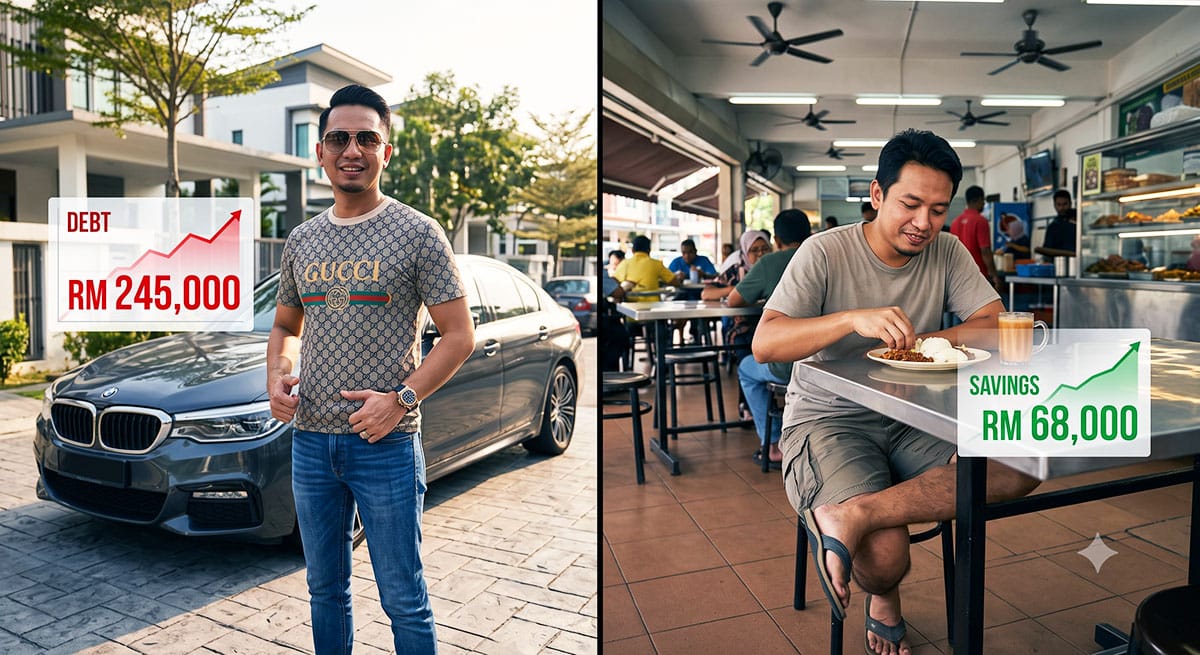
The cheapest order at the table might belong to the richest person there.
There is a moment that plays out at every mamak table in Malaysia. Someone orders the RM8 nasi lemak while their friend orders the RM35 seafood platter. Nobody blinks. Nobody assumes the RM8 person is broke. In fact, more often than not, that same person is the one who negotiated the best deal on their car, the one who knows exactly which app gives the biggest cashback, the one whose bank account looks nothing like their grocery basket.
Then somewhere else, someone walks in wearing head-to-toe branded everything, orders the most expensive item on the menu without glancing at the price, and settles the bill with visible flourish. Everyone assumes this person is doing well. Some of them are drowning in debt they will not clear for years.
Frugal and broke get confused constantly. They are, more often than not, exact opposites.
The Research Has Been Saying This for Decades
This is not a new observation. Thomas J. Stanley's landmark research in The Millionaire Next Door found that the people who actually accumulate wealth rarely look wealthy. His summary of the pattern, after studying genuine American millionaires for years, distilled it into three words: frugal, frugal, frugal. The pursuit of looking superior, he found, reliably produces inferior economic outcomes, not the reverse.
The behaviour has a name in personal finance circles now: stealth wealth, wealth kept deliberately invisible, either by design or simply because the person never cared to display it. One well-known account from a finance blogger describes walking into a bank in worn jeans and old sneakers, only to watch a banker's entire posture change once his account balance appeared on screen, six figures sitting quietly behind an appearance that suggested otherwise. That gap between appearance and reality is not the exception. Research consistently suggests it is closer to the rule.
The Opposite Pattern Is Just as Real
The inverse holds just as strongly. Conspicuous spending, buying visibly branded, expensive, attention-grabbing things specifically to be noticed, correlates with lower actual net worth, not higher. The logic makes sense once you sit with it: someone who is genuinely financially secure has nothing to prove and nobody to convince. Someone who is stretched thin often has every reason to want to look otherwise.
This produces one of the more uncomfortable truths about money and appearance: the flashiest person in the room is frequently the least financially secure one in it, and the quietest, most unremarkable spender is frequently sitting on the largest cushion.
Why This Confusion Persists Anyway
If the research is this consistent, why do people keep getting it backwards?
Because judging by appearance is a deeply human shortcut, not a Malaysian one specifically. Humans are wired to read visible signals as information, and spending has always doubled as a visible signal, whether or not it reflects the truth underneath. A car, an outfit, a watch, these are legible at a glance in a way that a savings account or an investment portfolio never is. We default to reading the legible signal because it is the only one available, even when it is frequently wrong.
Malaysia complicates this further because bargain hunting cuts across every income bracket here, not just the lower end. Discount culture, warehouse sales, cashback apps, year-end mega sales, these are embraced enthusiastically by high earners and modest earners alike. Chasing a good deal in Malaysia rarely signals financial hardship. If anything, it signals financial literacy. The person calculating unit price per gram at the pasar malam is frequently the same person with a healthier balance sheet than the one who never checks a price tag at all.
What Frugality Actually Buys You
Being frugal is not about deprivation. It is about directing money toward what genuinely matters and refusing to spend on what does not, which, counterintuitively, is exactly what creates the cushion that being "broke" lacks entirely.
Someone who is broke has no choice in the matter. The absence of spending is forced by circumstance. Someone who is frugal has every choice available and consistently declines the ones that do not serve them. The outward behaviour, buying the cheaper option, skipping the upgrade, repairing instead of replacing, can look identical from the outside. The internal reality could not be more different. One person has nothing left at the end of the month by necessity. The other has plenty left, specifically because they chose not to spend it.
My Take
I have never personally experienced being mistaken for broke because of my spending choices, which tells me something in itself. In Malaysia, chasing a good deal barely raises an eyebrow. Even people comfortably in the high income bracket are the ones pushing hardest for a discount at the counter. I am not sure the same holds for the genuinely elite tier, but across most of the income spectrum here, being frugal simply reads as being smart with money, not as a sign that something is wrong.
I do know someone who dresses like a million dollars every single day and has been close to broke the entire time I have known him. Appearance over substance, consistently. It is a pattern I have watched play out for years, and it never once correlated with what was actually happening in his bank account.
If I am honest, I would like to be the opposite of that entirely. Someone who could walk around looking like they have nothing, while quietly having more than enough sitting where it matters. That is genuinely the goal. Not to prove anything to anyone watching, just to know that the numbers underneath are solid regardless of what the surface suggests.
The lesson I want my son to actually absorb, more than any specific number or rule, is this: frugal means you only buy what you need, and what you need will always be worth more in the long run than what you merely want. There is nothing wrong with being frugal. It means there is always something left in the bank exactly when you need it most. Never spend to impress people who were never really counting anyway.
Kamarul Azwan (k.azwan@gmail.com) is a content creator under the Newswav Creator programme, where you get to express yourself, be a citizen journalist, and at the same time monetize your content & reach millions of users on Newswav. Log in to creator.newswav.com and become a Newswav Creator now!
The User Content (as defined on Newswav Terms of Use) above including the views expressed and media (pictures, videos, citations etc) were submitted & posted by the author. Newswav is solely an aggregation platform that hosts the User Content. If you have any questions about the content, copyright or other issues of the work, please contact creator@newswav.com.