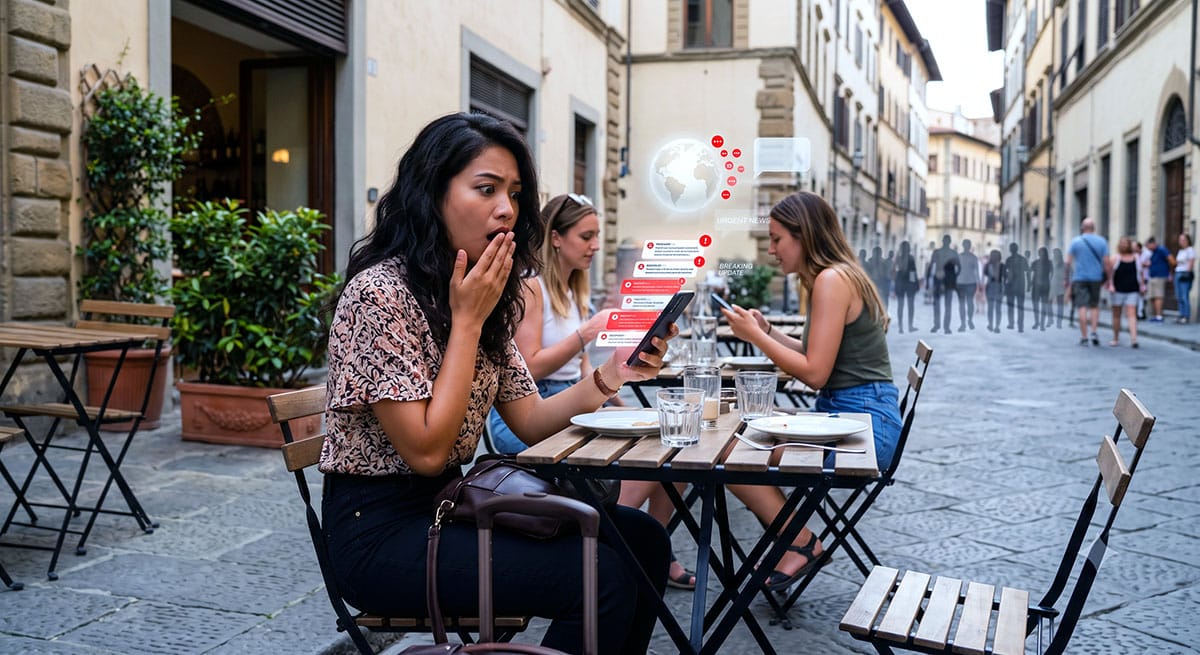
It felt like a private joke. Millions of strangers disagreed within hours.
She was on holiday, filming what she probably thought was harmless content for her followers. A comment here, a laugh there, remarks about the people around her that felt, in the moment, like nothing more than casual observation. Within days, the video had crossed borders, made international news, and turned into a public apology filmed with the comments section deliberately disabled.
That is the exact shape of overshare regret. Something said in a moment of impulse, posted without a second thought, that then travels far beyond the small audience it was ever intended for.
The Psychology Behind Why We Do This
There is a name for what happens to people's filters online: the online disinhibition effect, first described by psychologist John Suler in 2004. The core idea is simple. People routinely say and reveal more online than they would face to face, partly because the screen creates a sense of distance from real consequences, and partly because the immediate social feedback that normally makes us self-correct, a raised eyebrow, an awkward silence, is entirely missing.
In a face-to-face conversation, you read the room in real time and adjust. Online, that feedback loop is delayed, sometimes by hours, sometimes by however long it takes a video to actually reach the people it is about. By the time the reaction arrives, the content is already out, already spreading, already impossible to fully retract.
Researchers studying regretted social media posts have identified several recurring reasons people share things they later wish they hadn't: posting with good intentions that landed badly, posting to seem funny or interesting, and simply posting without thinking it through in an emotionally heightened moment. That last one, posting in a "hot" emotional state, explains an enormous share of the internet's most regretted content. The gap between feeling something and posting it has shrunk to almost nothing, and that gap used to be exactly where good judgment lived.
When Local Content Becomes a Global Incident
Malaysia had a recent, very public demonstration of exactly how this plays out. A Malaysian tourist filming a casual video during a trip abroad made disparaging remarks about the people she encountered, content that was likely intended for a small, familiar audience back home. Instead it went viral internationally, drawing coverage across multiple countries, sparking real anger, and eventually forcing a public apology that acknowledged the remarks were an impulsive, unplanned reaction made without any intention to cause conflict.
What makes this such a clean example of overshare regret is the mismatch between intent and reach. The comment was almost certainly meant as a throwaway aside for whoever happened to be watching a holiday video. It ended up representing an entire country's tourists to millions of people who had never heard of the person before that moment. Nobody sits down and plans to become an international incident. It happens in the gap between an impulsive thought and a platform with no real limit on how far that thought can travel.
Why Certain Content Backfires Faster Than Others
Not everything overshared causes damage. Plenty of oversharing is just mildly awkward, a slightly too personal caption, a rant that ages badly, information that probably should have stayed private but mostly just embarrasses the poster rather than harming anyone else.
The content that backfires hardest tends to share a specific pattern: it involves judgment of other people, especially people from a different background, culture, or community, made in a moment that feels private but is not. Humour that works fine among friends who share the same context lands very differently once it reaches an audience without that shared understanding. What felt like a joke to a small circle reads as mockery to millions of strangers, and once strangers are involved, the emotional distance that made disinhibition feel safe in the first place disappears completely.
The Loneliness and Validation Loop
Part of why oversharing keeps happening, even among people who know better, comes down to two forces working together rather than separately. There is a genuine human need for connection, and social media offers an easy, always-available substitute for it. And there is the pull of engagement itself, likes, comments, shares, view counts, all of which reward exactly the kind of content that pushes past normal boundaries. The posts that perform best are frequently the ones that reveal something, confess something, or provoke something. Restraint rarely goes viral. Oversharing regularly does.
For people building an audience specifically, content creators, aspiring influencers, this creates a genuine tension. The incentive structure of the platform rewards exactly the behaviour that carries the highest risk of regret later. Chasing relevance and chasing restraint frequently pull in opposite directions, and the algorithm has no interest in which one wins.
My Take
I have run a public blog since 2013, and I am careful, consistently, about what actually goes out under my name. That care extends beyond posts themselves, even into how I comment on other people's content, especially anything I personally disagree with. That instinct did not appear overnight. It came from understanding early on that anything posted publicly stops being fully within your control the moment it goes live.
What happened with that viral China trip video stuck with me, and not just because it was embarrassing to watch unfold. It made Malaysians look bad on a global stage, over comments that were almost certainly never meant to travel beyond a small circle of friends. That is the exact danger of oversharing in a moment of impulse. What feels private and casual when you hit post can become a permanent, searchable representation of you, sometimes representing far more than just you.
I do think it comes down to both loneliness and validation, depending on who is doing the posting. Ordinary people overshare partly out of a need for connection they are not finding elsewhere. Rising influencers chase attention and fame more directly, because validation from an audience has become the actual currency of their career. Neither instinct is unreasonable on its own. Both become dangerous the moment restraint gets abandoned entirely.
If my son eventually wants to build a presence online, the boundary I want him to hold from day one is simple: share with honesty, and always with respect for the people you are talking about. Never post personal, financial, or relationship matters publicly. Those things do not need an audience, and once shared, you cannot ever fully take them back.
Kamarul Azwan (k.azwan@gmail.com) is a content creator under the Newswav Creator programme, where you get to express yourself, be a citizen journalist, and at the same time monetize your content & reach millions of users on Newswav. Log in to creator.newswav.com and become a Newswav Creator now!
The User Content (as defined on Newswav Terms of Use) above including the views expressed and media (pictures, videos, citations etc) were submitted & posted by the author. Newswav is solely an aggregation platform that hosts the User Content. If you have any questions about the content, copyright or other issues of the work, please contact creator@newswav.com.
.png?width=1200&auto=webp&trim=0%2C0%2C0%2C0)