The success of Germany’s far-right Alternative for Germany (AfD) in state elections could herald a disaster for Ukraine, a European victory for Vladimir Putin, and a stampede of greed over democracy orchestrated by one man.
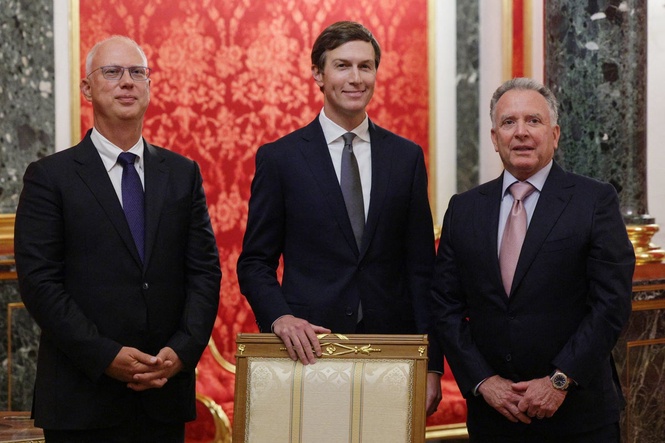
Kirill Dmitriev is to Donald Trump’s envoys, Jared Kushner and Steve Witkoff, what Putin is to the 47th president – their favourite and much favoured Russian.
What Putin gives Trump – the thrill of proximity to unlimited power – Dmitriev offers to America: unlimited potential wealth. He is the head of the Russian Direct Investment Fund, Moscow’s sovereign wealth government slush pot, and he has close links to the AfD.
There was unbridled delight in Moscow with the success of the AfD over the weekend.
Dmitriev called the result a win that “humiliates the arrogance, narrow-mindedness, warmongering, ineptitude and hypocrisy” of German chancellor Friedrich Merz’s governing coalition.
The AfD, seen by German intelligence as an extremist organisation, has enjoyed (among other things) Russian support for its social media campaigns to win the elections in Saxony-Anhalt, according to German and other European intelligence sources.
In addition, Markus Frohnmaier, AfD foreign-policy spokesperson in the Bundestag, has been an enthusiastic supporter of Putin’s policies in Ukraine since before the 2022 full-scale invasion.
And on 3 June he met Dmitriev in St Petersburg after meeting the head of Russia’s oil giant, Gazprom, at Russia’s “International Economic Forum”.
“Looking forward to building a great FUTURE together with AfD, Germany’s most popular party,” Dmitriev wrote on X afterwards.
“Along with AfD’s deputy chair Markus Frohnmaier, I discussed the economic cooperation with Germany, including restarting the Russia-Germany-US business dialogue,” he added.
The same day, 3 June, Dmitriev confirmed he was also in touch (as he often is) with Witkoff and Kushner.
That future is shaping up nicely for the Kremlin.
Looking forward to building a great FUTURE together with AfD, Germany’s most popular party.
— Kirill Dmitriev (@kadmitriev) June 3, 2026
Along with AfD’s Deputy Chairman Markus Frohnmaier, I discussed the economic cooperation with Germany, including restarting the Russia-Germany-US business dialogue.@SPIEF pic.twitter.com/ylzeErPbM0
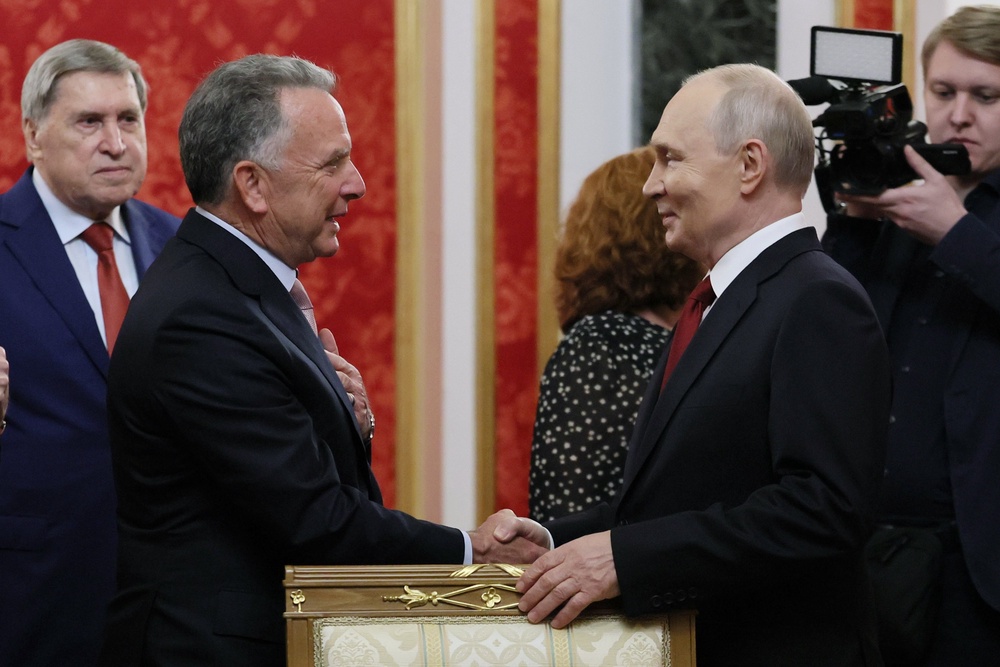
Dmitriev, who is unelected and holds no official government role in Russia, has been a regular guest of Kushner and Witkoff in Miami, ostensibly to work on a peace deal with Ukraine. No such sojourn has been offered to any Ukrainian.
Notoriously, Dmitriev is reported to be offering advantageous terms for American businessmen if they backed the unfreezing of $300m of Russian assets held in Europe. He later even reportedly dangled the idea that there was “$14 trillion” in business opportunities for the US in Russia if sanctions, imposed over its invasion of Ukraine, were lifted and normal business could resume.
Dmitriev was the main escort for Witkoff and Kushner when they visited Moscow at the weekend on the latest of numerous visits to the Russian president. After all the fanfare, there was no significant outcome from their first visit to Kyiv the next day.
Dmitriev, Witkoff and Kushner were behind a 28-point plan for peace in Ukraine that reflected business opportunities for America, lifted sanctions on Russia, and would have led to Russian annexation of vast tracts of the invaded democracy where US companies could join a minerals exploitation bonanza.
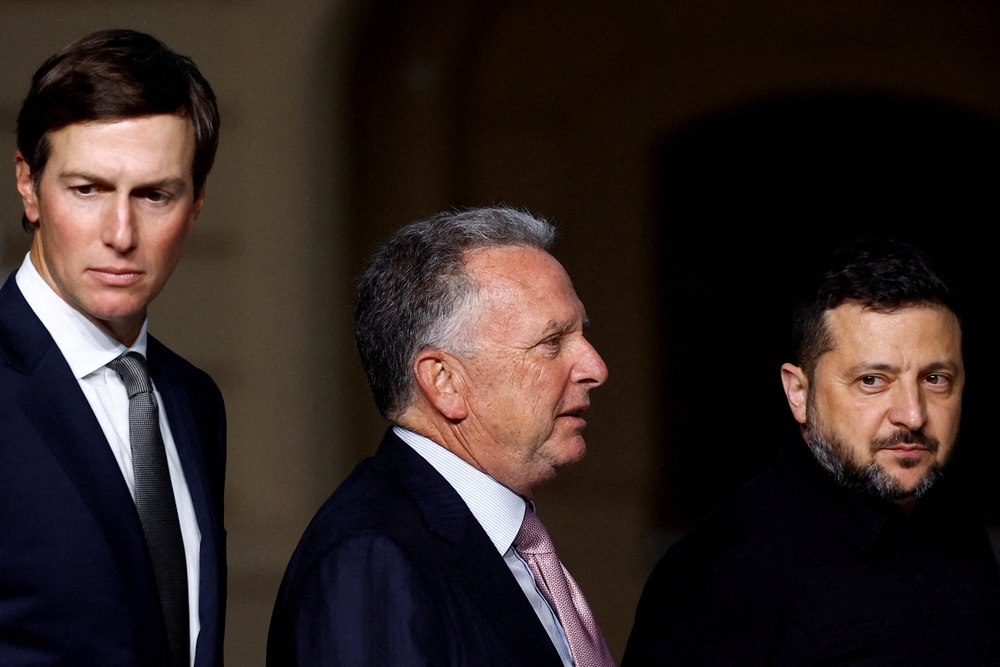
Witkoff and Kushner have also been Trump’s Middle East envoys. The diplomatic shuttling has included a business boom for both men.
Since their involvement in Middle East diplomacy, both men have seen striking inflows of Gulf-linked capital into businesses they own. Kushner, Trump’s principal Middle East adviser in his first term, created Affinity Partners immediately after leaving the White House in 2021; it subsequently received $2bn from Saudi Arabia’s Public Investment Fund.
In 2024, it received another $1.5bn from Qatar’s sovereign wealth fund and Abu Dhabi-based Lunate, taking assets under management to $4.8bn by the end of that year. Kushner is the sole owner of Affinity’s management company.
Witkoff, appointed Trump’s Middle East envoy in November 2024, has meanwhile benefited through his family's stake in Trump-linked crypto company World Liberty Financial.
Forbes estimates the Witkoff family made about $130m from WLFI token sales, plus roughly $48m after tax from selling part of its stake to an investment vehicle backed by Abu Dhabi royal and national-security adviser Sheikh Tahnoon bin Zayed.
The Trump administration has taken a consistently pro-Russian stand on every aspect of “peace talks” involving Ukraine. Early on in the administration, Trump ended military aid to Kyiv.
He then exploited Ukrainian vulnerability to extract a minerals deal from Volodymyr Zelensky that means Ukraine must pay back all the costs of war support it got from the Biden administration.
There are no US security guarantees seriously mooted for Ukraine in any Russian or American peace proposal.
There is agreement, or an understanding, between the US and Russia that Ukraine will have to give up all or most of the Donbas, about 25 per cent of its territory, give up on joining Nato, and enfeeble its military as part of any end to the war with Russia.
The AfD, meanwhile, has a vocal pro-Putin stand on almost every issue and often goes further in fulfilling the geopolitical aims of the Kremlin than even the Trump administration.
The AfD has taken legal action to try to stop German support for Ukraine’s armed forces. Its leaders have campaigned for an end to sanctions against Russia and a resumption of gas and oil sales by Moscow to Germany.
The party’s 2025 manifesto says that Ukraine’s future should be as a neutral state outside both Nato and the European Union. Trump and Co have not said Ukraine should stay out of the EU, which the AfD wants to leave and which Putin sees as Russia’s nemesis.
Ukraine’s diplomatic vulnerability, in other words, is not simply that Trump wants a deal, or that Germany’s politics are shifting rightward.
It is that the same individual, operating through the same playbook of framing Russian rapprochement as lucrative rather than dangerous, is working both ends of the problem at once – one negotiating table in Florida, one ballot box in Saxony-Anhalt.
If that pincer closes – a Washington-brokered settlement favourable to Moscow, arriving at the same moment Berlin's political centre of gravity shifts toward a party openly sympathetic to the Kremlin – Ukraine could find itself losing the war diplomatically and politically, at a time when Kyiv’s long-range drone strikes are putting Putin on the back foot.
Read MoreKey Republican is missing from GOP’s Dallas convention amid tensions with Trump
Trump says ‘we worked long and hard’ one day after 9/11 in latest dubious claim
Trump becoming major liability for Republicans in midterms, new poll shows
Iran War is costing Americans $100B in extra energy costs
‘Shocked’ Merz warns far-right AfD’s election win will have international impact
France’s wine harvest devastated by heatwaves as Champagne production halves