
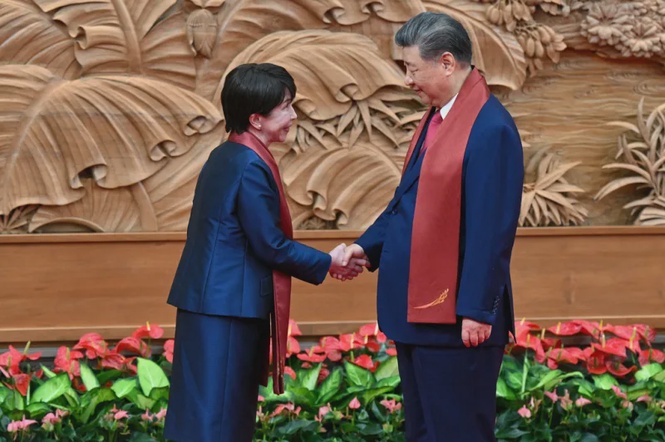
Japanese Prime Minister Sanae Takaichi left the Asia-Pacific Economic Cooperation (APEC) summit in Shenzhen, China, with two handshakes from Chinese President Xi Jinping but no talks, and a government survey released the next day, November 20, showed a record 93% of Japanese consider ties with China poor.
The summit was Takaichi's first trip to China since taking office, and the first time she had met Xi in person since her remarks on Taiwan a year ago plunged relations into a freeze.
A Low Key Arrival And A Seat Near The End
Unlike US President Donald Trump, whom Xi greeted personally at the airport, Takaichi was met by a Chinese foreign ministry official and driven away, Reuters reported. She stood near one end of the back row in the leaders' group photo and sat seven seats from Xi at the summit table. Japan's top government spokesman, Minoru Kihara, rejected the idea of a snub, saying China had extended her the customary courtesies.
The two leaders shook hands at the welcome banquet on November 18 and again on November 19. When Takaichi thanked Xi, he did not respond verbally. Takaichi later told reporters that China is an important neighbor and that the two sides need to talk precisely because issues remain unresolved.
Her Only One On One Was With Putin
Takaichi's only bilateral meeting in Shenzhen was with Russian President Vladimir Putin, the first face-to-face talks between Japanese and Russian leaders in about seven years. She pressed him over a detained Hokkaido Shimbun reporter and Moscow's takeover of Japan Tobacco's local subsidiaries, and Putin restated Russia's position. The meeting came as Trump, Xi, and Putin held their own three-way summit in the city.
Japanese Media See A Snub, Officials See A Foothold
Japan's press has read the trip in two ways. The Japan Times described a cold reception that prompted headlines at home about a "blatant" snub. "Little was indeed achieved in terms of Japan-China relations," Noriyuki Kawamura, a professor emeritus at Nagoya University of Foreign Studies, told the paper. Her critics, it said, saw the summit as proof of Japan's diminished standing.
Yet the paper's experts said the cold shoulder could rally her base. Yu Uchiyama, a political scientist at the University of Tokyo, noted that her support did not fall after her Taiwan remarks and said he "wouldn't be surprised" if loyal supporters grew more resentful toward China over her treatment.
The Yomiuri Shimbun, Japan's largest newspaper, struck a more hopeful note, saying her encounters with Xi and Putin could provide a foothold for an eventual breakthrough. "Interactions between leaders are the foundation of diplomacy," a senior government official told the paper. A close aide said the Putin talks were "more candid than we had expected," which would make substantive negotiations easier.
Poll Shows Record Distrust Of China
At home, the mood toward Beijing has hardened. The 93% who called Japan-China relations poor in the Cabinet Office's annual survey was up 6.6 points from last year and the highest since a similar question was first asked in 1986, Jiji Press reported. Only 6.7% called relations good, down from 13.4%. Some 86.4% said they feel no affinity toward China, though 70.4% still called the relationship important, Jiji reported in Japanese.
The survey was mailed to 3,000 adults between September 17 and October 25, and the government cautions that results are not fully comparable across years because its method has changed, public broadcaster NHK noted.
Taiwan Remarks Remain At The Heart Of The Chill
Relations soured after Takaichi told parliament in November 2025 that a Chinese attack on Taiwan could prompt a Japanese military response if it also threatened Japan's survival. Taiwan, a self-governed democracy that Beijing claims as its own, lies just over 100 kilometers from Japan's westernmost island. China retaliated with curbs on exports of critical minerals and warned its citizens not to travel to Japan.
Beijing has not softened. A day after the summit, China's foreign ministry said Japan's "most urgent task is to correct its wrong words and actions on the Taiwan issue as soon as possible," The Japan Times reported. In Shenzhen, Takaichi declined to say whether Japan would intervene in a Taiwan conflict, calling the question hypothetical, and said there had been "no change whatsoever" to Japan's position under the 1972 communique that normalized ties with Beijing, according to Reuters.
You've read it. Now join the conversation — follow us on X, Facebook and IG. Editor: Penny Wang
