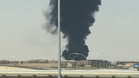
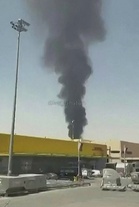
Yemen’s Houthis have claimed strikes on Riyadh and the Red Sea port of Yanbu after Saudi Arabia issued emergency alerts over what it called a “hostile aerial threat”, as black smoke rose at the city's King Khalid International Airport on Saturday, hours after the raid alert.
After the explosion, the flight tracking site Flightradar24 said the airport was experiencing "major problems." A journalist for the AFP news agency also reported seeing firefighters working to extinguish a burning fuel truck close to the site.
Saudi authorities said there were no casualties or damage and did not say what prompted the alerts, but the Saudi Civil Defence had been sending messages to residents in several parts of the country overnight, warning of potential danger and advising people to remain indoors and away from windows.
The Houthis later claimed, without providing evidence, that they had targeted “sensitive sites” in Riyadh and facilities belonging to Saudi oil giant Aramco in Yanbu. Houthi military spokesman Yahya Saree said cruise and ballistic missiles, as well as drones, were used. He also claimed Saudi Arabia had attempted to target the Houthi-held capital Sanaa, without providing details.
The claims could not be independently verified.
A naval blockade has already been declared by the Houthis
It comes amid an uptick in attacks from Yemen's Houthi rebels, who declared a naval blockade of Saudi Arabia in July.
The Houthis, whom the US has designated as a Foreign Terrorist Organisation, have since been increasingly targeting Saudi cities and shipping, further heightening tensions in the Middle East - which is already reeling under the effects of the Iran war and tensions surrounding the Strait of Hormuz.
Saudi Arabia has hit back with its own strikes on the group - which has seized vast stretches of territory in Yemen this month in a lightning offensive - but has failed to stop its advance.
“Developments around the Bab al-Mandab Strait underline the urgent need to prevent Yemen’s conflict from further threatening the security of the Red Sea and this vital international maritime route,” Khaled Khiari, the UN assistant secretary-general for the Middle East, Europe, the Americas, Asia and the Pacific, said earlier this week.
“What is needed now is sustained engagement that reduces tensions, prevents further escalation and safeguards freedom of navigation," he added.