.jpeg)
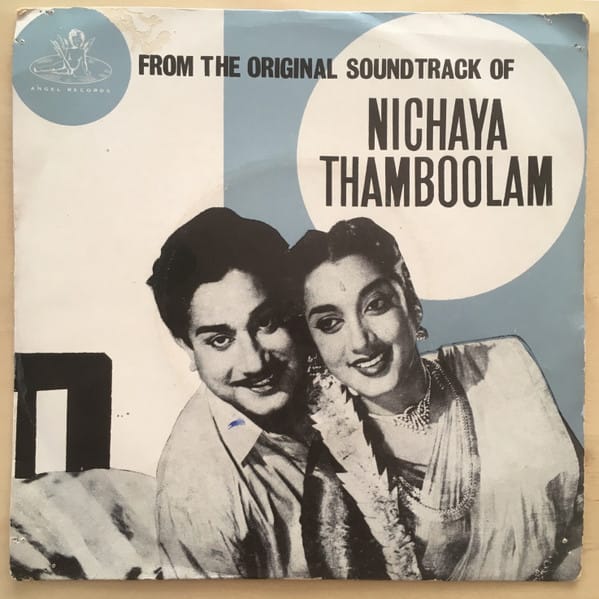
Padaithaane (from Nitchaya Thaapoolam, Tamil; 1962)
Lyricist: Kannadasan
My wife thinks I am nuts for listening to sad songs. No, I tell her. I am not into an exercise of self-pity or melancholy porn. It is just that, like Elton John said, sad songs say so much. I am in for the philosophy.
Nietzsche suggested that we all need tragedy in our life, or at least in its art form. Like a Greek tragedy in which the two opposing forces, the 'Apollonian' and the 'Dionysian', intertwine to create art, life is no different. We are brought down from our high chair to the ground by Nature to make us realise of our vulnerabilities by infusing sadness into our lives.
Tamil songs just get it right by infusing intricate facets of life into their audiences when a character faces obstacles. Its messages are immortalised via its many evergreen songs. 'Padaithane' (He Created) from 1962 hit 'Nitchaya Thamboolam' (a ritual of exchanging trays with gifts to mark mutual consent for marriage). Sivaji Ganesan, in his usual histrionic antics, some would call it overacting, plays out the plight of a newlywed man who suspects that he has been wronged by his wife. The wife, who had turned his life around, from being a loafer to a responsible householder, all the while had been two-timing him. Of course, in keeping with the pristine image of a chaste Indian wife, none of this is true.
In the song sequence, the character thinks aloud his predicament. He blames God for the emotional turmoil that he is encountering. He tries to make sense of His intricate game called life. He talks (sings) of Man's evolution from Ape to Homo Sapiens and how their simple lives became complicated with newfound bonds and relationships. He questions the purpose of our existence, our life chained by familial piety and desires. It is amazing how we, with our simple minds, have to deal with so many problems. Worst of all, we sometimes forget our mistakes only to repeat them.
The cinematographic technique employed for this particular song (music video) was described as avant-garde. It tried to employ American noir technique to bring out the dark hidden agenda of existentialism. The tall beams of light, long shadows, and illuminated pillars against an intensely dark background are pathognomonic for a noir movie.
A feeble attempt at translation...
He created,
God created Man.
(the singer is playing tricks with us. He modulates his voice to make it sound as if it can also be heard as 'why He created'?!)
He made us grow,
Grew misery in our hearts.
He gave us,
He gave us forgetfulness.
He separated,
Separated mind and sorrow.
When Man was Ape,
there was no turmoil in his mind.
family, wife, siblings, groups were none,
falling into trap of desire, compassion and love,
cannot have peace of mind.
Wandering, suffering, struggling, shrivelling,
Is not giving any benefit to anyone.
When one is born alone,
there is no disturbance.
When he joins another soul,
there is always trouble.
In Man's small head, so much burden.
It starts at 20 and till 70,
there is always dizziness (confusion).
Man, at the spring of his youth, raging with hormones and the spirit of freedom, plunges head-on to experience the pleasures of his senses. At this time, his heart rules, rather than his head. He follows blindly like a zombie, not thinking but merely as a reflex to the stimuli around him.
This is a one-way ticket which traps him in a slippery web of bonds, clutching tentacles and emotional baggage. By the time, he realises his position, he is ankle-deep rooted in the quicksand of hopelessness. Too many commitments, too many society-imposed dos and don'ts. He can always turn around and leave it all behind; the only person who matters is himself, and the only important thing is his emotional well-being. It is not easy. Even if he decides to cut off the umbilical cord of attachment, he is bound to repeat the whole debacle. He forgets and is blinded by his primal needs.
He can blame all his misdoings and misjudgements on God's misdeeds as heard in this song. Alternatively, he can say that only the good things in life are of God's greatness, but all its follies are only man's wrong moves. He may say that it is all part of the Divine master plan and He is just testing our faith.
N.B. Apollo is the Greek god of light and reason. Nietzsche identifies the Apollonian as a life- and form-giving force, characterised by measured restraint and detachment, which reinforces a strong sense of self. Dionysus is the Greek god of wine and music, and Nietzsche identifies the Dionysian as a frenzy of self-forgetting in which the self gives way to a primal unity where individuals are at one with others and with nature. Both the Apollonian and the Dionysian are necessary in the creation of art. Without the Apollonian, the Dionysian lacks the form and structure to make a coherent piece of art, and without the Dionysian, the Apollonian lacks the necessary vitality and passion. Although they are diametrically opposed, they are also intimately intertwined.
Farouk Gulsara (asokansham@gmail.com) is a content creator under the Newswav Creator programme, where you get to express yourself, be a citizen journalist, and at the same time monetize your content & reach millions of users on Newswav. Log in to creator.newswav.com and become a Newswav Creator now!
The User Content (as defined on Newswav Terms of Use) above including the views expressed and media (pictures, videos, citations etc) were submitted & posted by the author. Newswav is solely an aggregation platform that hosts the User Content. If you have any questions about the content, copyright or other issues of the work, please contact creator@newswav.com.