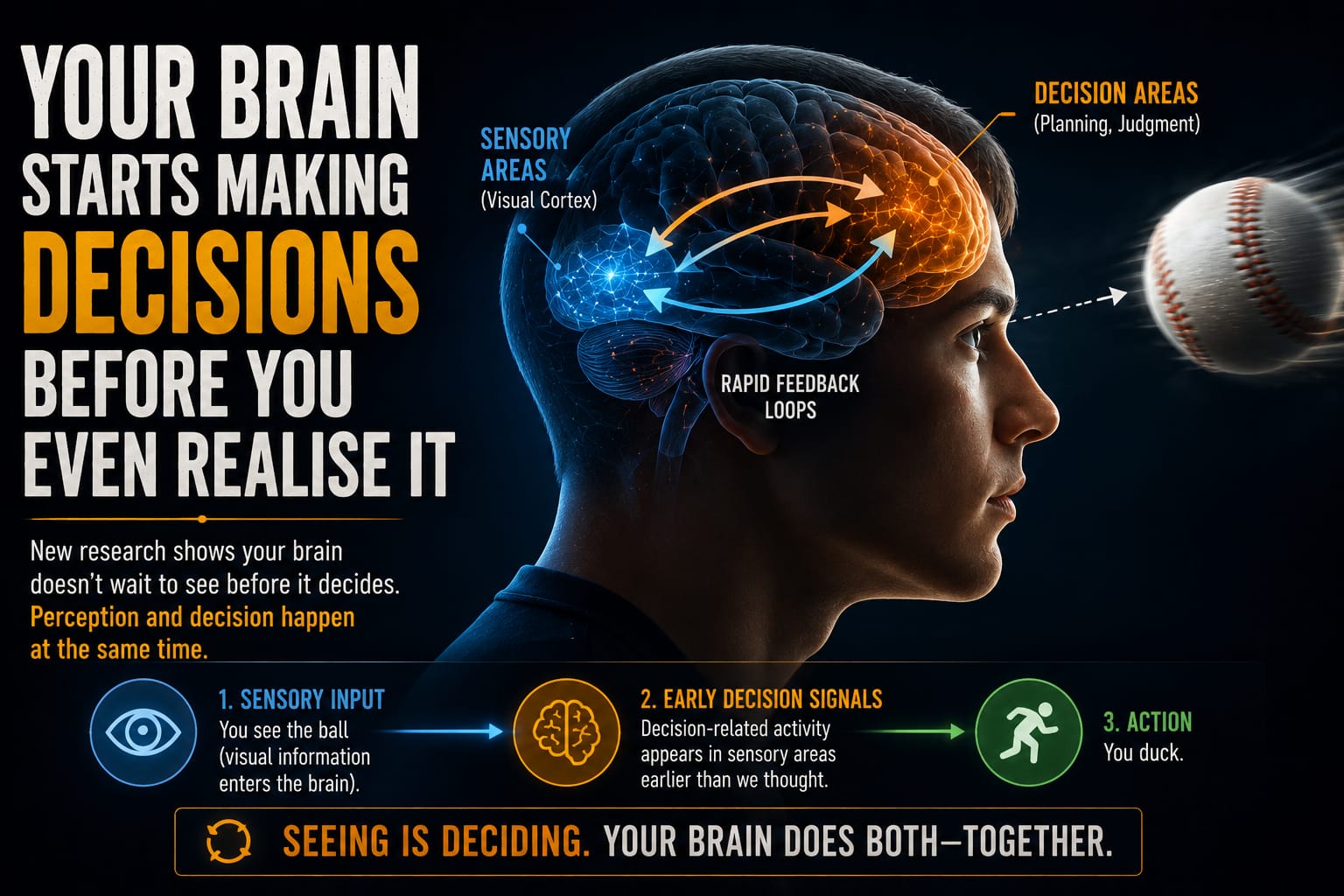
You probably assume that when you see something, your brain first processes the raw visual information and then, in a separate step, decides what to do about it. First, you see the ball coming toward you, then you decide to duck. Perception first, decision second. That is the intuitive model.
A study published in 2026 found that this model is wrong. Even the most basic sensory regions of the brain, the areas responsible for processing raw sights and sounds, are being influenced by higher decision-making areas through rapid feedback loops. Your brain is not waiting to finish seeing before it starts deciding. It is doing both at the same time.
The researchers found that decision-related signals appeared in primary sensory regions much earlier than previously thought. These regions were not just passively receiving information and passing it along. They were being actively shaped by feedback from areas of the brain associated with planning and judgment.
This challenges the traditional view of the brain as a strictly hierarchical system, where information flows from low-level areas upward to higher-level areas in a neat sequence. Instead, the brain operates more like a conversation. The higher areas are already sending signals back down, essentially telling the sensory areas what to pay attention to and how to interpret what they are receiving.
The practical implications are significant. It helps explain phenomena like intuition, where people sometimes "know" something before they can articulate why. It also sheds light on how experts in fast-paced fields, like surgeons, athletes, or fighter pilots, seem to react faster than their conscious processing speed should allow. Their brains are not waiting for the full picture. They are already making decisions with partial information, guided by feedback loops that have been trained through experience.
The findings were reported widely across neuroscience outlets and build on decades of research into how the brain balances speed and accuracy. It also raises questions about what we mean by "conscious" decision-making. If your brain is already steering your perception before you are aware of what you are perceiving, then the line between seeing and deciding is much blurrier than we thought.
This is one of those findings that sounds abstract until you think about it in everyday terms. Every time you catch a glass before it falls off the table, every time you swerve before you consciously register the obstacle, your brain was already one step ahead of you. It was making the call before "you" even knew there was a call to make.
My Opinion
This study quietly dismantles the idea that we are fully in control of our own decisions. Not in a scary, deterministic way. More in a "your brain is a lot smarter than you give it credit for" way. It is not waiting around for your conscious mind to show up and take charge. It is already running scenarios, already narrowing options, already pointing your attention where it needs to go. The next time someone tells you to "trust your gut," maybe the more accurate advice is "trust your feedback loops."
Ronny M (ronny76netstuff@gmail.com) is a content creator under the Newswav Creator programme, where you get to express yourself, be a citizen journalist, and at the same time monetize your content & reach millions of users on Newswav. Log in to creator.newswav.com and become a Newswav Creator now!
The User Content (as defined on Newswav Terms of Use) above including the views expressed and media (pictures, videos, citations etc) were submitted & posted by the author. Newswav is solely an aggregation platform that hosts the User Content. If you have any questions about the content, copyright or other issues of the work, please contact creator@newswav.com.