Astronauts' brains retain memory of gravity even after months in space, study finds

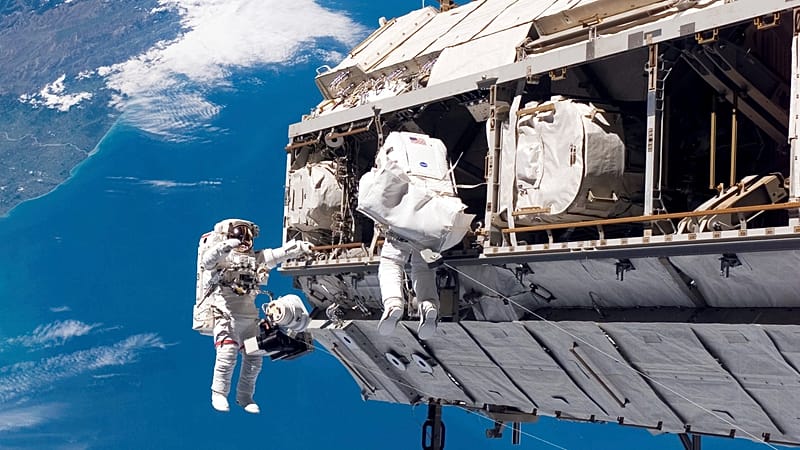
The human brain retains such a deep-rooted memory of gravity that astronauts in space continue to misjudge how tightly to grip objects even after spending months in weightlessness, according to a new study.
Published in the Journal of Neuroscience, the findings shed new light on how profoundly our lifelong experience of gravity shapes the most basic physical actions, and could have real implications for future missions to the Moon and Mars.
Related
The study, led by Philippe Lefèvre, a professor of Biomedical Engineering at Université Catholique de Louvain and Ikerbasque, tracked 11 astronauts (2 females, 9 males) aboard the International Space Station over missions lasting five to six months.
As Lefèvre explains, on Earth, gripping an object is an asymmetric action - you squeeze harder when lifting something up than when lowering it, because gravity only threatens to pull it from your hand on the way down.
In microgravity, that logic no longer applies. An object released at any point in its trajectory will simply float away, meaning grip force should be equal throughout the entire movement. Researchers expected astronauts to learn this fairly quickly.
But they didn't. Instead, something stranger happened. Rather than evening out their grip, astronauts actually began squeezing harder at the top of a movement than at the bottom.

Lefèvre explains it as a kind of perceptual illusion rooted in expectation: "When you are on board the ISS in weightlessness, the movement becomes symmetric because there is no more effect of gravity... what we observed was that the astronaut was gripping the object more when they are at the top than at the bottom. The brain somehow overcompensates the expectation."
In other words, the brain knows the object should feel heavy - because objects always have felt heavy - and overcorrects when it doesn't. Even after half a year floating through space, decades of Earth-based instinct proved almost impossible to shake.
Tests back on Earth
The research team was also granted rare access to the astronauts just one day after splashdown - a logistically difficult window, given that returning crew members are often exhausted and in need of immediate medical attention. What they found surprised them.
In those first few movements back on Earth, the astronauts were still gripping as though they were weightless - a potentially hazardous instinct when handling objects that could be dropped or damaged. But within just a few dozen repetitions, their grip had normalised entirely.
"What this shows is that when they return back to Earth, they relearn the Earth environment much faster than they learn the microgravity environment."
The implications of this study for future missions
The research could have implications for future missions, especially longer ones to the Moon or Mars.
"If we prepare astronauts to land on the Moon, for instance. In that case, they might need some specific training, because the way they are going to manipulate objects might be affected by partial gravity," says Lefèvre.
The researchers say further data is in the pipeline, including findings on how astronauts react when objects unexpectedly collide - another scenario where split-second grip adjustments could make all the difference.