Drought reveals Emperor Nero's bridge beneath Rome's Tiber river

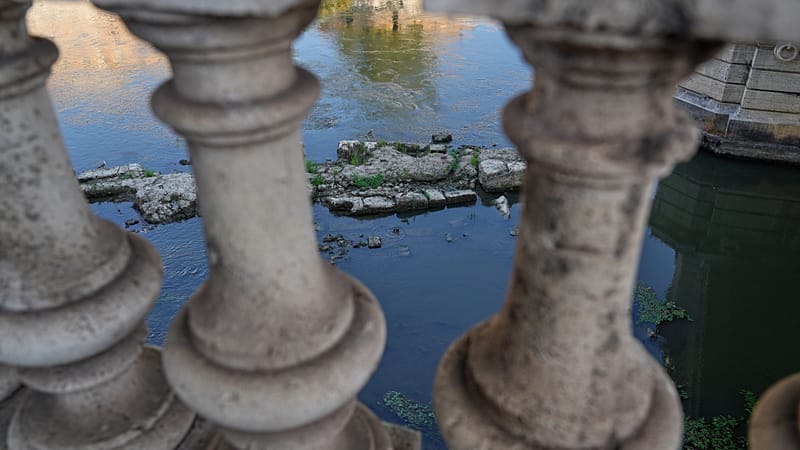
The remains of an ancient Roman bridge have resurfaced from the Tiber as water levels in Rome fall sharply after weeks without rain.
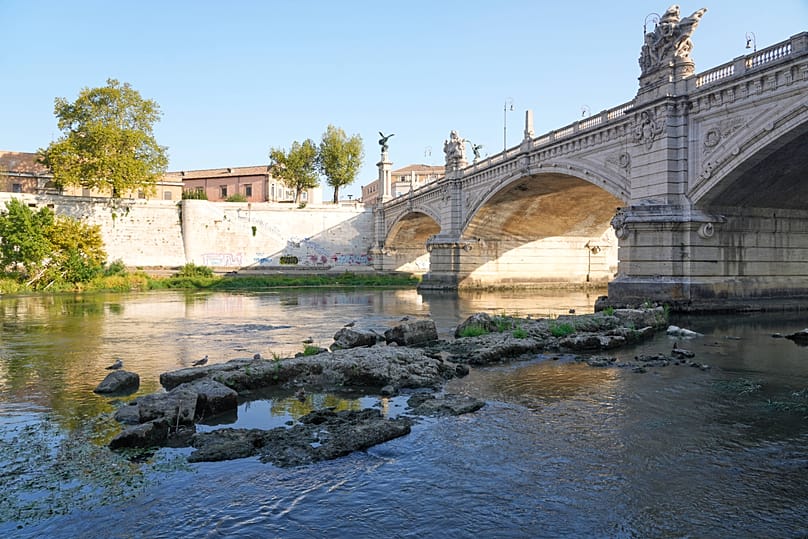
The bridge, traditionally known as Pons Neronis, or Nero's bridge, is located near St Peter's Basilica. Archaeologists say the structure may actually be older than Emperor Nero's reign.
Antonella Bonini, an archaeologist at Rome's cultural heritage superintendence, explains the history of the bridge: “The bridge passes near the villa of Agrippina, the circus of Caligula and then the circus of Nero and traditionally takes the name of Nero, because objectively Nero is the most famous person linked to this area.
"The bridge, however, is considered by scholars to be older (than Nero’s era), built by Caligula, Nero's uncle, to connect the villa of Agrippina, who was Caligula's mother, on the other side, currently roughly corresponding to the Santo Spirito Hospital (near the Vatican) and we assume that it already existed in 39 AD.”
Related
“We know that it was certainly no longer in use, at least at the end of the third or beginning of the fourth century," said Bonini. "In the registers of ancient Rome’s neighbourhoods (Cataloghi Regionari), which are registers that list the most important monuments of Rome, drawn up between the Diocletian and Constantinian ages, this bridge is no longer mentioned, the Pons Aelius bridge is listed in its place, that is, the bridge that connects Castel Sant'Angelo built by emperor Hadrian to connect his mausoleum with the center of the city.”
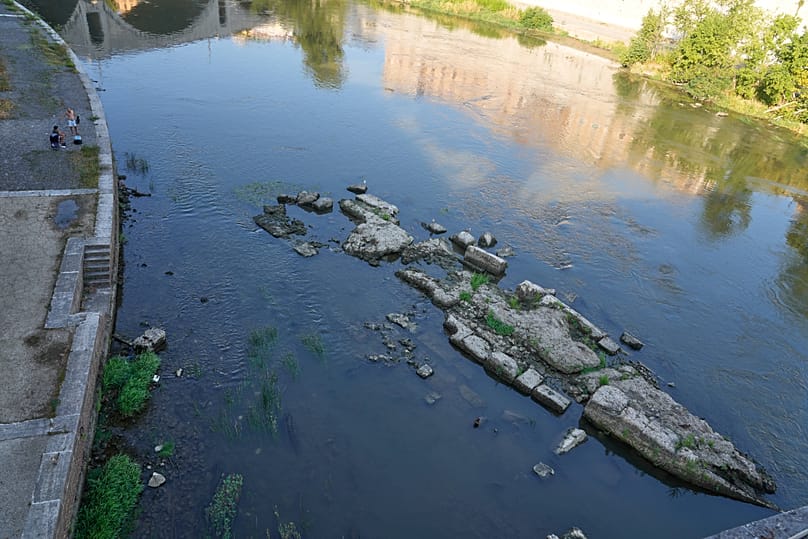
Giovanni Giganti, coordinator of Rome Civil Protection centre for water management, says the Tiber is now flowing at well below its historical average: “The Tiber is facing a rather important low-water phase. And this is in fact due to a series of factors including the prolonged drought of these summer months. In fact, the average flow rate in the urban stretch of Rome has fallen below 80 cubic meters per second, against a historical value that is around 150 on average.”
The drought is also part of a wider water crisis affecting Italy. Giganti says the lack of snow in the Apennines has further contributed to the situation:
“We are facing a major water crisis. And it is a crisis that is also due to the fact that this winter we did have quite abundant rainfall, but then the dry periods, as I said before, were quite long and then also another direct cause of this drought is the scarcity of snow on the Apennines.”
As the Tiber continues to run unusually low, the ancient bridge remains visible above the river, offering a rare glimpse of Rome's archaeological past.