No Iran delegation sent to talks with US yet as ceasefire set to expire

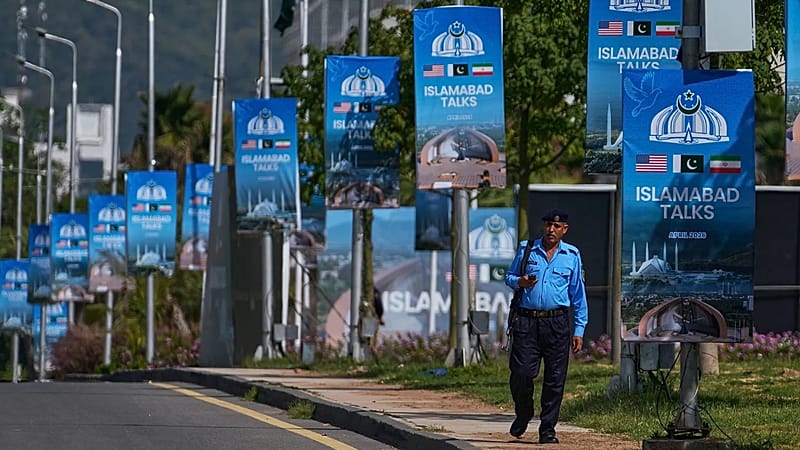
Iran said on Tuesday it has not yet sent a delegation to Pakistan for a second round of peace talks with the US, as the temporary ceasefire which paused the war is set to expire.
"So far, no delegation from Iran has departed for Islamabad, Pakistan, whether it is the main or subsidiary delegation, primary or secondary," Iranian state TV said, dismissing reports suggesting otherwise.
Tehran and Washington have accused each other of breaching the two-week truce that is set to end by Wednesday, as uncertainty grows over a push to stop the war from resuming.
During initial talks in Pakistan earlier this month, the highest-level discussions between the foes since the founding of the Islamic Republic in 1979, analysts pointed to the seniority of the delegations as an indicator of a willingness to strike a deal.
But those talks collapsed without an agreement, with Iran since closing the Strait of Hormuz again, and US President Donald Trump announcing a blockade of Iranian ports.

The White House said Vice President JD Vance was ready to fly back to Islamabad to lead the US delegation, which would also include Trump’s special envoy Steve Witkoff and the president’s son-in-law Jared Kushner.
The talks were initially planned to take place in Islamabad on Monday, but were disrupted after Iran announced its withdrawal, partly prompted by the US seizure of an Iranian-flagged cargo vessel en route to a port on Sunday.
The US Navy said the ship had not complied with its warnings and was attempting to evade its blockade of Iranian ports.
The blockade came into effect last week in response to Iran's closing of the Strait of Hormuz since the beginning of the war on 28 February, which sent oil prices spiralling worldwide.
Iran said the naval blockade of its ports is a violation of the ceasefire agreement, which the US refutes. Trump insisted that the US Navy will continue to enforce it until Iran reopens the strategic waterway it controls to maritime traffic, without conditions.
Earlier on Tuesday, Trump published a brief post on his Truth Social platform saying only that "Iran has violated the cease fire numerous times".

He gave no further details about the nature of the alleged violations or when they took place.
Tehran also said it refused to engage in any diplomatic efforts under the threat of attack, after Trump, in various posts on social media over the last few days, vowed to intensify the fighting and “blow up” the entire country if it fails to enter into a deal with Washington.
“Trump, by imposing a siege and violating the ceasefire, seeks to turn this negotiating table — in his own imagination — into a table of surrender or to justify renewed warmongering,” wrote Iran’s parliament speaker Mohammad Bagher Ghalibaf on X on Monday.
“We do not accept negotiations under the shadow of threats, and in the past two weeks, we have prepared to reveal new cards on the battlefield,” he added.
Related
Iran's Revolutionary Guard Corps (IRGC) — an elite unit with its own navy answering directly to the ayatollah — warned of targeting any vessel attempting to pass through the Strait of Hormuz without permission.
The waterways facilitate the passage of roughly one-fifth of the world’s oil exports, gas and other crucial items like fertilisers.
Brent crude, the international standard, traded at just over $95 a barrel on Tuesday, a steep drop-off from the close to $120 figure it reached prior to the ceasefire, but still a roughly 40% hike compared to prices in early February.