
A routine walk on a California property led one of the most remarkable treasure discoveries ever recorded in the United States. In 2013, a married couple uncovered a cache of 1,411 gold coins, a find that became known as the Saddle Ridge Hoard.
The discovery attracted international attention because of both its scale and its mystery. More than a decade later, no definitive explanation has emerged regarding who buried the coins or why they were left behind.
The couple, publicly identified only as John and Mary, have carefully protected their identities and the exact location of the discovery. Much of the story was later recounted by David McCarthy, Senior Numismatist and Researcher at Kagin’s, the firm that helped authenticate and sell the collection. His accounts offer the clearest picture of how an ordinary day led to an extraordinary find.
An Unexpected Discovery Beneath a Familiar Path
The discovery began when the couple noticed what appeared to be anold metal can protruding from the ground during a walk with their dog. As reported by Popular Science, finding historical objects on the property was not unusual, as the area had previously yielded old nails, bullets and other nineteenth-century artifacts.
Curious, they dug up the can and attempted to open it. After carrying it home and prying off the lid, they found something entirely unexpected.David McCarthylater recalled that a single gold coin was visible through the dirt inside the container, with the edge of a $20 gold piece peeking out.
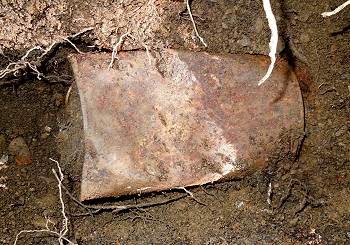
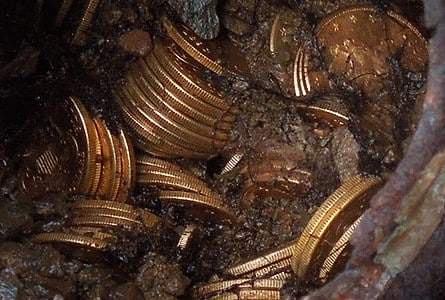
The unexpected discovery prompted the couple to take a closer look. Over the next two weeks, repeated searches of the area uncovered a series of additional containers. McCarthy said the couple ultimately located eight cans after surveying the site with a metal detector. Inside were 1,411 gold coins with a combined face value of approximately $28,000. Their market value was substantially higher because many of the pieces were highly sought after by collectors.
A Cache Of Coins With No Clear Owner
While the discovery itself was remarkable, the origin of the coins remains uncertain. The pieces were minted over a period spanningfrom the 1860s to the 1890s, and the cans containing them were found in varying states of decay.
Popular Science notes that these details suggest the coins may have been buried at different times rather than all at once. The location of the find has also attracted attention. The property lies within 200 miles of the region associated with the California Gold Rush, an area where gold played a major role in everyday economic life during the nineteenth century.
McCarthy explained in an interview for Coinweek that burying gold was a common practice in Northern California at a time when many communities lacked convenient access to banks. Individuals who accumulated significant wealth often sought alternative ways to protect it.
“If you had 10, 20, 30 thousand dollars in gold that you’d acquired over time, you’re not going to leave it in your house,” he said. He added that, “If you don’t have a bank to put it in, the only logical choice is to bury it in the ground. It’s pretty typical human behavior.”
Yet several aspects of the hoard remain difficult to explain. Many coins were found in pristine condition, indicating they may never have circulated. Some had been minted in Georgia, thousands of miles from California, adding another layer of uncertainty to the collection’s history.
What Happened to the $10 Million Treasure?
After realizing the significance of the find, the couple contactedKagin’s for assistance. Most of the coins were eventually sold, and many became available through Amazon, marking what was described as the first time a major coin discovery was sold via the online retailer.
The proceeds were used for several purposes. As explained in the samr source, the couple paid off debts and donated part of the money to charity. They also kept a small number of coins, intending to pass them down as family heirlooms. Two pieces from the collection were donated to the Smithsonian. One was a$10 gold coin minted in 1888, while the other was a $20 gold coin minted in 1892.