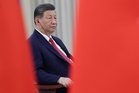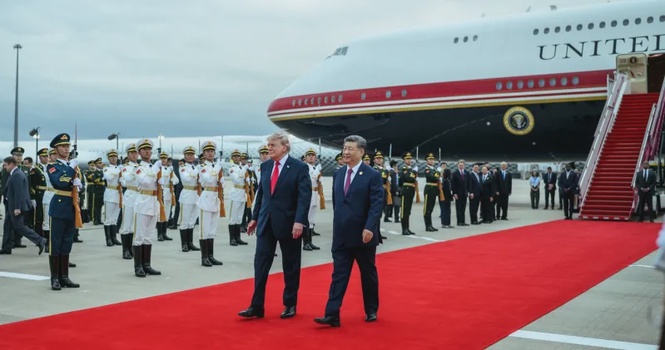
US President Donald Trump has clearly thought hard about Taiwan but rarely says what he would do if China attacked it, and the way he talks about the island suggests little appetite for sending US troops to defend it, New York Times White House and national security correspondent David Sanger said in Taipei on November 21.
Sanger, who has covered the White House for The Times for 27 years, also said Trump has brushed off the Six Assurances that President Ronald Reagan gave Taiwan in 1982 as belonging to a long time ago.
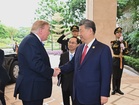
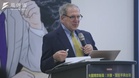
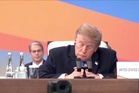
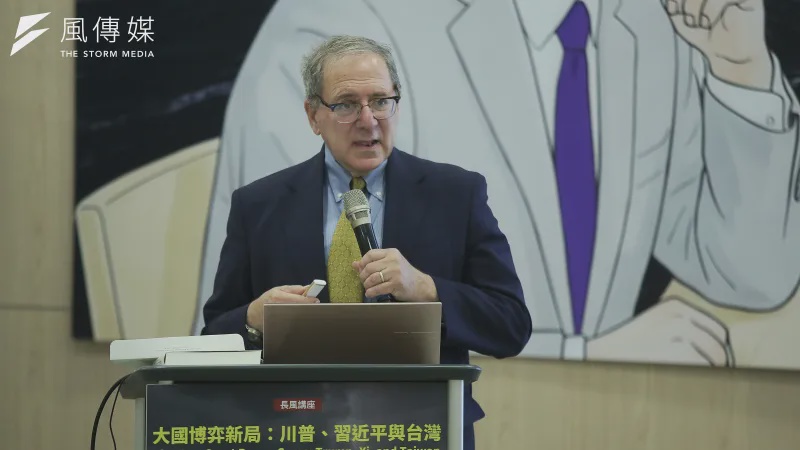
He spoke at a lecture hosted by the Fair Winds Foundation, a Taipei-based nonprofit chaired by former Premier Jiang Yi-huah, titled "The New Great Power Game: Trump, Xi Jinping and Taiwan." The talk came days after he covered the APEC summit in Shenzhen, where Trump, Chinese President Xi Jinping, and Russian President Vladimir Putin held a three-way meeting. It also examined the three Trump-Xi meetings of 2026 and the shift in US politics after the midterm elections.
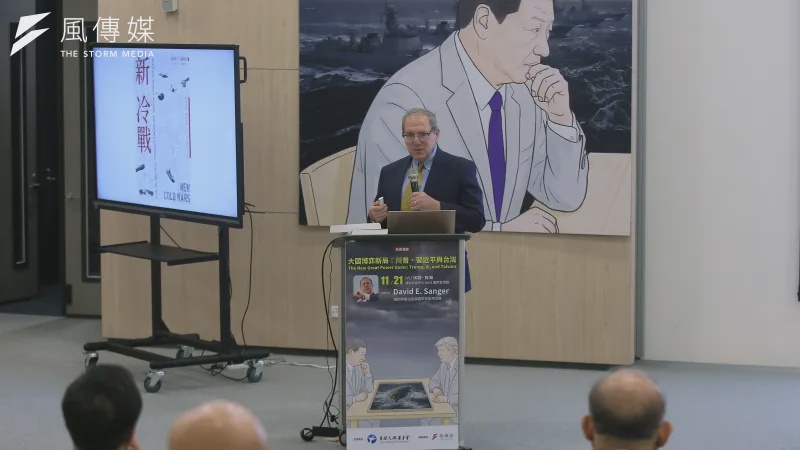
Sanger Has Covered Five Presidents Up Close
Sanger, 66, has worked at The New York Times for more than 40 years and has been a White House correspondent since 1999. He has interviewed five US presidents: Bill Clinton, George W. Bush, Barack Obama, Joe Biden, and Trump. Before the White House beat, The Times posted him to Japan for six years, where he saw the last years of the country's bubble economy.
He has long covered presidential foreign policy, national security, and technology competition, and has been part of three Times reporting teams that won the Pulitzer Prize. He also teaches at Harvard University's Kennedy School of Government. His 2024 book, "New Cold Wars," examines Taiwan's strategic position and the so-called silicon shield.
Trump Called Taiwan Arms Sales A Bargaining Chip
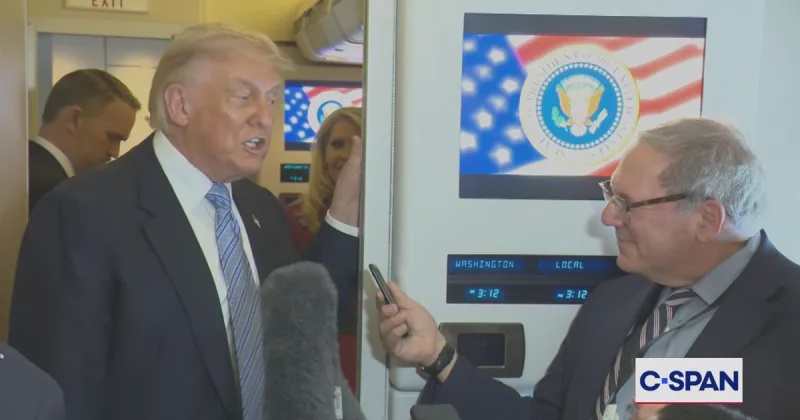
To show where Trump stands, Sanger went back to the first Trump-Xi meeting of the year, when Trump visited Beijing in mid-May. On the flight home aboard Air Force One, Trump took questions from the White House press corps. Sanger asked him several questions about US-China relations, including whether he would release US arms sales to Taiwan that he had put on hold before the trip.
Trump answered that the arms sales were a big bargaining chip for him, Sanger recalled, and said he had raised them with Xi when they met. Trump has called the roughly $14 billion arms package "a very good negotiating chip" in dealing with China, Chatham House noted.
Sanger found the answer telling. US administrations have sold arms to Taiwan so that it can defend itself, he said. And one of the Six Assurances that Reagan gave Taiwan in 1982 is that the United States will not discuss arms sales to Taiwan with Beijing.
Trump looked at Sanger and said 1982 was a long time ago, Sanger recalled, as if Reagan's assurances to Taiwan did not count for much.
A Spoon For Taiwan And A Statue For China
Sanger told another story from the Oval Office. Whenever he was asked about Taiwan, Sanger said, Trump would often pick up a pen or a spoon and say, "See this? This is Taiwan." He would then look for something very large in the office, such as a book or a statue, to stand in for China.
Trump's point, as Sanger described it, was that Taiwan is very small, China is very big, both are very far away, and he wanted to keep strategic ambiguity, the long-standing US policy of not saying whether it would defend Taiwan. From those remarks, Sanger said, he came away with the sense that Trump would think twice before getting involved in an armed conflict over a small, distant place.
"He has never said that. He never answers directly what he would do if Taiwan were invaded, or slowly squeezed economically. But you get the impression that he is not very keen to use the military, unlike Biden, who said three times that he would send US forces to defend Taiwan," Sanger said.
Trump Thinks About Taiwan More Than He Lets On
From his many exchanges with Trump, Sanger said, it is clear that Trump has thought a great deal about Taiwan, but he seldom talks about it. What is certain, he added, is that with Trump's style, it will not be easy for the United States to hold a steady position in the face of China's designs on Taiwan.
Taiwan Analyst Sees Trump Drifting From America's Own Policy
A Taiwanese security analyst made a similar point a day earlier. Kuo Yu-jen, vice president of the Institute for National Policy Research, a Taipei think tank, said this week's run of diplomacy showed a widening gap between how Trump behaves on the world stage and how the United States behaves. That run included the ASEAN summit, a US-Philippines summit, a leaders' meeting of the Quad (the United States, Japan, India, and Australia), and the US-China-Russia summit.
Speaking at the institute's forum on ASEAN, APEC, and Trump's Asia trip on November 20, Kuo said: "Trump's international behavior and America's international behavior seem to be split. There is a very obvious disparity. The Quad was able to hold a summit because everything lined up. The country that the United States, Japan, India, and Australia all care about is the Philippines, and this year's ASEAN meetings were held in the Philippines. That is why you got to see Trump on the same stage as Prime Minister Modi."
"But throughout the whole process, you could see that US-India relations are really not good. The Quad summit did not reach as many substantive conclusions as the 'Squad' of the United States, Japan, the Philippines, and Australia. Those four countries still reached far more conclusions on security cooperation," he said.
"So I do not expect to see another Quad summit. It is a bit like US-Japan-South Korea security cooperation today: high-level political relations are not great, but practical cooperation keeps making progress," Kuo said.
You've read it. Now join the conversation — follow us on X, Facebook and IG. Editor: Penny Wang