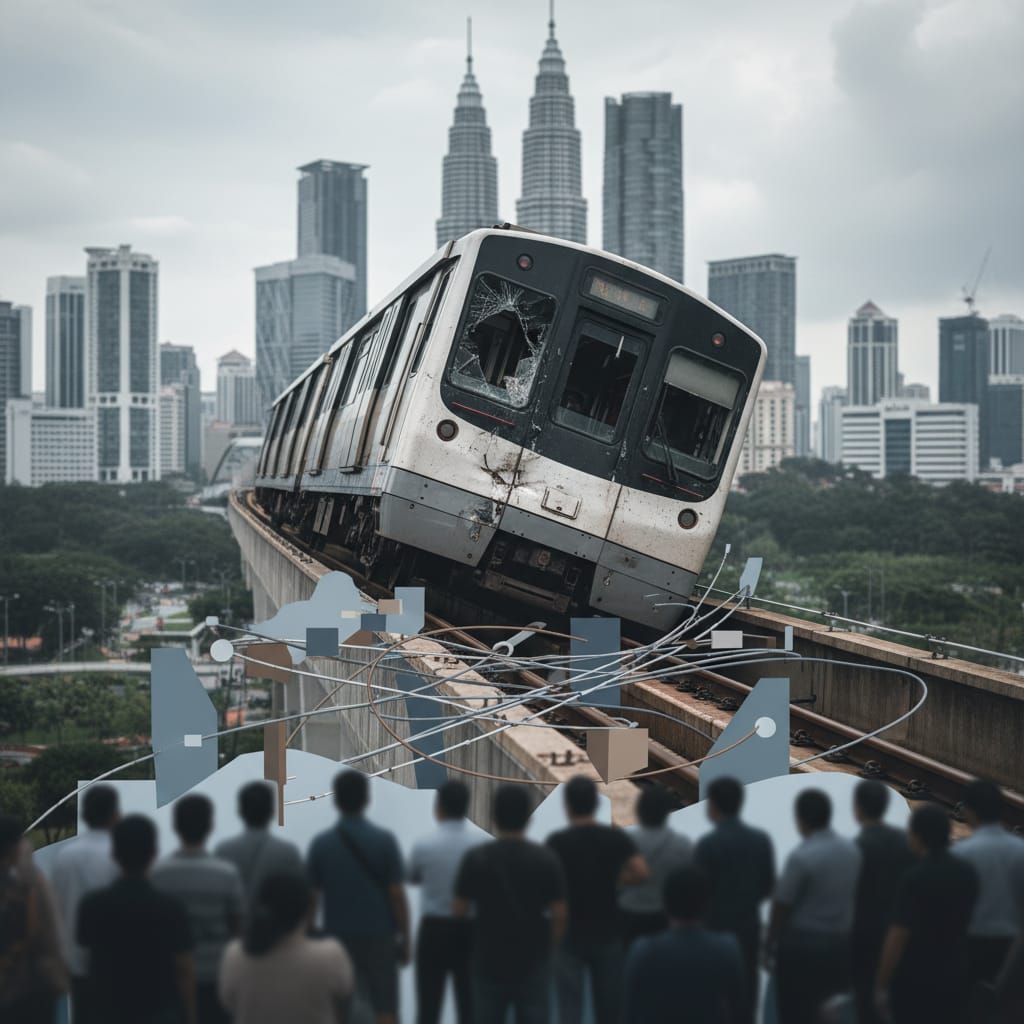
In the early morning of Thursday this week, thousands of riders in Kuala Lumpur boarded the Kelana Jaya Light Rail Transit expecting to be at work, school, or appointments on time. Instead many found themselves paused between stations as screens blinked static and announcements murmured uncertainty. For over an hour, trains crawled or stopped entirely after a signalling system disruption hit the Kelana Jaya line, forcing commuters into an unwanted break mid‑journey. This was not a minor delay. Riders reported long waits of up to 60 minutes locked between Gombak and Putra Heights, sharing frustration and disbelief that a system billed as “rapid” could become what felt like a rolling parking lot. This episode, now widely shared and discussed on social platforms and in commuter groups, is also part of a larger pattern of rail reliability issues that Malaysians are increasingly aware of. Recent coverage by New Straits Times confirmed that a signalling failure halted services on one of the capital’s backbone lines, disrupting schedules during peak travel hours and prompting apologies and remedial work by operator Rapid Rail. (NST Online)
The question now is not whether an LRT can break down, but how often such breakdowns happen and what that signals about Malaysia’s transport infrastructure. Are these isolated technical glitches or symptoms of a deeper reliability problem? How do these delays affect daily lives and the broader push to shift commuters away from private cars onto public transit? And most importantly, what must be done to prevent another morning where working Malaysians discover that their train ride felt like a stagnant roadside traffic jam?
The Anatomy of a Delay
Public transport failures always hit commuters first. They break routines, fray tempers, and trigger ripple effects across work schedules, meetings, and family commitments. For many who rely on the LRT as a lifeline, a single hour of delay can cascade into missed hours of productivity.
The disruption on Thursday affected the Kelana Jaya line, one of the busiest Light Rail Transit corridors in Greater Kuala Lumpur. According to coverage by New Straits Times, Rapid Rail acknowledged a signalling anomaly between major stations, slowing trains and causing cumulative delays. (NST Online)
Signalling systems are the central nervous system of rail networks. They coordinate train movements, regulate speed, and ensure safe distances between vehicles. A glitch may be triggered by software faults, hardware failures, power issues, or even environmental factors. When signalling falters, operators often must manually control trains at reduced speeds for safety until the system is restored. For riders, this translates into uncertain waits and unpredictable schedules.
Technical faults are not unique to Malaysia. Rail systems around the world occasionally suffer breakdowns or signal failures. But in a city that has invested heavily in public transit infrastructure and aspires to reduce traffic congestion, frequent or prolonged disruptions raise questions about resilience and maintenance.
A Pattern of Frustration
This week’s delay was not an isolated anecdote. Commuters have increasingly shared stories of LRT and MRT disruptions across multiple lines in recent months and years. An informal analysis published by local media outlet Cilisos found that from late 2022 to late 2025, urban rail networks in Kuala Lumpur experienced an average of 7 to 8 disruption announcements per month, equating to roughly one to two issues every week across all major lines. (CILISOS - Current Issues Tambah Pedas!)
During some months disruptions spiked significantly. October 2025, for instance, saw multiple signalling issues on the Putrajaya MRT Line and other segments, causing delays, manual operations, and shuttle bus substitutions. (CILISOS - Current Issues Tambah Pedas!)
Passengers express their frustration not just through complaints on platforms like Reddit and commuter forums but through hardened expectations. Many now travel assuming that at least one segment of their journey may be slower than the schedule suggests. They build buffers into their travel time, leave earlier, or adapt flexible work arrangements when possible. But this is not a sustainable adaptation. Longer commute times erode quality of life and confidence in public transport as a reliable alternative to private vehicles.
Riders Share Their Reality
Inside the carriages, the mood shifts quickly when trains slow or stop. What began as a routine, orderly commute can morph into anxious waiting, guesswork over alternative options, and discomfort. Social media comments from previous incidents paint a vivid picture: passengers stranded at stations for over half an hour without clear updates, crowded platforms, and frustrated commuters grappling with uncertainty. These are not isolated personas but reflections of everyday lives impacted. (Reddit)
One commuter wrote in a thread about being stuck between stations for over an hour, questioning why the system could stop moving in the first place. Another described trains lining up at stations, packed beyond capacity due to delayed intervals. These snippets illustrate the lived experience behind aggregate data. They also highlight how public expectation has shifted; reliability is no longer just a convenience but a baseline requirement.
Beyond Technical Glitches
Frequent disruptions have many root causes, some technical and others institutional. Modern rail systems rely on complex infrastructure, and maintaining high reliability requires consistent investment, rigorous maintenance, and robust contingency planning.
Malaysia’s urban rail systems are managed by agencies like Rapid Rail under the Prasarana group, tasked with operations, maintenance, and upgrades. Yet, several factors complicate the picture:
- Aging infrastructure: Some parts of the network have been operational for over two decades, suggesting wear and tear that requires upgrade and replacement. Reliability may erode if investment lags behind need.
- Capacity constraints: As ridership grows, trains run more frequently and with heavier loads, putting additional strain on signalling and control systems.
- Maintenance backlog: Technical maintenance must be continuous and forward‑looking. Postponed upkeep often results in breakdowns during peak usage.
- Environmental and external impacts: Heavy rain, heat, and even construction nearby can affect track and signalling performance.
Prasarana has acknowledged the need for upgrades. Recently it announced plans to introduce 14 new trains on the Kelana Jaya LRT line, with the first expected to be operational by May 2026, signalling a shift toward boosting capacity and improving service quality. (The Edge Malaysia)
New trains promise quieter rides, dynamic station indicators, and greater capacity per car. But rolling stock alone cannot fix signalling faults or systemic issues that lead to stoppages.
The Broader Transport Narrative
Malaysia’s transport vision in the 2020s aims to reduce urban congestion, cut emissions, and shift more commuters to reliable public transit. Investment plans in Budget 2026 allocated significant funds to strengthen transit networks and support bus fleets. (travelweekly-asia.com) Yet when the LRT itself becomes unpredictable, public trust can erode.
This matters not just for daily commuters but for broader policy goals. Governments use public transit reliability to justify further investments, partnerships, and regional development plans. Frequent breakdowns weaken the economic argument for transit‑oriented development and can fuel calls to revert to road expansion projects that, while familiar, worsen congestion and pollution.
The impact also extends to social equity. Not all passengers can afford alternative transport like ride‑hailing or private vehicles. When public transit fails, lower‑income workers, students, and shift workers feel the consequences more acutely. Delays become a form of inequality in daily life, widening the gap between those with transport options and those without.
Looking Ahead: Solutions Over Rhetoric
Technical reliability can be improved, but it requires focused, sustained action across multiple fronts:
1. System Upgrades and Redundancy
Invest in modernised signalling systems with redundancy to prevent single failures from crippling an entire line. Redundancy means parallel systems ready to take over when one fails.
2. Proactive Maintenance
Routine inspections, predictive maintenance using real‑time data, and scheduled component replacements can reduce unscheduled disruptions.
3. Transparent Rider Communication
Commuters deserve clear, timely updates during delays. Real‑time alerts via apps, station displays, and announcements improve user experience even when services falter.
4. Capacity and Infrastructure Expansion
New trains and expanded lines help disperse demand and reduce strain on existing assets. But infrastructure investment must be paired with operations excellence.
5. Accountability and Performance Metrics
Operators should publicly report reliability metrics such as mean time between failures and on‑time performance. Transparent metrics create accountability and informed public discourse.
6. Community Engagement
Understanding commuter experiences through surveys and feedback can inform service improvements and build trust.
Importantly, technical fixes must be paired with organisational culture that prioritises reliability as a non‑negotiable service standard. Commuters measure success not by “how much more frequent trains are” but by “whether my train gets me there on time.”
What do you think I’d love to hear your opinion in the comments section.
Transport infrastructure is more than rail lines and trains. It shapes daily life, work patterns, economic access, and urban rhythm. When a train stops for an hour due to a signalling glitch, the inconvenience ripples across workplaces, households, and even mental wellbeing.
For years, Malaysia has championed urban transit growth. New LRT extensions linking Penang Island and mainland, public consultations on project alignments, and transport planning efforts convey ambition and forward‑thinking. (The Star) Yet, ambition without reliability risks becoming aspirational rhetoric rather than everyday reality for commuters.
Daily transit reliability matters. It affects how cities function. It shapes trust between citizens and institutions. And it determines whether a nation’s infrastructure can sustain economic growth while improving quality of life.
When public transit works, it frees people from car dependency, opens access to opportunities, and reduces urban pollution. When it stalls, even for an hour, it reminds us how fragile progress can be if not nurtured with care, foresight, and accountability.
AM World (tameer.work88@gmail.com) is a content creator under the Newswav Creator programme, where you get to express yourself, be a citizen journalist, and at the same time monetize your content & reach millions of users on Newswav. Log in to creator.newswav.com and become a Newswav Creator now!
The User Content (as defined on Newswav Terms of Use) above including the views expressed and media (pictures, videos, citations etc) were submitted & posted by the author. Newswav is solely an aggregation platform that hosts the User Content. If you have any questions about the content, copyright or other issues of the work, please contact creator@newswav.com.