Astronomers have detected erythrulose, a four-carbon sugar, in a giant cloud of gas and dust near the center of the Milky Way. It is the first time a sugar of this type has been identified in interstellar space.
The discovery comes from a study led by Izaskun Jimenez-Serra and published on the arXiv preprint server. While the space between stars may seem empty, scientists have spent decades uncovering a surprising variety of organic molecules hidden within vast molecular clouds.
Those discoveries matter because many of these compounds are associated with the chemistry that existed before life emerged on Earth. The newly detected sugar fits into that picture, but its presence in deep space raises a puzzling question that researchers are still trying to answer.
A First For Interstellar Chemistry
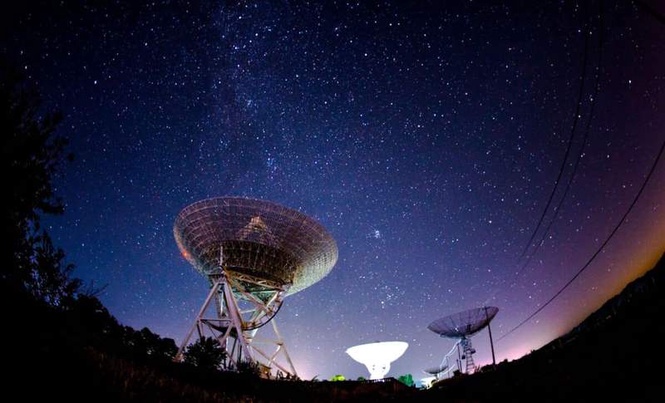
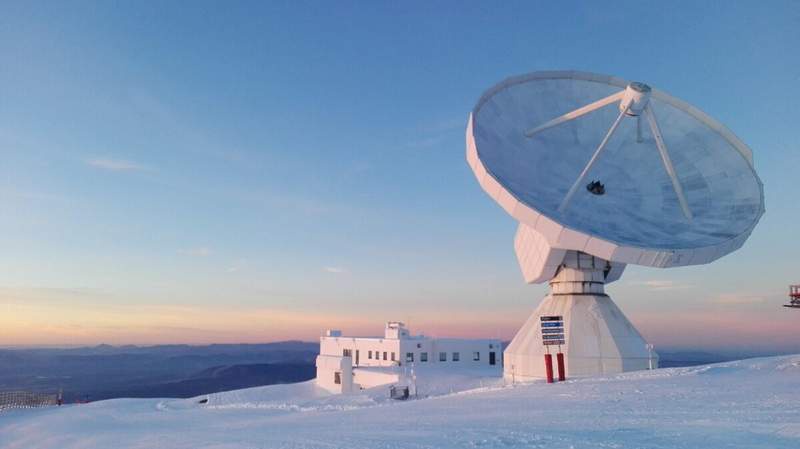
The sugar was found in G+0.693-0.027, a molecular cloud already known among astronomers for its rich chemistry. To identify the molecule, researchers used observations from the 40-meter Yebes telescope and the 30-meter IRAM telescope, both of which are designed to detect the faint radio signals emitted by molecules in space.
According to the study, the team searched through a dense collection of spectral signatures until they found the telltale fingerprints of erythrulose. Their analysis showed that the probability of those signals appearing by chance was only 0.2%, giving researchers confidence that the detection is real.
Erythrulose belongs to a family of compounds known as ketose sugars and contains four carbon atoms. While other complex organic molecules have been found in interstellar clouds before, this is the first confirmed detection of a four-carbon sugar in the interstellar medium.
The Real Surprise Was What Was Missing
Finding erythrulose was only part of the surprise. Scientists were just as intrigued by what they didn’t find. The cloud appeared to contain very few three-carbon sugars, even though those molecules are often thought to be important stepping stones toward larger sugars. According to the study, erythrulose was at least eight times more abundant than compounds such as glyceraldehyde.
To figure out why, the researchers ran advanced computer simulations. What they found suggested that the sugar may be forming in a very different way than expected.
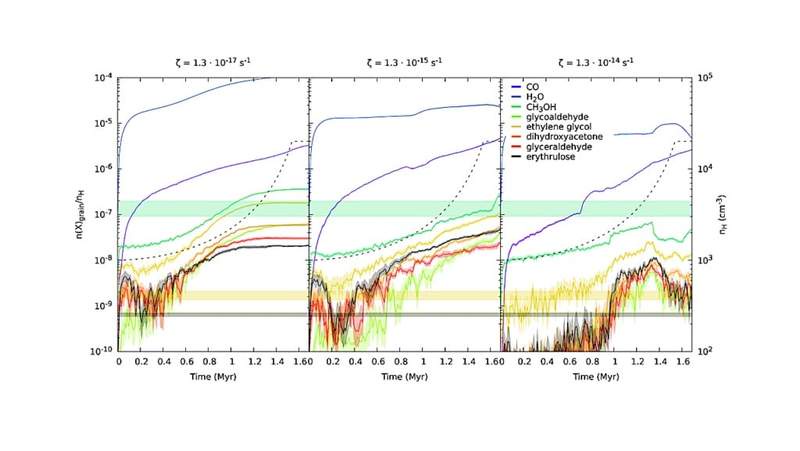
Instead of growing one carbon atom at a time, erythrulose seems to be created when smaller two-carbon molecules join together on the icy surfaces of dust grains drifting through space. These grains are constantly exposed to cosmic rays and hydrogen atoms, creating highly reactive conditions that help new molecules form. In other words, a four-carbon sugar may be able to emerge directly, without first passing through a three-carbon stage.
A Molecule That Could Explain How Life Began
The discovery is drawing attention because it could help scientists better understand how life first emerged. Today, all known life stores genetic information using DNA and RNA, both of which depend on a five-carbon sugar called ribose. The problem is that ribose is not easy to produce under the conditions believed to have existed on the early Earth. Because of that, some researchers have suggested that another genetic system may have come first, before DNA and RNA took over.
One of the most promising alternatives is Threose Nucleic Acid (TNA), a simpler molecule built around a four-carbon sugar known as threose. According to the study, ketose sugars like erythrulose can naturally convert into aldose sugars such as threose when liquid water is present.
That is what makes the new finding especially intriguing. The researchers reported that the detection of erythrulose in interstellar space creates a direct chemical link to a molecule that has long been considered a possible precursor to modern genetic material. The study also noted that vast quantities of organic compounds likely reached Earth during the Late Heavy Bombardment, a period when the young planet was repeatedly hit by asteroids and comets.