A strange gamma-ray emission from the center of the Milky Way remains one of astronomy’s most persistent puzzles. New research has failed to rule out self-annihilating dark matter as a possible source of the signal known as the Galactic Center Excess. The emission appears as a spherical glow of high-energy light extending thousands of light-years from the core of our galaxy.
For more than a decade, researchers have debated whether it comes from ordinary astrophysical sources, such as pulsars, or from something more elusive. The question matters because dark matter is believed to account for 85% of the universe’s matter, yet it remains effectively invisible.
A Crowded Core Clouds The Signal
The Galactic Center Excess is difficult to interpret because it comes from one of the busiest regions of the gamma-ray sky. The center of the Milky Way is bright, dense, and filled with overlapping sources of high-energy radiation.
That makes it hard to separate one possible origin from another. In the report, Florian List, a researcher at the University of Vienna, explains the challenge clearly:
“Interpreting the signal is particularly difficult because the Galactic Center is an exceptionally bright and crowded region of the gamma-ray sky.”
Several explanations have been proposed. One leading possibility involves pulsars, which are rapidly spinning neutron stars capable of producing gamma rays. Another involves a specific class of dark matter particles that could release gamma rays when they annihilate with themselves.
That second idea is unusual, but not random. Some proposed dark matter particles would be their own antiparticles. When two such particles interact, they could destroy each other and release energy into space as gamma rays.
A Dark Matter Explanation Remains Open
The team’s research, published in Physical Review Letters, describes dark matter as invisible because it does not interact with light or with ordinary matter made of atoms in the usual way. It also outweighs ordinary matter by a ratio of five to one.
At first glance, that might suggest dark matter annihilation should flood the universe with gamma rays. But in this model, dark matter rarely interacts with itself. The process would only become relevant in places where dark matter is densely clustered.
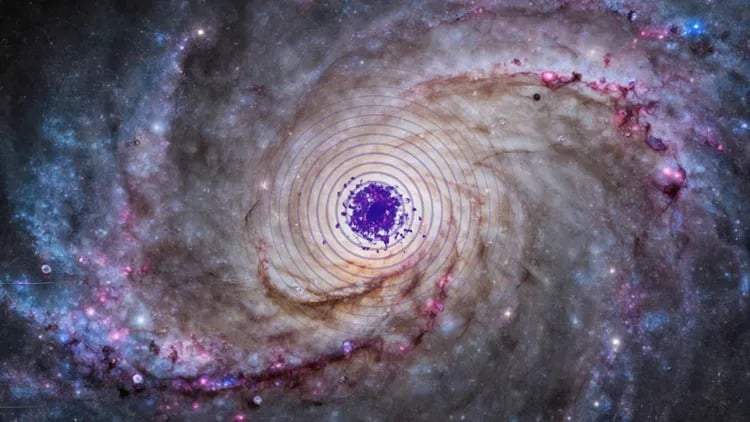
That is why the center of a galaxy is such an important region for this question. The heart of the Milky Way is one place where enough dark matter could be packed together for annihilation to matter.
The research compares the idea to what happens when an electron meets a positron, its antimatter counterpart. In that case, the two particles annihilate and release energy. For self-annihilating dark matter, the particles would act as their own antiparticles.
Machine Learning Changes The Pulsar Picture
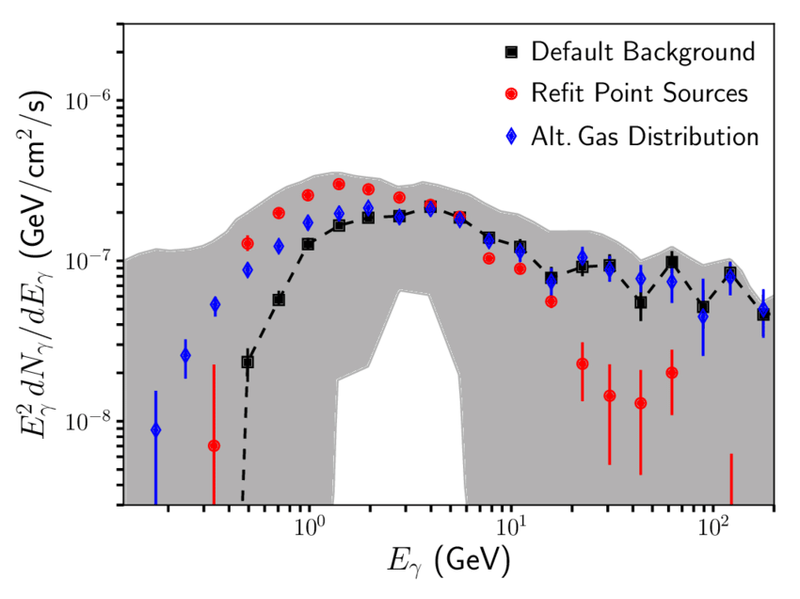
To test the competing explanations, List and his colleagues used machine learning trained on more than one million simulated gamma-ray observations. Previous approaches had suggested that bright, unresolved point sources could explain the Galactic Center Excess.
The new analysis points to a different result. It found that these point sources, including pulsars, would need to be extremely faint. That makes them nearly indistinguishable from the kind of emission expected from annihilating dark matter.
The numbers are striking. Earlier research suggested that a few hundred pulsars might be enough to explain the excess. The new findings indicate that more than 35,000 pulsars would be required near the heart of the Milky Way.

Nick Rodd, a scientist at Lawrence Berkeley National Laboratory, said that:
“Our new analysis shows that the sources would have to be so faint that they would be almost indistinguishable from the emission expected from annihilating dark matter.”
The study does not solve the mystery. It narrows the debate, maybe uncomfortably so, by showing that the dark matter explanation cannot yet be dismissed. List said the work does not show that dark matter is responsible for the signal, but it suggests that ruling out the possibility would be premature.