A good accounting and tax bundle for a Malaysian Sdn Bhd covers four things: proper bookkeeping through the year, financial statements prepared under the right accounting standard, corporate tax filing with LHDN (Lembaga Hasil Dalam Negeri, the Inland Revenue Board), and e-invoicing compliance through the MyInvois system. If a package is missing any one of these four, gaps stay hidden until a deadline arrives and forces you to fix them under time pressure.
Boss Boleh works with Sdn Bhd owners from the day they incorporate through every annual filing after that, so we see where “bundled” packages quietly leave things out. This article breaks down what belongs in a proper bundle, what you can reasonably expect to do yourself, and where a tax agent differs from a general accountant.
TL;DR
- A complete bundle includes bookkeeping, financial statement preparation under MFRS or MPERS, annual tax filing (Form e-C) with LHDN, and e-invoicing setup through MyInvois.
- Annual Returns go to SSM (Suruhanjaya Syarikat Malaysia, the Companies Commission of Malaysia) within 30 days of your incorporation anniversary; Financial Statements go within 30 days of being circulated to members, which must happen within six months of financial year end.
- A tax agent and an accountant are not interchangeable. One keeps your books; the other is registered with LHDN to represent you on tax matters.
- Late SSM lodgements attract administrative fees of RM50 to RM200; separately, the Companies Act 2016 allows court fines of up to RM50,000 upon conviction for certain breaches.
- You can use your own accountant or tax agent even if your company secretary is a different provider.
What Does a Compliant Accounting and Tax Bundle Actually Cover?
At minimum, a bundle built for a Malaysian Sdn Bhd should include financial statements prepared under MFRS (Malaysian Financial Reporting Standards) or MPERS (Malaysian Private Entities Reporting Standard), an annual corporate tax return filed with LHDN using Form e-C, and e-invoicing compliance through the MyInvois system. These three outputs are not optional extras. They are the baseline that every active Sdn Bhd eventually has to produce, regardless of size.
Here’s the part that catches new owners off guard: these three things depend on each other. Your tax return is built from your financial statements. Your financial statements are built from your bookkeeping records. And your e-invoicing records increasingly feed into both. If the bookkeeping is messy, everything downstream slows down or gets priced up, because someone has to clean up the mess before they can file anything.
A package that only promises “tax filing” without naming who prepares the financial statements, and on which standard, is incomplete. Ask the provider directly: MFRS or MPERS, and who signs off.
Bookkeeping, Accounting, or Tax Agent: Who Does What?
Building on the dependency above, the practical question is who actually does each piece of work, because these are three different jobs often sold under one umbrella.
- Bookkeeping services (Malaysia) means recording transactions: sales, purchases, payroll, bank movements. This is the raw data layer. Done weekly or monthly, not once a year.
- Accounting takes that raw data and turns it into financial statements: profit and loss, balance sheet, cash flow. This needs someone who understands MFRS or MPERS treatment, not just data entry.
- A tax agent is a person approved under the Income Tax Act 1967 to prepare and file your tax return and represent you to LHDN. Not every accountant is an approved tax agent, and not every tax agent does your bookkeeping.
The tax agent vs accountant distinction matters because of liability and scope. Your accountant can prepare clean financial statements. But if LHDN queries your tax computation, you want someone registered as a tax agent handling that conversation, because they are the one authorised to represent you on tax matters. A good bundle should specify both roles, even if one provider or one partner handles both.
When Are Annual Return and Financial Statement Deadlines Due?
Separate from tax, your Sdn Bhd has company secretarial deadlines running in parallel, and a bundle that only talks about tax has left out half the compliance calendar.
- Annual Return: lodged with SSM within 30 days of your incorporation anniversary (Section 68, Companies Act 2016).
- Financial Statements: for a private company, generally lodged within 30 days after circulation to members (Section 259), and that circulation itself must happen within six months of your financial year end (Section 258).
These two deadlines are tracked by your company secretary, not your tax agent. This is one reason Boss Boleh’s plans bundle Annual Return submission and Financial Statement submission alongside company secretarial work. It means the person managing your SSM deadlines is also the one who knows whether your financial statements are ready in time to meet them, instead of two separate vendors discovering a gap only when it’s already late.
What Happens If You File Late or Skip a Requirement?
There are two separate cost categories here, and conflating them leads to confusion.
First, SSM’s own late-lodgement penalty schedule charges an administrative fee, generally ranging from RM50 to RM200 per document depending on how late it is lodged. This applies regardless of intent, it is an administrative fee, not a court process.
Second, the Companies Act 2016 separately allows for court fines upon conviction for statutory breaches. Under Section 68, a default on Annual Return lodgement may result in a fine of up to RM50,000 against the company and the officers who contravene the section, upon conviction. Under Section 259, failure to lodge financial statements may result in a fine of up to RM50,000 against the responsible officer upon conviction, with a further fine of up to RM1,000 for each day the offence continues after conviction. These are maximums a court may impose upon conviction, not automatic charges, and most companies never reach this point because they correct the lodgement before enforcement escalates.
The practical takeaway: SSM’s administrative fees are the everyday cost of running late. Court fines are a separate, more serious consequence reserved for unresolved breaches. Neither replaces the other, and a company secretary appointment does not remove the directors’ own duty to keep the company compliant.
How Does E-Invoicing Fit Into Your Bundle?
Stepping back from filing deadlines, e-invoicing is the newer piece that most older “accounting package” descriptions don’t mention at all, simply because it didn’t exist when those packages were written.
LHDN e-invoicing operates through the MyInvois portal (a Malaysian Revenue Board digital invoicing system), and businesses need e-invoicing software Malaysia-compliant with that system to issue and validate invoices correctly. Rather than treating this as a bolt-on, a sound bundle folds e-invoicing setup into the same workflow as your bookkeeping, since invoice data is also the raw material for your accounts.
E-invoicing compliance requirements change periodically. Confirm current obligations directly with LHDN or your tax agent rather than relying on a general article.
Frequently Asked Questions
Does my Sdn Bhd need both a company secretary and a tax agent?
Yes. A company secretary (Section 235, Companies Act 2016) handles SSM filings and statutory registers. A tax agent handles your LHDN tax submission in Malaysia. They are legally distinct roles, though one provider may offer both.
Can I use my own accountant even if I sign up with an online company secretary?
Generally yes. Boss Boleh’s plans let you keep your own external accountant or tax agent if you prefer, while Boss Boleh handles the company secretarial side.
Is bookkeeping the same as accounting?
No. Bookkeeping records transactions. Accounting turns those records into financial statements under MFRS or MPERS. You need both, in that order.
What’s the difference between tax filing and tax agent services?
Tax filing is submitting the return. A tax agent is the qualified person authorised to prepare that return and deal with LHDN on your behalf if there are queries.
Do I still need financial statements if I qualify for audit exemption?
Yes. Audit exemption (Section 267(2)) only removes the requirement for an external audit of those statements. You still need to prepare and lodge financial statements, and you still need a company secretary.
How do I know if my bundle is missing something?
Ask the provider to name, specifically: who prepares your financial statements and under which standard, who files your tax return and whether they are a registered tax agent, and whether e-invoicing software is included or separate.
ABOUT BOSS BOLEH
Boss Boleh is an online company secretary and compliance platform built for first-time entrepreneurs. Beyond company secretarial work, it also offers a one-stop compliance solution for entrepreneurs, including accounting, tax planning and tax filing services. Our plans bundle Annual Return and Beneficial Owner submissions to SSM and Financial Statement submission, while leaving you free to keep your own external accountant or tax agent if you already have one. With over 1,500 Google reviews at a 4.9-star average, we support clients in Kuala Lumpur, every other Malaysian state, and Malaysians living overseas.
References
Companies Act 2016 (Act 777), sections 68, 235, 258, 259, 267(2)
You’re welcome to join our community group to get exclusive and latest trend of business insight!
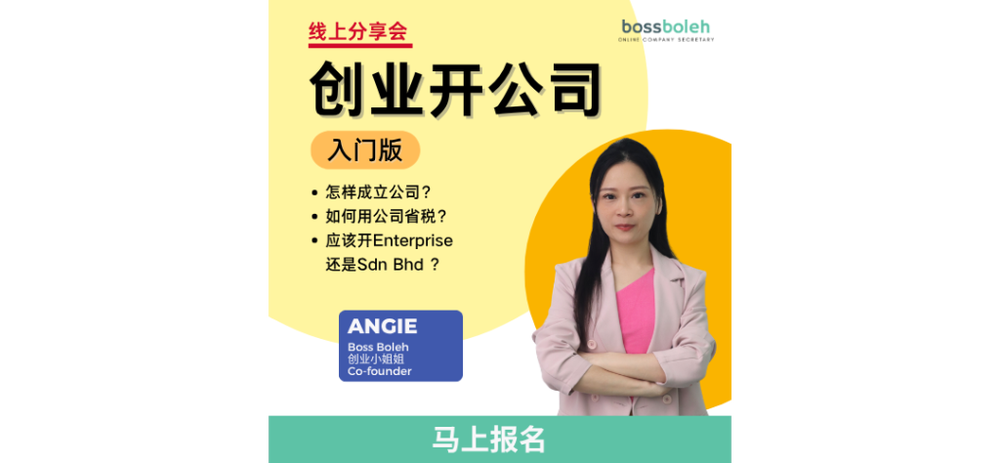
Want to learn more about managing your business structure the right way?
Join our FREE webinar! We’ll walk you through compliance essentials and how to convert from Enterprise to Sdn Bhd with confidence.
For more details, feel free to WhatsApp us!
WhatsApp: 018-7678055