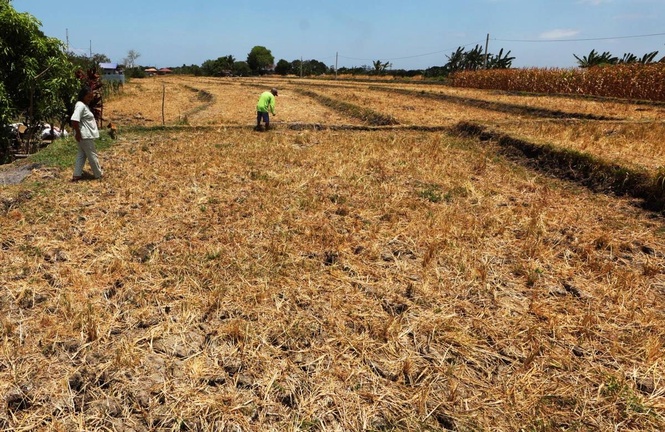
THE Department of Agriculture on Wednesday said it was strengthening measures to protect rice production from the impacts of El Niño, including installing solar-powered irrigation systems, better weather monitoring and more responsive crop calendars.
“We have more tools now to mitigate the impact,” Agriculture Secretary Francisco Tiu Laurel Jr. said.
He said the DA was strengthening interventions to improve water availability, promote climate-resilient rice varieties, enhance farm monitoring and help farmers adjust planting schedules based on local weather and water conditions.
The government is also pursuing additional resources to support measures that will mitigate the potential effects of El Niño on agriculture, including interventions to help farmers manage production costs and sustain farm productivity.
While the DA continues to address immediate production challenges, the more significant effects of El Niño on rice production are anticipated during the first semester of 2027, particularly during the dry-season cropping period.
“The extent of the impact will depend on the severity and duration of dry conditions, water availability, and the effectiveness of timely interventions,” the DA said.
To protect local buffer stocks from El Niño, the DA said that rice imports were not barred from entering the country. Also, the agency stated the Philippines may need to import as much as 5 million metric tons of rice.
Recently, the Philippine Atmospheric, Geophysical, and Astronomical Services Administration (Pagasa) warned that El Niño may intensify into a very strong one by end-2026 and persist until the first half of 2027. This is expected to bring below-normal rainfall, prolonged dry spells, reduced water supply and extreme heat in parts of the country.
Lower output
Based on current estimates, the agency said full-year palay production in 2026 could be around 1 million metric tons lower than the previous year’s output.
The Philippine Statistics Authority earlier reported that palay output in the third quarter reached 3.08 million metric tons, around 18 percent lower than the 3.75 million MT recorded during the same period last year.
Agriculture Undersecretary Christopher Morales, who oversees the agency’s Rice Industry Development Program, said the decline was anticipated.
“We anticipated the decline for the 3rd quarter production, mainly because of the reduction in harvested area. High fertilizer and fuel costs affected farmers’ investment in inputs and, in some cases, their planting decisions,” he said.
By region, Cagayan Valley led the palay harvests with 375,396.86 MT, followed by Soccsksargen (375,332.08 MT) and Bangsamoro Autonomous Region in Muslim Mindanao (290,199.42 MT).
By province, Isabela topped the palay harvests with 229,664.80 MT, followed by Zamboanga del Sur (181,116.07 MT) and Bukidnon (151,966.17 MT).
Area harvested with palay from July to September, according to the PSA, is estimated at 755,370 hectares, down 17.6 percent from the 916,770 hectares area harvested recorded in the same quarter last year.
Other factors
Morales stressed the production decline should not be attributed solely to El Niño, where other factors also affected farmers’ production decisions and cropping schedules.
These include high fertilizer and fuel costs, delayed planting, irrigation constraints, farmers’ reluctance to take production risks amid high costs and uncertain returns, and weather disturbances, including heavy rains associated with the southwest monsoon or “habagat.”
While the DA continues to address immediate production challenges, the more significant effects of El Niño on rice production are anticipated during the first semester of 2027, particularly during the dry-season cropping period. The extent of the impact will depend on the severity and duration of dry conditions, water availability, and the effectiveness of timely interventions.