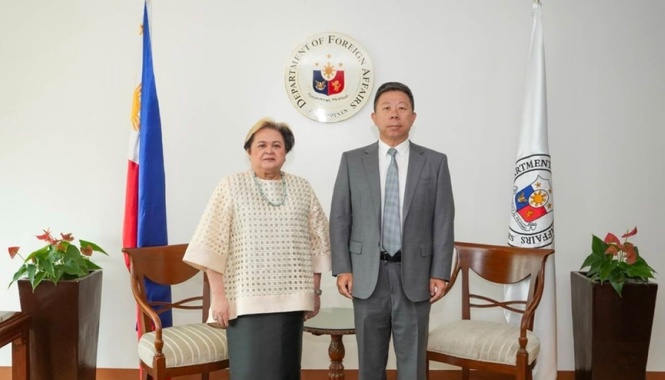
FOREIGN Affairs Secretary Ma. Theresa Lazaro on Monday summoned Chinese Ambassador Jing Quan to express the Philippines’ strong objection to his public statement which conveyed “a threat of the use of force.” Lazaro told Jing that his Oct. 15 statement, in which he said China could “easily win” if it chose to use force against the Philippines in their ongoing maritime dispute, was “provocative and unacceptable, and does not contribute to creating understanding,” the DFA said in a statement.
The DFA called out Jing for issuing a “thinly veiled threat of the use of force” in addressing the maritime dispute between the Philippines and China.
During a chance interview at the sidelines of the Second Diliman Dialogue on China-Philippines relations, Jing reportedly said that if the two sides were to become embroiled in conflict and confrontation, China “may easily not use force, as we love peace.”
Lazaro said such language “aggravates an already sensitive bilateral atmosphere and undermines the shared efforts of both countries to build mutual understanding and cooperation.” The Foreign Affairs Department also said it “reserves the right to take further diplomatic action as it deems necessary.” “It is not the place of a foreign mission to publicly criticize or taunt Philippine officials and legislators who are acting within their mandates,” it added.
“As a democracy, the Philippines values freedom of expression and a plurality of voices, and it will not accept attempts by a foreign envoy to intimidate those who exercise them,” the DFA said.
Lazaro emphasized that sensitive issues are “best addressed through established diplomatic channels and bilateral mechanisms, which preserve space for dialogue and engagement.” “The department remains committed to candid dialogue and constructive engagement, in line with its mandate and the direction of the President,” it said.
It will “keep open lines of communication with China and work to stabilize bilateral relations, especially in non-sensitive areas, while firmly upholding the country’s consistent positions on important issues.” In a statement on Oct. 15, the DFA said the business of diplomacy “requires tact and restraint in order to create space necessary for discourse, dialogue and engagement, regardless of the disparity in positions or perspectives.” “It is regrettable that Chinese Ambassador Jing Quan today had a poor choice of words that would seem to convey a thinly veiled threat of the use of force, which is hardly helpful in the context of the complicated bilateral ties between the Philippines and China,” the DFA said.
“It is hoped that all diplomats accredited to the Philippines take greater care in the language used in public statements so as not to further erode mutual trust and confidence, nor derail the advancement of dialogue and constructive engagement,” it added.
Diplomatic path
Malacañang said President Ferdinand Marcos Jr. does not favor the call by some lawmakers to declare Jing persona non grata.
“We know the president’s perspective — he would not wish to make this kind of declaration against any foreign representative here in our country,” Presidential Communication Office Undersecretary Claire Castro said.
“Whatever the opinions of other leaders or senators may be, we respect their sentiments and opinions,” the Palace press officer said on Monday.
“But still, as we have said, the president does not act in an undiplomatic manner,” Castro said in Filipino.
“Everything he says can affect our country and our fellow citizens. That is why the president is not aggressive in his views regarding any foreign relations and international engagements,” she said.
The president, Castro said, would not prevent any legislator from calling out Jing “because, after all, we have freedom of expression.” “On the part of the president... negotiations with any country must be diplomatic,” she said.
Castro also said the president would not skip the Asia-Pacific Economic Cooperation (APEC) in China in November.
“We do not see the President canceling his [APEC] schedule, as this is one of the best ways to foster better dialogue between the president and the leadership of China,” she said.
Senate resolution
On Monday, Sen. Erwin Tulfo filed a resolution urging the DFA to recommend declaring Jing persona non grata over his remark that China could easily win if it resorted to force.
In Proposed Senate Resolution No. 739, Tulfo expressed serious concern over Jing’s statement.
He said the remark raised serious concerns about diplomatic conduct and its implications for Philippine sovereignty and national security.
Tulfo urged the DFA “to recommend to the appropriate authorities the declaration of Ambassador Jing Quan as persona non grata,” citing the severity of his remarks and their implications for Philippine sovereignty, national dignity and bilateral relations.
He stressed that diplomatic relations between the Philippines and China must be anchored on mutual respect, constructive engagement and peaceful dialogue.
Before filing the resolution, Tulfo challenged Jing to leave the Philippines rather than wait for the government to declare him persona non grata.
“Why wait to be declared persona non grata? Why wait for persona non grata? Then just go home. Bbali-bbali (korean for quickly),” Tulfo said in a media interview.
The senator said members of the Senate majority had discussed filing a resolution over the weekend following the ambassador’s remarks, which he described as provocative and unbecoming of a diplomat.
Tulfo also criticized the Chinese Embassy’s response to calls for Jing to be declared persona non grata, including its reported warning that China could bar Filipinos from entering its territory.
He said foreign diplomats should exercise restraint in their public statements because they represent their countries, their people and their leaders.
“If you’re a diplomat, you have to tone down your statements because you represent your country, your people and your leader,” Tulfo said, adding that envoys should pursue dialogue instead of making remarks that could be interpreted as threats.
He said Jing could have eased the controversy by clarifying his remarks and reaffirming his willingness to engage in diplomatic dialogue.
Defense Secretary Gilberto Teodoro Jr. also rejected Jing’s statements, reaffirming the Philippines’ position on sovereignty, maritime rights and international law.
Speaking during the Senate Committee on Finance hearing on the Department of National Defense’s proposed 2027 budget on Monday, Teodoro said the government already conveyed its objections to the ambassador’s remarks.
“We refute all allegations made by the ambassador that we are troublemakers and are provoking,” Teodoro said, reiterating the Philippines’ support for the United Nations Convention on the Law of the Sea and the United Nations Charter.
Senate Finance Committee Chairman JV Ejercito described the ambassador’s statements as hostile and undiplomatic, saying diplomacy and good relations with neighboring countries must be accompanied by mutual respect.
Ejercito clarified that his criticism was directed at the Chinese government’s policies, not the Chinese people.
Senate Minority Leader Alan Peter Cayetano, meanwhile, called for a measured approach to disputes with China, stressing that the Philippines must defend its sovereignty and sovereign rights without allowing tensions to escalate.