The Department of Labor and Employment (DOLE) is strengthening its efforts to prepare Filipino workers for emerging opportunities in the blue economy, focusing on developing future-ready skills and creating more decent, high-value jobs in the maritime sector.
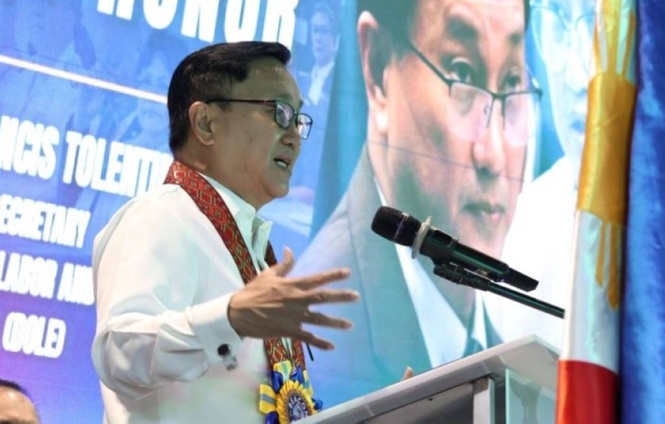
Labor Secretary Francis N. Tolentino said during the Blue Economy Annual Trade and Conference (Beacon) Tuesday, September 29, that Filipino workers and Philippine industries must benefit from the continued expansion of the ocean economy, particularly as rapid advances in technology and the transition toward greener maritime operations reshape jobs and skills requirements.
He emphasized the need to invest in Filipino workers’ skills and capabilities as artificial intelligence, automation, green shipping technologies, low-carbon fuels, and modern shipbuilding and ship repair techniques transform the maritime industry.
Tolentino said that the Philippine ocean economy generated P1.08 trillion in economic value in 2025, equivalent to 3.8 percent of the country’s gross domestic product, and provided employment to 2.46 million Filipinos.
He also noted that these figures represent millions of Filipinos whose livelihoods are linked to the sea, including seafarers, fisherfolk, coastal communities, shipbuilders, ship repair workers, and other workers engaged in ocean-related activities.
Given the ocean economy’s vast contribution to jobs and livelihoods, Secretary Tolentino underscored the need for stronger partnerships among government, industry, academe, and other stakeholders to ensure Filipino workers are equipped and can participate in higher-value segments of the industry.
“Growing the maritime industry requires investments that create well-paid jobs, technology transfer, expertise, and access to higher education opportunities. We need partners who are willing, able, and patient to help us build these capabilities here in the Philippines and not abroad,” Tolentino said during his keynote address.
The blue economy is a framework for the sustainable management, stewardship, and development of coastal and marine ecosystems and resources to foster economic growth, improve livelihoods, and ensure ocean health.
The initiative supports President Ferdinand R. Marcos Jr.’s directive to accelerate blue economy development to generate millions of jobs, bolster local livelihoods, and elevate the Philippines into a competitive regional maritime hub.
Preparing seafarers for the shift from manual to technical jobs
As maritime industries continue to evolve, Tolentino underscored the importance of shifting manual labor to more technical and specialized work, such as marine engineering, ship design, vessel retrofitting, and ship repair, as the industry adopts new technologies and moves toward more advanced, specialized operations.
Tolentino said that investing in skills development, technology, education, and industry capabilities will create better employment pathways and enable Filipino seafarers to participate in the global maritime economy.
With the Philippines recognized as the world’s fourth-largest shipbuilding and ship repair nation, Tolentino said sustaining and advancing the country’s position will require continued investments in Filipino workers’ capabilities, as well as in the technologies and systems of the future.
Beyond developing skills, the Secretary said strategic investments in maritime industries can open more opportunities for Filipino seafarers to move into higher-value jobs.
Strengthening protection for maritime workers
Along with facilitating employment opportunities, DOLE is strengthening mechanisms to protect the rights and welfare of Filipino seafarers.
Tolentino said the Department has established the Maritime Labor Affairs Office to consolidate services for Filipino seafarers, including legal assistance, conciliation, dispute settlement, workers’ education, and employment services.
The Office also supports the implementation of the Magna Carta of Filipino Seafarers and is tasked with helping establish a pool of trained maritime conciliator-mediators, labor arbiters, and voluntary arbitrators who understand seafarer laws, international standards, and maritime industry practices.
The Labor Attorneys’ Office also provides a mechanism for qualified workers, including seafarers who cannot afford legal counsel, to receive free legal assistance and representation.
“Rights must not remain in promises written in law. They must be understood, accessible, and enforceable, regardless of a worker’s financial capability,”
Secretary Tolentino said.