RESIDENTS of an island south of the tip of Davao Occidental in Mindanao are reaping the fruits of the quiet heroism of a group of engineers who went on a precarious mission to reconnect the island after a disaster cut it off from the cellular grid.
When a magnitude 7.8 earthquake rocked Southern Mindanao in early June, one of the first casualties was communication. Cell sites were damaged. Communities were cut off. On remote Balut Island in the municipality of Sarangani, mobile connectivity was completely lost.
For engineers of Smart Communications, however, losing contact with the island was never an option.
“Even as emergency responders assessed the destruction, we immediately activated our Incident Command Center in Davao City, and we coordinated teams so we could restore the network as quickly and safely as possible,” said Harvy Calceña, a senior supervisor in Smart’s Network Service Operations team in Mindanao.
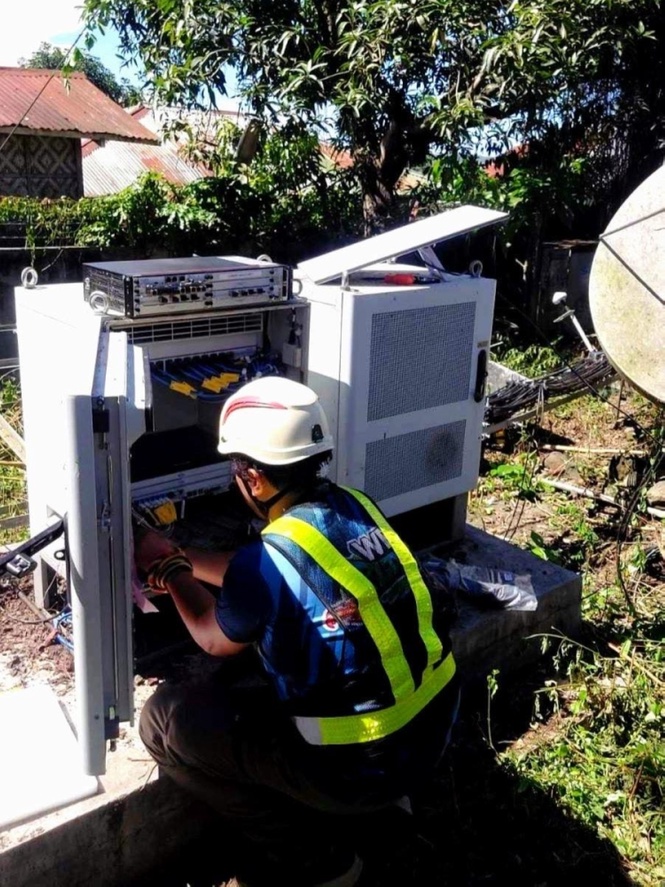
Across the affected provinces, Smart engineers were immediately deployed, carrying not only specialized equipment but also a shared and deeply ingrained mission: reconnect families, emergency responders and communities when communication matters most.
Initial restoration teams reached Sarangani and GenSan the day after the earthquake to assess damage and begin repairs. Equipped with essential tools, including a vehicle-mounted Starlink system, the team of engineers worked despite damaged infrastructure and difficult conditions.
But the toughest assignment lay beyond the mainland, separated from the rest of the province by the Sarangani Strait.
“Balut Island had become inaccessible through conventional commuter transport. We knew that reaching it would require more than technical expertise. It would demand careful planning, precision and a willingness to go wherever the mission called,” Calceña added.
A four-man team answered that call: engineers Elvan Dela Rosa, Jann Wency Tico and Ness Bihag, together with rigger-mechanic Ronnel Dalubatan.
Balut ‘mission possible’ team
Dela Rosa, an 18-year veteran Smart engineer, is no stranger to reconnecting communities after disasters. He had helped in network restoration following each of the catastrophic trio of super typhoons Pablo in 2012, Yolanda in 2013 and Odette in 2021, three of the strongest on record to ever affect the Philippines.
For Tico, a network field engineer from Davao City and also a Typhoon Odette veteran, joining the team was more than a work assignment. It hit close to home, as Tico had relatives on Balut Island. “We were able to reach my aunt who lives on the island, but the connection was patchy at best as it only relied on ‘piso wifi’ set up by informal providers,” Tico shared.
For Bihag, the mission was deeply personal. Living in GenSan City, the island is part of his area of responsibility. There was simply no way he was going to say no to the mission. “I was initially scared because of the prospect of going to the island via a helicopter, but my sense of responsibility won over the fear,” Bihag said.
Working with a cross-functional group from transmission engineering, network operations and even cybersecurity, the crew, which Calceña had dubbed the Balut Mission Possible Team, preconfigured every piece of equipment before deployment, transforming what would normally be a complex installation into a plug-and-play operation. This meticulous preparation would prove invaluable once they reached the island.
On June 14, the team boarded a helicopter provided by Pacific Global One Aviation (PG1), PLDT’s aviation arm, bound for Balut Island.
Moments after landing, they immediately got to work. Just two hours and 44 minutes later, at exactly 2:44 p.m., the isolated site’s mobile service was restored, reconnecting the island with the rest of the country and bringing service back to Smart and TNT customers on the island.
Going beyond the call of duty
Against all odds and notwithstanding the many aftershocks that rocked the island while they were there, the Balut Mission Possible Team safely returned to base on June 16, mission accomplished.
The successful operation underscored how disaster response depends not only on technology but also on people willing to go beyond the extra mile — crossing damaged terrain, overcoming logistical challenges and working against time so that vital communications can be restored.
To Dela Rosa, the mission was all in a day’s work. “Going beyond the call of duty comes with being a telecom engineer, even more so when it involves assisting our colleagues who’ve also been affected by these disasters.”
For Tico, the Balut mission was an opportunity to show his devotion to his job. “When I am assigned to a critical mission, that means I have the trust of my bosses. That is something I take very seriously; I will not let them down.”
For Bihag, who believes that his job is to be the first line of defense of cell sites, being prepared is key. “I even have micro-preparations for whatever could happen, and presence of mind is also key.”
As Filipinos observe National Disaster Resilience Month, the Balut mission is a reminder that resilience is built through the dedication of those working behind the scenes. For Smart’s engineers, every restored signal means more than a functioning cell site. It means families can reach one another, responders can coordinate lifesaving efforts and communities can begin recovering together. To Smart, its #KonektedforResilience advocacy helps prove that keeping Filipinos connected often begins with engineers willing to go wherever the signal is needed most.
Althea Joyce T. Aragon is an executive under the PLDT and Smart Public Engagement Group, the communications team responsible for stakeholder engagement and public communications for PLDT Inc. and Smart Communications Inc.