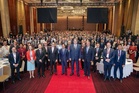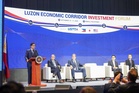
PRESIDENT Ferdinand Marcos Jr. will attend this year’s Brics summit in India’s capital New Delhi this weekend. He is attending in his capacity as the current chairman of the Association of Southeast Asian Nations (Asean).
It will be the first time a Philippine leader has been invited to the annual meeting of the coalition of major emerging economies.
Brics stands for Brazil, Russia, India, China and South Africa, the group’s original members when it was formed in 2009. It has since expanded to include Egypt, Ethiopia, Iran, the United Arab Emirates and Indonesia. At least 30 other developing countries are interested to join.
In terms of demographic scale, Brics represents roughly half of the world’s population. It accounts for as much as 40 percent of global gross domestic product (GDP) and controls a large slice of the world’s energy supply.
With its size and economic potential, Brics has been touted as the voice of the Global South and a powerful platform for shaping global order in the decades to come.
Many used to belittle Brics as the poor man’s version of the Group of Seven (G7), the cartel of seven giant economies that has long dominated international financial governance.
Not anymore. It has grown in stature as the G7’s emerging rival, and, consequently, anti-West. The sentiment is fueled by the fact that China is not only Brics’ chief architect, but also its biggest financier and main political driving force.
Brics was established on the premise that international institutions like the World Bank and International Monetary Fund (IMF) were in the tight grip of Western powers, and had ceased to serve developing countries.
The first leaders’ summit was hosted in 2009 by Russia, which envisioned an alliance that would be the counterweight to Western economic dominance.
In no time, China took charge of charting the course for the new grouping, and attracting new members to its fold.
It was Beijing which set up the New Development Bank (NDB) in Shanghai as the hub of a financial structure that will directly compete with the World Bank and the IMF.
It also aligned Brics’ agenda with the Belt and Road Initiative, China’s version of the G7’s Partnership for Global Infrastructure and Investment.
Brics’ biggest ambition is the “de-dollarization” of international trade and pushing the Chinese currency, renminbi, as an alternative.
Even as the Brics economies challenge the Western-dominated order, bilateral issues have created fissures within the group that erode its policymaking capabilities. China and India, for one, have not fully settled their decadeslong border disputes, and New Delhi maintains strong economic ties with Washington.
The members are also divided on what the bloc should be. The “anti-Western” faction made up of China, Russia and Iran is at odds with the “nonaligned” camp of India, Brazil, the UAE and South Africa.
Brics’ biggest structural weakness is that it does not have a conflict-resolution mechanism to settle internal disputes. For now, the feuds are manageable, but as the coalition grows, the need for a formal structure for resolving differences becomes more urgent.
Understandably, the West is wary of Brics. The coalition, basically, is not anti-Western. Its vision is inclusive economic globalization, an “open and balanced world economy, and supporting countries to embark on a development path that suits their own national conditions.”
For Indian Prime Minister Narendra Modi, the “expansion and modernization of Brics sends a message that all global institutions should adapt to changing times” and that [expansion] will further strengthen the faith of many countries of the world in the multipolar world order.”
President Marcos’ participation in the Brics summit provides an opportunity for the Philippines and the Asean to forge greater cooperation in trade, investment, regional security and climate resilience with the coalition’s members.
The country can gain access to a bloc that controls a fifth of the global GDP and open a huge alternative market for agricultural exports like fruits and food products outside of traditional buyers like the United States and Japan.
The NDB could provide the Philippines with a lending pipeline for high-stakes infrastructure, digital connectivity and climate-resilience projects with less restrictive conditions than those imposed by Western financial institutions.
These are pathways that the Philippines would do well to explore.