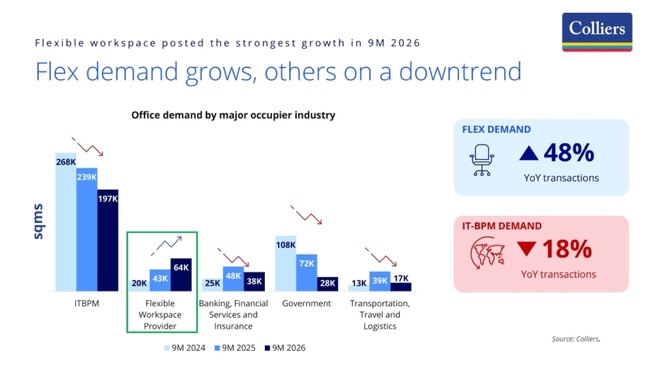
THE flexible office sector kept the office property market afloat in the first nine months of 2026, recording a 48 percent year-on-year (YoY) increase in transactions even as demand for traditional office space continued to decline. However, a stagnant third quarter and expectations of slow leasing activity in the last quarter of the year have prompted the recalibration of year-end forecasts, according to Kevin Jara, director and head of office services-tenant representation of real estate advisory firm Colliers Philippines.
“The main enemy of the office market is uncertainty — driven by domestic politics, the corruption scandal, the impeachment trial, and the war in the Middle East — affecting investor confidence. He added that peso depreciation, which could be an advantage for investors, is being 'neutralized' by high inflation and interest.”
Speaking at the company’s virtual Q3 2026 Philippine Property Market Briefing on Oct. 28, Jara said that flex office space was the sole growth driver in the office market, which he described as “cautious” due to geopolitical tensions in the Middle East and domestic economic and political pressures.
Choosing flex office space, Jara explained, is “a risk mitigation measure used by companies to manage uncertainty. It reduces the initial cash outlay and relieves occupiers of financing pressure through all-in pricing, bundling of the rent, utilities, and construction costs that are carried in the service agreements with the providers."
Colliers reported flexible workspace net take-up rose by 185 percent YoY, with 7,600 seats positive net take-up in the first nine months of the year.
“Flexible workspace presents a stronger growth story for the office market in Manila right now,” Jara said.
While major operators are leading the flex expansion, new players have entered the market as well. Flexible workspace supply is broadening across Metro Manila, with 10,200 total available seats as of the third quarter, Jara reported. New flexible workspace locations include Robinsons Exxa Tower, Four NEO, Ayala Malls the 30th, Sayva Financial Center, Alveo Park Triangle Tower, Gentry Corporate Plaza, Six Neo, and Robinsons Summit Center.
Despite the growth in flexible offices, Jara said risk mitigation would still be a key factor in occupiers’ decisions on their office space.
The rise of GCCs
He noted that headcount growth in most industries is still on track. He said the IT-BPM industry is expected to increase its workforce to more than 2 million people by 2028. Global Capability Centers (GCCs) are reportedly expanding their headcounts by around 3 to 10 percent annually.
“Business is still growing, but it is not necessarily translating into office space,” Jara said.
The office market is undergoing a transition period, where occupiers are still figuring out how work — transformed by AI — will translate into real estate and affect their office space needs, Jara noted.
The 2026 Colliers Occupier Workplace results for Manila showed that occupiers believe that AI’s greatest impact over the next three years will be on productivity and output. In the area of expected workforce and space changes due to the effect of AI, the survey showed that occupiers believed that AI will have the most impact in creating new roles, increasing the number of project-based and cross-functional teams, which will require different workspaces for collaboration, training and tech-enabled spaces.
AI’s transformation of work presents new opportunities for the growth of Global Capability Centers (GCCs), “which provide higher-value work that is needed to use AI. We see GCCs as a growing driver or enabler for office demand,” Jara said.
According to Jara, GCCs are expanding into the Philippines, the second largest destination for delivery centers of excellence after India, with Metro Manila accounting for more than 80 percent of GCC footprint in the country,
While Metro Manila is the main entry point for GCCs, there are significant opportunities for these companies in “tier one cities” like Cebu, Davao, Pangasinan, and Iloilo.
“Traditionally, GCCs start and grow in Manila before moving to the provinces,” Jara explained. “We have pockets of talent supply suited for GCC operations in the provinces, where there is also a healthy pipeline, in terms of emerging roles in health care, cybersecurity, analytics, and machine learning.”
Jara said the GCCs’ continued growth represents a “bright spot” amid the office sector’s subdued performance, and attracting more of them to the Philippines will be key to the recovery of office demand.
“We need more GCCs to come in so we have significant scale,” Jara said.