.jpg)
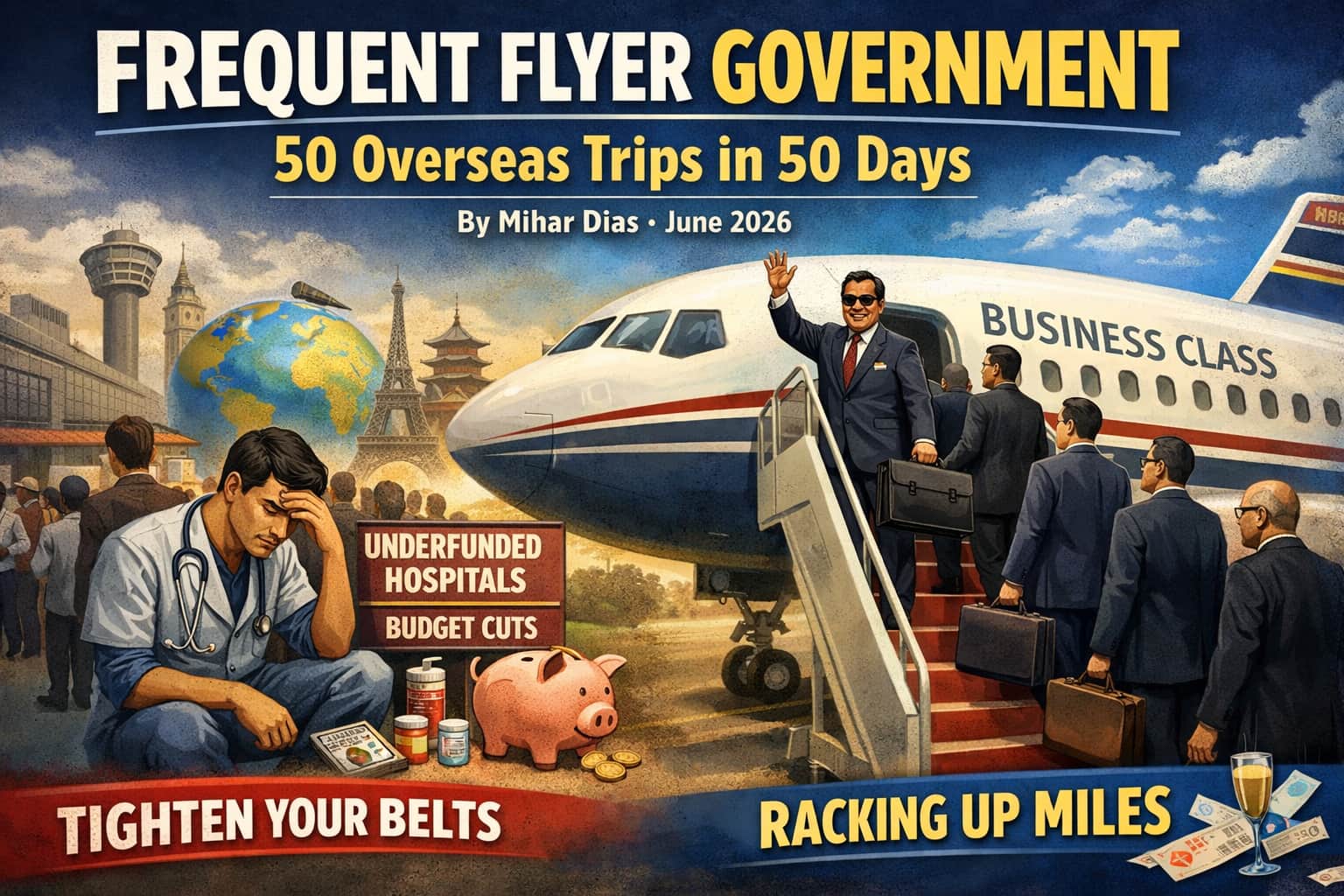
Frequent Flyer Government: 50 Overseas Trips in 50 Days
By Mihar Dias June 2026
Malaysians may have discovered the country's newest growth industry. It is not semiconductors, artificial intelligence, green technology or high-value manufacturing.
It is airport lounge diplomacy.
Fifty overseas trips in fifty days. One foreign excursion every single day. https://codeblue.galencentre.org/2026/06/ministers-officials-go-around-the-world-on-50-trips-in-50-days/
At a time when ministries are preaching austerity, hospitals are rationing overtime, specialists are fighting for training placements and ordinary Malaysians are counting ringgit before buying eggs, our governing class appears to have discovered that the shortest route to public service runs through the business-class check-in counter.
The government tells civil servants to tighten belts. https://codeblue.galencentre.org/2026/06/ministers-officials-go-around-the-world-on-50-trips-in-50-days/
The belts, apparently, are tightened only after take-off.
What makes the spectacle particularly damaging is not that foreign travel itself is wrong. Diplomacy matters. Trade missions matter. Defence cooperation matters. International negotiations matter.
But volume eventually becomes symbolism.
When citizens hear that ministries are freezing recruitment, reducing claims, limiting laboratory tests and struggling to fill specialist positions, they naturally ask a dangerous question: if money is so scarce, how is there always enough for another delegation to Geneva, another forum in Shanghai, another conference in Europe and another study visit abroad?
A government asking citizens to sacrifice cannot appear to be collecting airline points.
The contrast is brutal.
Doctors are told there is no money.
Young specialists find training opportunities shrinking.
Hospitals face manpower shortages.
Yet somewhere another delegation is discussing sustainability in Wellington, urban planning in Baku, climate policy in New Zealand, forestry in New York, defence exhibitions in Paris and field studies in Florence. https://codeblue.galencentre.org/2026/06/ministers-officials-go-around-the-world-on-50-trips-in-50-days/
One official explanation is that these trips are investments.
Perhaps they are.
But investments require returns.
How many jobs came from these visits? How much foreign investment was secured? What technology was transferred? What contracts were signed? What measurable benefits reached Malaysians?
The public rarely receives answers.
Instead, social media pages display smiling group photographs beneath conference banners. Delegates stand shoulder to shoulder in hotel ballrooms thousands of kilometres from home. Statements speak of "strengthening ties", "exploring opportunities", "enhancing cooperation" and “sharing experiences.”
Such phrases have become the bureaucratic equivalent of bubble wrap. They protect everyone while explaining nothing.
Particularly troubling are the so-called study tours.
Military college participants exploring Amsterdam's cultural attractions and Italy's historic sites may indeed gain valuable insights into Dutch and Italian civilisation. But Malaysians struggling with rising costs may reasonably ask whether Pisa and Florence are now essential components of national defence.
Perhaps the Leaning Tower has strategic value not yet disclosed to Parliament.
The problem is not merely the travel itself.
It is the absence of transparency.
The public does not know how much these trips cost.
The public does not know how many officials accompanied each delegation.
The public does not know whether business-class travel was used.
The public does not know whether five-star hotels were booked.
The public does not know whether private sponsors funded certain visits.
The public does not know whether alternative online participation was considered.
In an era where multinational corporations conduct billion-dollar negotiations through video conferencing, governments still often behave as though policy cannot be discussed unless accompanied by buffet breakfasts and conference tote bags.
Technology has advanced.
Official travel habits have not.
Some journeys are clearly necessary.
The Prime Minister attending ASEAN meetings cannot be questioned. Foreign ministers must engage internationally. Trade negotiations require physical presence. Defence cooperation occasionally demands face-to-face discussions.
But necessity is not contagious.
If one trip is justified, it does not automatically validate fifty.
Austerity is ultimately about moral authority.
Leaders cannot ask hospitals to cut spending while government delegations circle the globe. Ministers cannot preach sacrifice while airport immigration officers recognise them by first name. Departments cannot deny resources to frontline services while simultaneously expanding travel itineraries.
The optics are terrible because the reality appears worse.
Perhaps every single trip was justified.
Perhaps every delegation produced tangible benefits.
Perhaps every ringgit spent yielded ten ringgit in returns.
If so, publish the figures.
Show Malaysians the costs.
Show them the outcomes.
Show them the contracts signed, investments obtained, agreements reached and measurable returns generated.
Transparency transforms suspicion into trust.
Secrecy turns boarding passes into political liabilities.
The danger for the government is not merely accusations of extravagance. It is the growing perception that there are two economies.
One economy operates in overcrowded hospitals, understaffed clinics and households facing rising living costs.
The other operates in airport lounges.
One economy waits months for medical appointments.
The other waits for boarding announcements.
One economy hears there is no money.
The other keeps accumulating frequent flyer miles.
Governments often speak about being close to the people.
It is difficult to remain close to the people when you spend fifty days at thirty thousand feet.
At some point every administration must decide whether it wishes to govern from Putrajaya or transit through Doha, Istanbul, London, Paris and Tokyo.
Because while ministers travel the world representing Malaysia, someone must remain behind to explain to Malaysians why their own journeys have become increasingly difficult.
And increasingly unaffordable.
The public understands diplomacy.
What it struggles to understand is why austerity always flies economy while government so often appears to fly something considerably more comfortable.
Mihar Dias (mihardias@gmail.com) is a content creator under the Newswav Creator programme, where you get to express yourself, be a citizen journalist, and at the same time monetize your content & reach millions of users on Newswav. Log in to creator.newswav.com and become a Newswav Creator now!
The User Content (as defined on Newswav Terms of Use) above including the views expressed and media (pictures, videos, citations etc) were submitted & posted by the author. Newswav is solely an aggregation platform that hosts the User Content. If you have any questions about the content, copyright or other issues of the work, please contact creator@newswav.com.