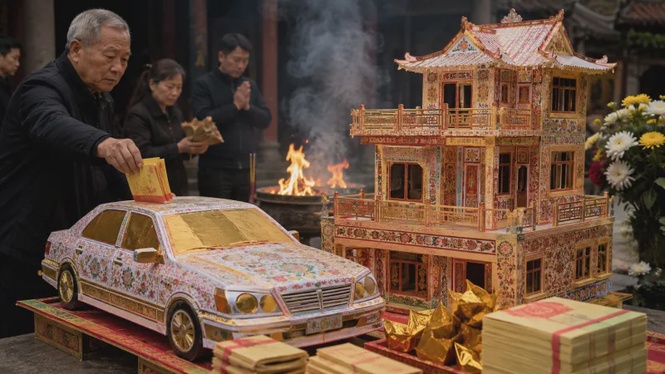
Walk into a Taiwanese funeral and you might see a paper house the size of a bicycle — complete with paper furniture, a paper garden, and paper servants. Beside it: a paper Mercedes-Benz, stacks of paper banknotes, and perhaps a paper smartphone. Within hours, all of it will be set on fire. And that, say Taiwan's cultural scholars, is exactly the point.
A Chinese Belief That Has Shaped Funerals for Two Millennia
The tradition runs back more than 2,000 years to one of Confucianism's most enduring ideas: that death does not end a family's duty of care. The Book of Rites (also known as Liji;禮記), a foundational text of ancient Chinese civilization, put it plainly — "Serve the dead as you serve the living; serve the departed as you serve the present."
This principle, known as shì sǐ rú shì shēng (事死如事生), held that the bond between the living and the dead remained intact — and that obligations of love and respect continued beyond the grave. Ancient Chinese nobles furnished their tombs with bronze vessels, silk garments, and terracotta armies, all intended to replicate earthly life in the world beyond. Over time, paper substitutes emerged as a practical alternative. The intention survived; only the materials changed.
Paper Houses, Paper Cash, Paper Cars: A Complete Afterlife Package
In modern Taiwan, paper offerings are engineered to cover every imaginable need. Paper houses provide shelter. Paper cars and sedan chairs offer transportation. Paper clothing, shoes, and accessories cover daily necessities. Bundles of paper "hell bank notes" — mock currency printed for use in the afterlife — ensure financial security. Some families go further, commissioning elaborate replicas of luxury watches, designer handbags, or even full-scale paper villas.
The logic is disarmingly simple: the deceased should want for nothing. For many families, preparing these offerings is also a deeply personal act — one last chance to say I still think of you, and I will make sure you are taken care of.
How a Chinese Tradition Put Down Deep Roots in Taiwan
Paper offerings arrived in Taiwan with Han Chinese immigrants centuries ago, woven into a society that placed ancestor veneration at the heart of family life. Funerals were not only occasions for grief — they were rituals of kinship, opportunities to show love for parents and grandparents even after their deaths.
What makes Taiwan's version distinctive is how fluidly it has absorbed the modern world. Where earlier generations burned paper farmhouses and horse-drawn carriages, today's craftspeople produce paper flat-screen TVs, paper laptops, and paper high-speed rail tickets. The catalogue of offerings mirrors whatever a family believes their loved one enjoyed or deserved in life. The tradition stays the same; only its contents keep updating.
Why Scholars Say It Is Philosophy, Not Superstition
To outside observers, burning paper goods at a funeral can look like magical thinking. Taiwan's cultural scholars push back firmly. Researchers including Lee Yih-yuan (李亦園), one of Taiwan's most respected anthropologists, and Lin Mei-jung (林美容), a leading scholar of Taiwanese folk religion, have argued that paper offerings belong to the same tradition as tomb-sweeping, ancestral altars, and memorial offerings — all forms of structured grief, not irrationality.
What these rituals share is a function: they give the living something concrete to do in the face of loss. Burning a paper house is a way of saying I did what I could for you. The smoke carries not property, but intention.
Overseas Chinese communities around the world still observe versions of this tradition, adapting it to new countries and new generations while keeping its core meaning intact. At its heart, paper burning is not about what the dead receive. It is about what the living cannot stop giving.
In Full
From Paper Houses to Paper iPhones: How Taiwan Cares for Its Dead