.jpg)
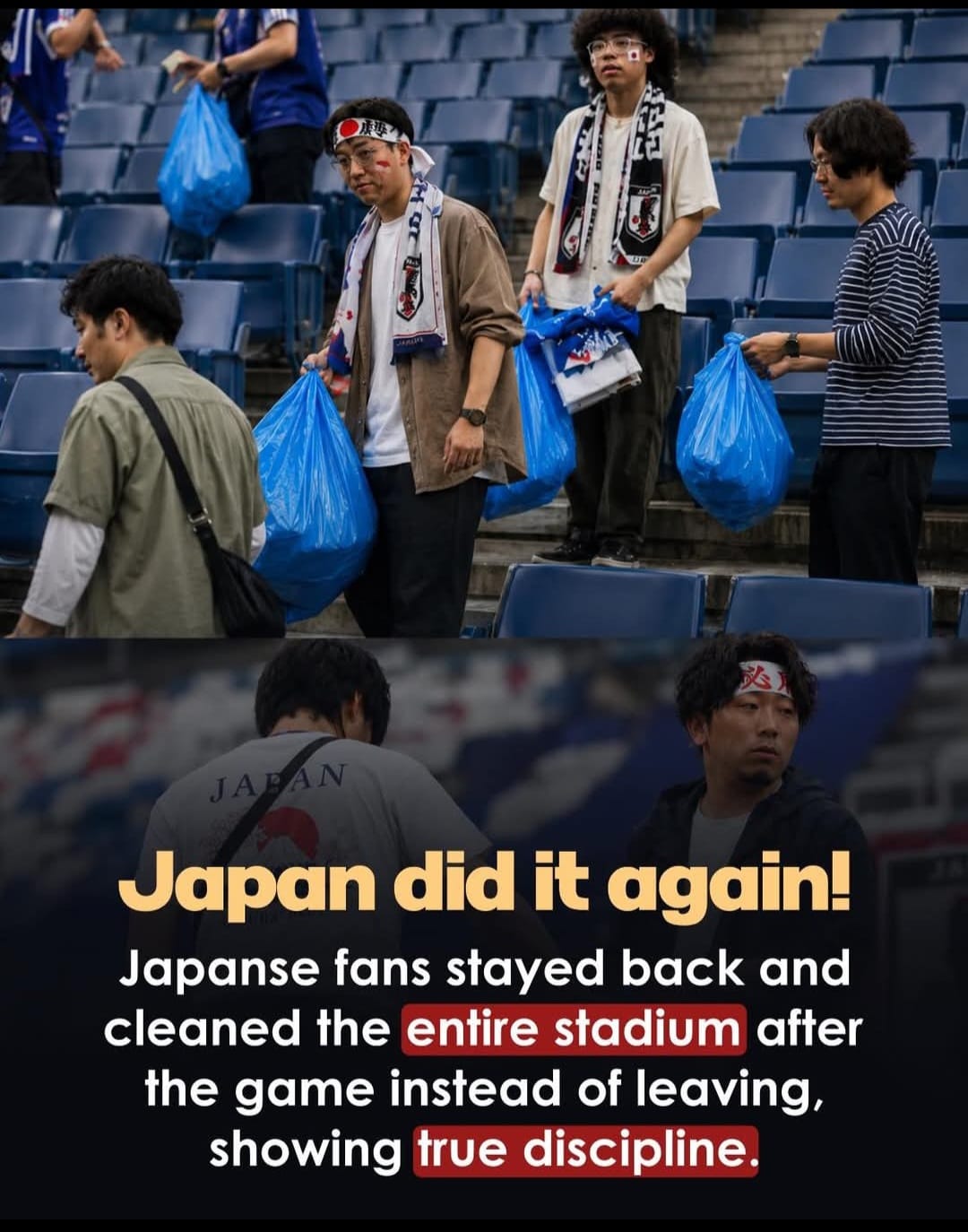
The Match After the Match: Japanese Fans Cleaned Up Stadium When the Game Ended
By Mihar Dias. June 2026
The football match ended in a 2-2 draw between Japan and the Netherlands at Dallas Stadium. The players exchanged jerseys, the commentators exchanged clichés, and the fans exchanged selfies.
Then something unusual happened.
The Japanese supporters stayed behind.
Not to argue with the referee. Not to complain about VAR. Not to post angry messages on social media about tactical substitutions.
They stayed to clean the stadium.
Armed with blue plastic bags that had moments earlier served as cheering props, they quietly collected rubbish from seats and walkways. https://www.facebook.com/share/p/1PYHL5G1zo/
No cameras were requested. No certificates were issued. No ministers arrived to launch the cleaning exercise. They simply did what they have done for decades.
For many of us, this behaviour is almost exotic.
In much of the world, a sporting event is considered complete only after spectators leave behind enough litter to convince archaeologists that a civilisation once flourished there. Empty cups, food wrappers, crushed drink cans and mysterious sticky substances become part of the post-match landscape.
The unwritten philosophy seems to be simple: “I bought the ticket, therefore somebody else can clean up.”
The Japanese approach operates on a radically different assumption.
They believe that public space belongs to everyone, which means responsibility belongs to everyone too.
Imagine introducing this concept locally.
A football stadium announces that supporters should clean their own section before leaving.
Half the crowd would assume it was a new tax.
The other half would immediately ask whether there was an allowance attached.
Some would demand a committee be formed to study the matter first.
Others would insist cleaning should only be carried out after a proper launching ceremony complete with bunting, speeches and a giant mock-up broom for photo opportunities.
Yet in Japan, this attitude begins in childhood through the tradition of souji, where students clean their own classrooms and shared spaces. The lesson is profound: cleanliness is not someone else's job.
It is your job too.
Perhaps that is why Japanese fans continue this practice whether their team wins, loses or draws.
Most supporters around the world see themselves as customers.
Japanese supporters behave more like custodians.
The distinction matters.
A customer asks, “What service am I entitled to?”
A custodian asks, “What can I contribute?”
That mindset explains why Japanese players often leave locker rooms spotless, complete with thank-you notes and folded origami cranes.
Meanwhile, elsewhere, some dressing rooms occasionally resemble locations where a minor natural disaster has just occurred.
The remarkable thing is that the Japanese fans do not view their behaviour as remarkable.
That is perhaps the greatest lesson of all.
True civic responsibility is not something you perform when television cameras are watching.
It is something you do automatically when nobody is looking.
The image of NFL star Jameis Winston joining Japanese supporters in cleaning the stands captured the world's imagination because it revealed a universal truth. Good habits are contagious.
People are inspired not by speeches but by examples.
Politicians frequently tell us about national transformation.
Consultants produce colourful slides explaining behavioural change.
Government departments launch campaigns complete with logos, slogans and hashtags.
Yet a few hundred football fans carrying rubbish bags may have delivered a more powerful lesson than all of them combined.
The final score in Dallas was 2-2.
But the real victory came after the whistle.
Long after the goals are forgotten and the highlights disappear into the archives, people will remember the sight of supporters cleaning up after themselves.
Because in an age when everyone demands rights, it is refreshing to encounter a culture that quietly remembers responsibilities.
Perhaps that is why the Japanese continue to win admiration even when they do not win the match.
Sometimes character is revealed not by how loudly you celebrate.
But by whether you pick up the empty cup before you leave.
This story is not really about football. It is about citizenship. The Japanese fans demonstrated that civilisation is measured less by what happens during the event than by what is left behind after everyone goes home.

Share your passion for football through #GilaBola and stand a chance to win cash prizes worth up to RM1,200!
Find out how to join here. Don't miss out! T&Cs apply.
Mihar Dias (mihardias@gmail.com) is a content creator under the Newswav Creator programme, where you get to express yourself, be a citizen journalist, and at the same time monetize your content & reach millions of users on Newswav. Log in to creator.newswav.com and become a Newswav Creator now!
The User Content (as defined on Newswav Terms of Use) above including the views expressed and media (pictures, videos, citations etc) were submitted & posted by the author. Newswav is solely an aggregation platform that hosts the User Content. If you have any questions about the content, copyright or other issues of the work, please contact creator@newswav.com.