
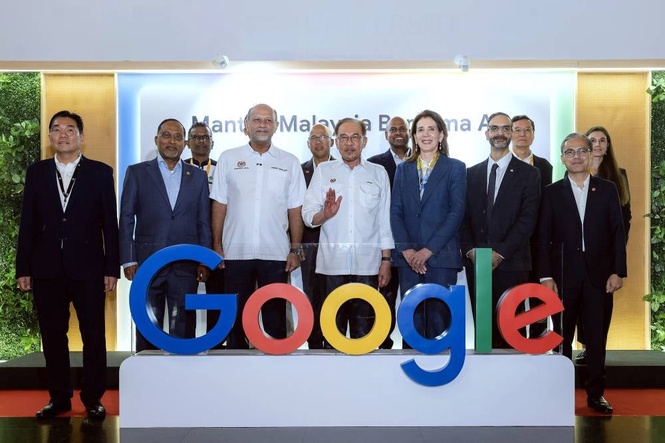
KUALA LUMPUR - Google will invest US$15 billion (approximately RM63 billion) in Malaysia over the next two years, from 2027 to 2028, with the project expected to support more than 37,000 local jobs annually during construction.
The investment would also strengthen Malaysia's artificial intelligence (AI) capabilities, expand clean energy capacity and improve water security.
Officiating the ceremony, Prime Minister Datuk Seri Anwar Ibrahim said the investment reflected international confidence in Malaysia's economic stability, talent and ambition to become a regional digital powerhouse.
"Foreign direct investment is indispensable to Malaysia's economic dynamism. Capital inflows of this magnitude provide essential fuel for macroeconomic expansion.
"They build cutting-edge physical assets, strengthen confidence among global markets and anchor our position at the forefront of global artificial intelligence," he said.
Anwar said the investment aligned with the government's Ekonomi Madani framework and New Industrial Master Plan 2030, particularly in strengthening local industries, developing human capital and ensuring responsible management of energy and natural resources.
He highlighted that Google's collaboration with more than 80 Malaysian entities across civil engineering, power systems, network infrastructure and logistics would create opportunities for local companies to strengthen their capabilities and compete globally.
The company expects the construction of its new data centre campuses between 2027 and 2028 to contribute an average of US$1.1 billion annually to Malaysia's gross domestic product (GDP).
Around 6,000 of the more than 37,000 jobs expected to be supported annually during the construction phase will be in the construction sector, with average annual labour income estimated at US$378 million.
Once operational, the facilities are projected to sustain more than 9,000 local jobs annually, with wages averaging 45 per cent above the national median.
The jobs will include specialist positions such as data centre technicians, mechanical and electrical engineers, logistics operations managers and physical security managers, alongside contractor opportunities with local suppliers.
Anwar also welcomed Google's commitment to upskill approximately 800,000 Malaysians between 2027 and 2031, saying the initiative would help ensure that the benefits of technological advancement reached different segments of society.
"We do not want an AI divide where only an elite few in boardrooms or technology laboratories thrive while the rest of the nation looks on as spectators," he said.
The four programmes would target educators and students, microentrepreneurs, civil servants and vocational jobseekers through AI literacy, digital skills training and specialised data centre courses.
They include Experience AI Malaysia, Jelajah AI MSME, Anjakan Kemahiran AI Demi Rakyat (Akad Rakyat) and Data Center Institutes, which will be established at selected polytechnics in Selangor and Negeri Sembilan from 2027.
The programmes would introduce AI literacy in classrooms, help microentrepreneurs use digital tools to expand their businesses, equip local council officers with AI skills to improve public services and provide technical training for TVET jobseekers seeking employment in data centre operations.
The Data Center Institutes would be established at selected polytechnics in Selangor and Negeri Sembilan from 2027, offering a 10-week training programme led by industry experts.
Google plans to bring more than one gigawatt (GW) of new clean energy capacity to Malaysia's National Grid, in collaboration with Tenaga Nasional Berhad (TNB), to support the country's growing electricity demand and energy transition.
The company also said it would pay for 100 per cent of the electricity consumed by its data centre campuses, as well as the direct infrastructure costs required to connect them to the grid.
In 2027, Google plans to introduce community-based initiatives to strengthen grid resilience and help safeguard electricity affordability, including programmes aimed at reducing household electricity bills in states hosting its infrastructure.
On water security, Google would expand its collaboration with the Global Environment Centre (GEC) to improve the quality of the Sungai Buloh and Sungai Selangor river basins through nature-based solutions, including constructed wetlands, riverbank bio-engineering and pollution monitoring.
The company would also work with Clean International, Water Watch Penang and Gravity Water to install rainwater harvesting systems and 20,000-litre storage tanks at four schools in Selangor.
The facilities are expected to provide each school with at least two weeks of emergency water capacity for up to 2,000 community members during unscheduled water supply disruptions.
Meanwhile, Google's president and chief investment officer Ruth Porat said the investment reflected the company's commitment to expanding its presence responsibly while delivering long-term benefits to Malaysia's economy and people.
"Google is committed to growing our presence responsibly, delivering lasting value for Malaysia's economy and people.
"This investment aligns with Malaysia's development priorities, providing the foundational computing capacity to deliver the upside of innovation across the country while adding local power and water resources as our operations scale," she said.
The investment builds on Google's more than 15-year presence in Malaysia and follows its US$2 billion investment announced in 2024.
Its first data centre campus at Elmina Business Park in Selangor is already operational, while additional campuses are planned in Selangor and Negeri Sembilan.
The campuses will be developed in industrial zones and designed to operate efficiently while supporting the growing demand for digital and AI services.


