Your Sdn Bhd’s financial statements are four main documents: the income statement (shows if you made money), the balance sheet (shows what you own and owe), the cash flow statement (shows where cash actually went), and the Directors’ Report (shows what the directors confirm about the year). If you can read these four, you can answer the only question that matters: is this business actually healthy, or is the cash just moving around without growing? This guide breaks down each document in plain terms, using real Ringgit examples, so you stop nodding along in meetings with your accountant and start spotting problems yourself.
Quick rundown
- The income statement tells you if you made a profit. The balance sheet tells you what your company owns versus owes. The cash flow statement tells you if that profit is actually sitting in your bank account.
- A profitable company can still run out of cash. These three statements answer different questions, which is why you need all three, not just one.
- Under the Companies Act 2016, Section 259, your financial statements generally need to be lodged with SSM within 30 days after they’re circulated to members, whether they’re audited or unaudited.
- Whether you need a full audit or can file Unaudited Financial Statements depends on revenue thresholds, not on how small you feel your business is.
- Directors sign a Statement by Directors and Statutory Declaration confirming the numbers are true. Read that part first, not last, because it tells you what the directors are personally vouching for.
What exactly are “financial statements” and why should a first-time founder care?
Financial statements are the official yearly report of what your Sdn Bhd earned, owns, owes, and spent cash on. Under the Companies Act 2016 and Malaysian Private Entities Reporting Standard (MPERS), a complete set generally includes the Directors’ Report, a Statement by Directors, a Statutory Declaration, statements of financial position, comprehensive income, changes in equity, and cash flows, plus an Independent Auditors’ Report if your company is audited. That sounds like a lot of paperwork. In practice, three documents do almost all the explaining: the income statement, the balance sheet, and the cash flow statement. The rest are supporting confirmations and disclosures.
Many first-time founders treat this bundle as something to sign and forget. That’s a mistake, because these documents are also what banks, investors, and potential buyers of your business will read first. If you can’t explain your own numbers in a meeting, it shows.
Understanding income statement: how do you know if you actually made money?
The income statement (also called a profit and loss statement) shows your revenue, costs, and the profit or loss left over, for a specific period, usually one financial year. It answers: did the business make money this year?
Here’s a simplified worked example for a small consulting Sdn Bhd:
- Revenue: RM400,000
- Cost of services (staff, subcontractors): RM180,000
- Gross profit: RM220,000
- Operating expenses (rent, salaries, software, marketing): RM150,000
- Net profit before tax: RM70,000
QUICK TAKE AWAY
Revenue minus direct costs gives gross profit. Gross profit minus operating expenses gives net profit. If net profit is positive, the business made money on paper for that year. Whether that money is sitting in the bank is a separate question, answered by the cash flow statement, not this one.
Balance sheet explained: what does your company actually own and owe?
The balance sheet is a snapshot, taken on one specific date, of what your company owns (assets), what it owes (liabilities), and what’s left for the shareholders (equity). Unlike the income statement, which covers a whole year, the balance sheet is a single freeze-frame.
The core equation never changes: Assets = Liabilities + Equity. Think of it like a household’s net worth statement. Your house and savings are assets, your mortgage is a liability, and what’s left over after subtracting the mortgage from the house value is your equity. A company works the same way, just with different line items.
| Category | Example line items | What it tells you |
| Assets | Cash, trade receivables, equipment, inventory | What the company controls and can use or sell |
| Liabilities | Trade payables, bank loans, tax owed | What the company must pay back, and when |
| Equity | Paid-up share capital, retained earnings | What belongs to the shareholders after liabilities are settled |
If liabilities are growing faster than assets year over year, that’s a signal worth asking your accountant about, even if the income statement still shows a profit.
Cash flow statement basics: why can a profitable company still run out of cash?
Building on the income statement above, the harder question is whether that profit ever turned into usable cash. The cash flow statement tracks actual money moving in and out, split into three activities: operating (day-to-day business), investing (buying or selling equipment, assets), and financing (loans, share capital, dividends).
Here’s the mechanism that trips up most first-time founders: the income statement counts revenue the moment you invoice a client, not the moment they pay you. So a company can show RM70,000 net profit on paper while its clients are sitting on unpaid invoices for months. Meanwhile, rent, salaries, and supplier payments still go out in cash every month. That gap between “profit recorded” and “cash received” is exactly what the cash flow statement exposes, and the income statement cannot.
QUICK TAKE AWAY
Profit is an accounting figure. Cash is what pays your staff and suppliers. A company can be profitable and still face a cash crunch if customers pay slowly. Check the cash flow statement, not just the bottom line of the income statement, before assuming you’re financially comfortable.
What do the Directors’ Report and Statement by Directors actually confirm?
A related but distinct part of the statements is the set of director confirmations that sit alongside the financial figures. Under Section 253 and the Fifth Schedule of the Companies Act 2016, the Directors’ Report must disclose the directors’ names, the company’s principal business activities, the net profit or loss for the year, any material transfers to reserves, share issuances during the year, and any benefits given to directors.
The Statement by Directors and the Statutory Declaration are shorter but carry real weight: the directors are personally confirming the financial statements give a true and fair view of the company’s position. If you’re a director, this is the part you should read carefully before signing, because you’re vouching for the whole document, not just the top-line profit figure.
Audited vs unaudited financial statements in Malaysia: which one applies to you?
This is where questions about audit thresholds usually come from. Under Companies Commission of Malaysia (SSM) practice, audit exemption thresholds apply based on revenue limits, provided the company stays under the applicable threshold across the current and prior two financial years. Companies that qualify can file Unaudited Financial Statements (UAFS) through Malaysian Business Reporting System (MBRS) instead of going through a full audit.
The practical difference in the document itself: Audited Financial Statements include an Independent Auditors’ Report. Unaudited Financial Statements skip that report but must include an Audit Exemption Certificate, signed by a director, confirming the company meets the exemption criteria.
| Audited Financial Statements | Unaudited Financial Statements (UAFS) | |
| Who reviews the numbers | An external auditor | No external auditor review required |
| Key extra document | Independent Auditors’ Report | Audit Exemption Certificate (director-signed) |
| Filing deadline | Generally 30 days after circulation to members | Generally 30 days after circulation to members |
One thing worth being clear about: qualifying for audit exemption doesn’t remove your other obligations. You still need proper accounting records, a qualified company secretary, and timely lodgement of your Annual Return and financial statements. You appoint your own auditor if a full audit is required, and file the audited or unaudited statements with SSM yourself or through your chosen company secretary service. Boss Boleh’s company secretary team supports the SSM-side filings, including Annual Return and financial statement submissions, while you keep the freedom to use your own external auditor or tax agent for the actual numbers.
How does e-invoicing fit into your financial statements?
Stepping back from the statements themselves, a separate but connected piece is e-invoicing, which Malaysia has been rolling out for businesses. E-invoicing standardises how your sales and purchase invoices are issued and recorded, which over time feeds more accurate, more consistent data into your revenue and expense figures.
Frequently Asked Questions
What’s the deadline for lodging financial statements with SSM?
Under Section 259 of the Companies Act 2016, a private company generally lodges its financial statements within 30 days after they are circulated to members, unless an extension is approved. This applies to both audited and unaudited statements.
What happens if financial statements are filed late?
Late lodgement can attract SSM’s schedule of penalties, ranging roughly from RM50 to RM200 per document depending on how late it is. Separately, under Section 259, the officer responsible for the default may face a fine of up to RM50,000 upon conviction, plus up to RM1,000 for each day the offence continues after conviction. These are two different consequences, not one combined bill.
Can a small company skip audit entirely?
A company that meets the audit exemption revenue criteria can file Unaudited Financial Statements instead of audited ones. This decides whether an audit is required, not whether financial statements need to be prepared and filed at all.
Do I still need a company secretary if my company is audit-exempt?
Yes. Audit exemption under Section 267(2) only concerns the audit requirement. Every Sdn Bhd still needs a qualified company secretary under Section 235, regardless of audit status.
What’s the single most useful statement to check monthly?
Most first-time founders get the most value from checking their cash flow statement monthly, since it catches cash shortages early, well before the annual income statement and balance sheet are even prepared.
Does a profitable business always have good cash flow?
Not necessarily. A business can report a net profit on its income statement while still facing cash shortages, usually because revenue is recorded before customers actually pay. Check both statements together.
ABOUT BOSS BOLEH
Boss Boleh is an online company secretary and compliance platform built for first-time entrepreneurs and founders trying to make sense of their first set of financial statements. Beyond company secretarial work, it also offers a one-stop compliance solution for entrepreneurs, including accounting, tax planning and tax filing services. We handle Annual Return and Beneficial Owner submissions to SSM, support both Unaudited and Audited Financial Statement filings, and let you keep your own external auditor or tax agent if you already have one. Our standard corporate resolutions are built into the subscription plans, with WhatsApp support available throughout, whether you’re in Kuala Lumpur, elsewhere in Malaysia, or running your business from overseas.
References
- Companies Act 2016 (Act 777), sections 235, 253, 259, 267(2)
You’re welcome to join our community group to get exclusive and latest trend of business insight!
Want to learn more about managing your business structure the right way?
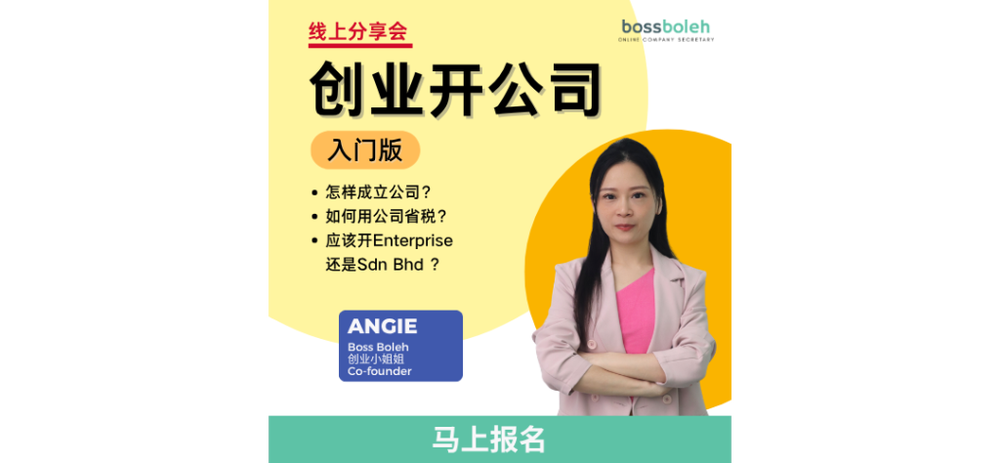
Join our FREE webinar! We’ll walk you through compliance essentials and how to convert from Enterprise to Sdn Bhd with confidence.
For more details, feel free to WhatsApp us!
WhatsApp: 018-7678055