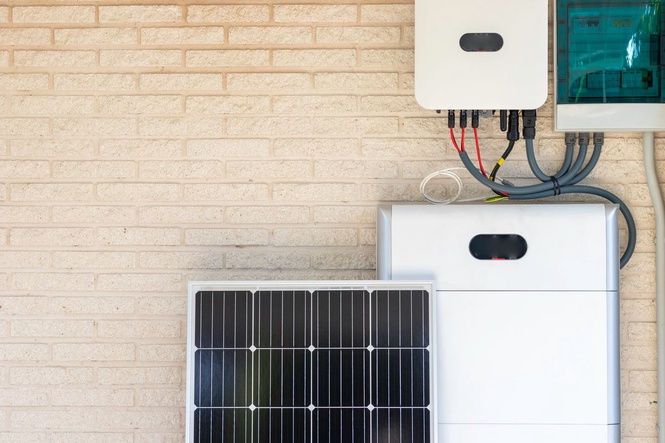
There's a socket in my house that I hope I'll never really need to use. It looks like any other plug socket, but there's one important difference: it's connected to my solar battery. If the power goes out, I can flip a switch and use the electricity stored in the battery to keep a few essential appliances running.
So far, I've only used it to charge my laptop. But in a prolonged blackout, could it keep my fridge freezer running? What about the wifi, lights or even the kettle? And how long would the battery last before running out of charge?
These are questions I've been thinking about since the government launched its new “Be Ready” campaign, which encourages households to prepare for emergencies, including power cuts.
The government’s advice includes keeping torches, power banks and other essential supplies on hand; it also highlights how some homes with solar panels and battery storage can continue accessing electricity when the grid goes down. But there's a catch: not every solar battery can do this, and even those that can may have their limitations.
As I discovered when I looked more closely at my own 9.5kWh GivEnergy system, having a battery doesn't necessarily mean you can carry on using electricity as normal when the lights go out.
Read more: Best solar panels, compared
What happens to a solar battery during a power cut?
You might think that if you've got solar panels on your roof and a battery full of electricity, a power cut wouldn't be much of a problem. Your panels could carry on generating electricity and your battery could take over when needed. Unfortunately, it doesn't usually work like that.
Most domestic solar panel systems are connected to the electricity grid, so when there's a power cut, they're designed to shut down automatically, even if the sun is shining. Just recently, for example, I had a fault in my consumer unit and my house was without electricity. Because the solar panels are connected to a circuit in the unit, I wasn't generating any electricity at this time.
And there's a good reason for this. If solar panels continued sending electricity into the grid while engineers were repairing a fault, it could put them in danger.
The same problem applies to batteries. Unless yours has been set up to provide emergency power, it won't necessarily keep your sockets and lights working when the grid goes down.
Some batteries, though, have what's called an emergency power supply (EPS), which allows them to provide electricity independently of the grid, usually through a dedicated socket or specially configured circuits.
There are three main ways that this can work. The first is having a separate socket installed that’s connected to the battery, which you can turn on and use during a power cut.
Another, more costly option is that you can enable certain parts of the house, such as your lighting or the sockets serving your fridge-freezer, to continue receiving electricity. Or, finally, with the right equipment, you can have battery-powered electricity to most or all of the house, although there are still limits on how much you can use. As you can imagine, this is the most expensive option.
My system uses the first option, which is probably the simplest.
How my solar battery works during a blackout
I have a 9.5kWh GivEnergy battery connected to an AC-coupled inverter. The inverter is the bit of equipment that converts the electricity stored in the battery into the type of electricity my household appliances can use. When the system was installed, I also had an electrician fit a dedicated backup socket inside the house. If there's a power cut, I can simply operate a switch on the battery system to activate the emergency supply, then plug an appliance into the socket.
The rest of the house would still be without electricity. My lights wouldn't suddenly come back on, and I couldn't use any of the normal sockets. But I would have somewhere to plug in a few essentials, such as lamps, a heater or even a fridge-freezer.
My inverter's specifications say it can provide up to 3,000VA of backup power, which is roughly equivalent to 3,000W for many common household appliances. That sounds like quite a lot, and potentially it is. But it doesn't mean I could connect everything at once. The actual limit also depends on the backup socket and how it's been installed. So what could I realistically run?
Read more: Best plug-in solar panels, reviewed
What appliances could my solar battery power during a blackout?
If the electricity went off for an extended period, my first concern would probably be the fridge-freezer. I'd also want to keep phones charged, have some lighting and, ideally, keep the wifi working, assuming the broadband network was still operating. The good news is that most of these use relatively little electricity.
A kettle or electric heater is another matter. These can draw several thousand watts while they're running, which could take my inverter close to its backup power limit.
To get an idea of what's possible, below are some typical estimates for the electricity different appliances consume.
Appliance | Estimated power consumption |
Wifi router | 10W |
LED lamp | 10W |
Laptop | 50W |
Fridge-freezer | 150-300W average |
Television | 100W |
Kettle | 2,000–3,000W |
These aren't measurements from my own appliances. They're illustrative figures from the Centre for Sustainable Energy, and the actual amount of electricity used will vary depending on the brand and model and how it's being used.
A fridge-freezer, for example, doesn't run continuously; its compressor switches on and off to maintain the temperature, so its average electricity consumption is much lower than its power draw when the compressor is running.
There are also two different limits to consider. The first is how much electricity the battery can store, measured in kilowatt-hours (kWh). Mine has a nominal capacity of 9.5kWh. The second is how much power the inverter can deliver at any given moment, measured in kilowatts (kW). In other words, even with a full battery, I couldn't necessarily run several high-powered appliances all at the same time.
I'd also need to think about the practicalities of connecting everything to one socket, using suitably rated extension leads without overloading them.
How long would my solar battery last in a blackout?
This is the question I was most curious about. After all, having a backup power supply is only so useful if it runs out after a couple of hours. The answer depends on how much electricity is stored in the battery when the power goes off and what you're using it for.
My battery can store a nominal 9.5kWh, but I can't assume all of that would be available to power appliances. Some electricity is lost when the inverter converts it, and the battery system itself uses energy to operate.
I've also never tested it through a prolonged blackout, so the following figures are estimates rather than measured running times.
To get a rough idea of how long my battery might last, I've made a few assumptions. If it were 80 per cent charged when the power went off, and I allowed 15 per cent of that stored energy for losses and unavailable capacity (meaning 85 per cent of that stored energy is available to use), I'd have approximately 6.5kWh to work with.
Using that figure, I've calculated the theoretical running times below. These aren't guaranteed predictions of how my battery would perform in a real blackout, and the actual times could be considerably shorter. But they should give you an illustrative idea of what you might expect.
Total power consumption | Estimated running time |
100W | Around 65 hours |
200W | Around 32 hours |
500W | Around 13 hours |
1,000W | Around 6.5 hours |
As I said, the 85 per cent assumption isn't a verified efficiency figure for my system, and things such as inverter standby consumption and minimum battery charge levels could shorten the actual running time, especially over longer periods. Still, it's encouraging. If I were careful about what I plugged in, the battery might be able to keep a few essential appliances working for a substantial period. Of course, there's a fairly obvious catch: if the battery were nearly empty when the power cut happened, it would be much less useful.
Will my solar panels keep charging the battery during a blackout?
You might think that with solar panels on the roof, I could simply recharge the battery when the sun came out and keep going indefinitely. Unfortunately, that's not the case.
As we've seen, most grid-connected solar systems shut down during a power cut. And that means the panels aren't automatically able to top up the battery, even if it's a bright, sunny day.
Some newer battery systems can operate independently of the grid and allow solar panels to continue generating electricity during an outage. With the right equipment, they can potentially power appliances during the day and recharge the battery at the same time.
My system, though, is different. I have an AC-coupled GivEnergy inverter, and the standard emergency power supply arrangement for this type of inverter doesn't allow the solar panels to recharge the battery during a blackout. So, unless my installation has additional equipment that changes this, I'd be relying on whatever electricity was already stored when the power went off.
It's something worth checking with your installer, particularly if you're thinking about buying a battery to provide emergency power.
Can a solar battery power your whole house during a blackout?
A solar battery can power your whole house during a blackout, but only if it's been set up to do so. Some home battery systems have equipment that can automatically disconnect the house from the grid when the power fails and switch it over to battery power. Others are designed to keep only certain circuits working, such as lighting, refrigeration and a few sockets.
My setup is more basic. I have one dedicated socket, rather than a system that keeps the entire house running. But even if you've got whole-home backup, you can't necessarily carry on as though nothing has happened. A system with a 5kW backup output, for instance, could struggle if you tried to run an electric shower, oven and kettle simultaneously. And the more electricity you're using, the faster the battery will run down. In a prolonged power cut, I'd be much more interested in keeping the essentials going than trying to power everything in the house.
How do I know if my solar battery will work during a power cut?
The easiest place to start is with your installation paperwork or the manufacturer's specifications. Look for terms such as emergency power supply, EPS, backup output or island mode.
If you're not sure what your system can do, it's worth asking your installer a few questions:
- Does my battery have emergency backup capability?
- Will it switch on automatically, or do I need to do something?
- Which sockets or circuits will work during a power cut?
- How much power can I use at once?
- Can my solar panels recharge the battery while the grid is down?
- Can I reserve some battery capacity in case of an emergency?
It's much better to understand how everything works now than trying to figure it out by torchlight. And if your system needs any changes to provide backup power, these should be carried out by a suitably qualified electrician.
Should I keep some battery charge in reserve for blackouts?
This is something I'm now reconsidering. I bought my battery primarily to save money on electricity. During the day, it stores any surplus electricity I generate, which I can then use in the evening instead of having to buy it from the grid.
Naturally, that means the battery isn't always full. Depending on the weather and how much electricity we're using, there are times when it could be nearly empty. This is fine when the grid is working normally, but it wouldn't be ideal if a power cut happened at that moment.
Some battery systems allow you to keep a percentage of the stored electricity in reserve, rather than using it all during normal household operation. The trade-off, though, is that any electricity you save for emergencies is electricity you likely have to buy from the grid for everyday use. Over time, this could make your savings smaller. Whether that's worthwhile probably depends on how concerned you are about power cuts and how often they happen where you live. For me, it's certainly something to think about.
The verdict: Is a solar battery worth having for blackouts?
The government's Be Ready campaign recommends preparing for power cuts by keeping essentials such as torches, charged power banks, a battery-powered radio, drinking water and food that doesn't need cooking. It also highlights that some solar and battery systems can continue supplying electricity when the grid goes down, provided they've been designed to work independently of it. Having a battery is no substitute for those basic preparations. But it could make a prolonged power cut considerably easier to manage.
When I had mine installed, my main aim was to reduce my electricity bills, and the backup socket was a useful extra that I hoped I'd rarely have to use. And thankfully, that remains the case. But looking at what the battery could potentially power has made me appreciate that socket even more than I did before.
The biggest lesson is that simply having a solar battery doesn't guarantee you'll have electricity in a blackout. You need the right backup equipment, a certain type of installation, enough charge in the battery and a realistic idea of what you can run from it. And that's something I'd rather know before the lights go out.
Interested in installing solar panels in your home?
Read MoreAre solar panels worth installing in the UK?
Best solar panels for UK homes 2026: Compared by an expert
Solar panel grants and UK funding 2026, explained
Solar panel grants UK: What’s available, who qualifies and how to apply
Households could get access to free or cheap loans to install solar panels
Gas boiler vs heat pump: Which saves more money, according to an energy expert
How much solar panels cost in the UK, according to an expert