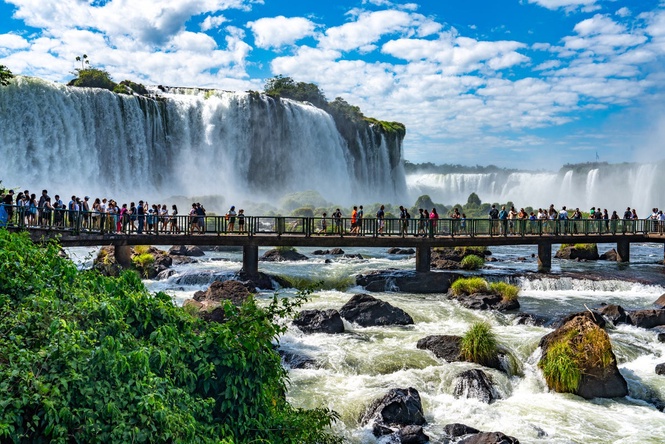
Argentina has temporarily closed tourist access to Iguazu Falls following heavy rainfall linked to the El Nino climate pattern.
On Monday, Iguazu National Park officials restricted access to the falls after the river's flow exceeded 12,000 cubic metres per second – more than six times its average rate of approximately 1,500 to 1,800 cubic metres per second.
“Temporary restrictions are being imposed on the movement of people and access to public-use areas,” Iguazu National Park said in a statement to the Buenos Aires Times on Monday.
José María Hervás, the park director, called the closure a “precautionary measure” because “it just keeps raining”, with the volume of water being released from dams upstream on the Iguazu River not falling, added the Argentinian newspaper.
The Iguazu Falls is the largest waterfall system in the world and sits on the border between Argentina and Brazil.
Tourist access to the falls is expected to reopen on Tuesday following a “gradual decline” in the river’s flow, said The Guardian.
The park was previously closed on the Argentinian side in 2023 and 2024 after flooding caused by another El Nino episode.
El Nino is a climate phenomenon that originates in the equatorial Pacific Ocean and alters rainfall patterns in different regions of the world.
In September, the national park warned that El Nino increases the risk of wetter and more changeable conditions across parts of southern South America, adding “it does not mean Iguazu Falls will remain flooded or closed throughout 2026–2027”.
It said: “For travellers, the practical response is flexibility: monitor official park notices, allow backup time and treat boat tours and exposed walkways as weather-dependent.”
The Argentine Devil’s Throat Circuit has been temporarily closed since 3 August, 2026, while the rest of the Argentine park remains open for visitors.
In August, Argentina's National Meteorological Service (SMN) said: “In Argentina, during its warm phase—known as El Niño—the probability of above-normal rainfall increases along the coast, with more frequent episodes of intense rain.
“In this context, it is especially important to strengthen the capacity to anticipate high-impact weather events: severe storms, hail, strong gusts of wind, and significant rainfall accumulations in just a few hours.”
Read more: El Nino is now hottest ever recorded and still growing in strength, announces Japan
10 best places to see the northern lights in the UK
What will El Nino mean for travel?
Tourists warned as Spanish hotspot issues new rules for popular beach and pools
Can I take my power bank on a flight after ban by several airlines?
Passengers panic in mid-air as power bank catches fire during flight
Woman who jumped from cruise ship rescued after 20 hours at sea near Greek island