I can’t say I’ve ever wanted to fold my phone in half. OK, maybe once or twice, in response to a particularly frustrating notification – but not habitually, every time I use it.
And that had always been my response to the folding phones that have been released by various companies in recent years, and now by Apple, in the form of the newly released iPhone Duo. In short: why?
Sure, the technology required to make the phones is incredibly impressive. The first time you see a screen bend in the middle so that it can fold over, it can feel like you’ve met a wizard, or taken psychedelics, as your basic assumptions about physics and technology are warped.
But the technology didn’t seem to match up with the experience. In practice, those foldable phones just seemed to be two phones stuck together, one twice as big as the other, leaving you with a compromised version of both and a constant fear that it might crease or break or fall apart.
And then you actually fold the iPhone, as I just did after Apple’s launch event in California. And all of a sudden it feels like it makes sense.
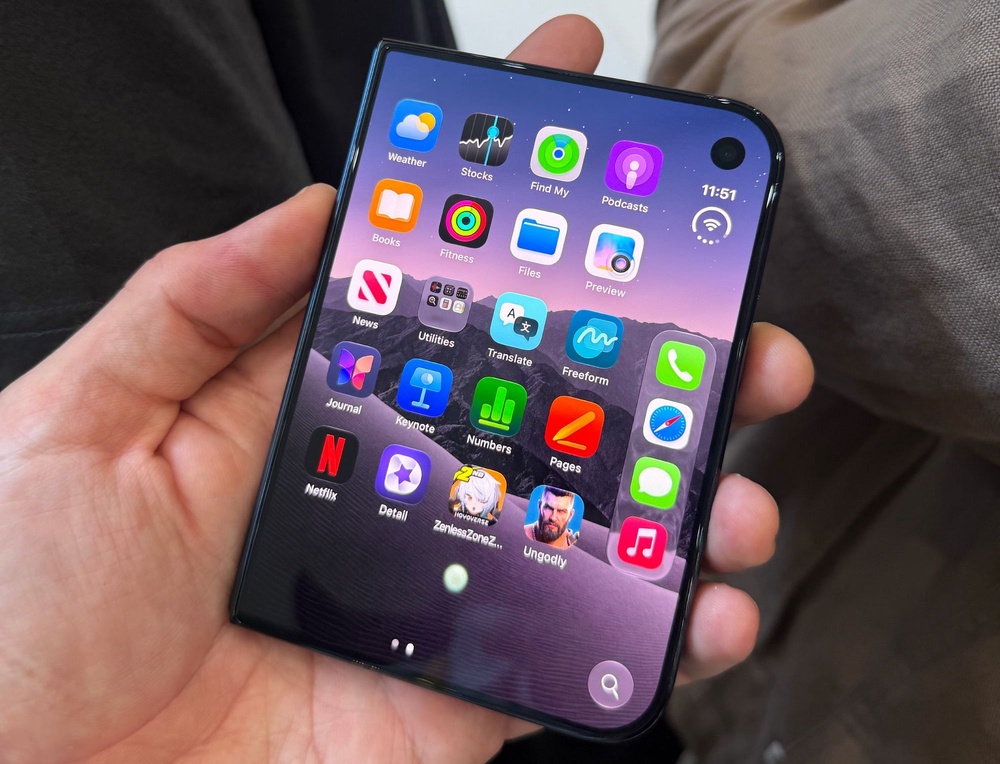
First, it is just so satisfying to open and close. In its introduction, Apple made much of the complex engineering challenge of making a hinge that that is both robust and effortless to open and close; in practice, this means that you can simply sweep the phone closed, until its two sides meet and are magnetically drawn together with a rewarding thunk.
Maybe that seems superficial, and no doubt the novelty of the fidgety joy in opening and closing it will fade. But the feeling underpinning that experience is a substantial one: opening and closing the device can be done thoughtlessly and without worrying, bringing none of the feeling in some other devices that every close could be the last and the hinge could fall apart.
Similarly, when it is on a screen or seen from afar, the new design of the closed iPhone Duo can look a little odd: why is it shaped like a big D, making it asymmetrical and like any iPhone before it? In use, you forget about that very quickly, because the software wraps around those two corners and they fade away.
And, in much the same way, from a distance the display on the inside looks a little darker than a normal iPhone screen; it isn’t, it’s a matte finish that keeps reflections down. In general, the iPhone Duo is something you really have to feel for yourself – which is good, given that it feels so nice.
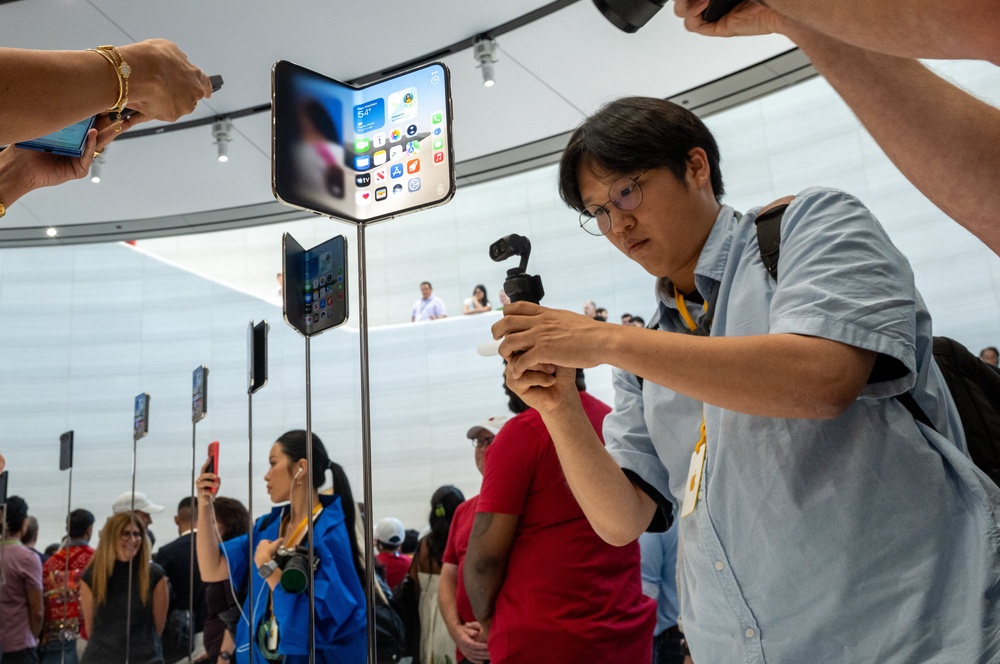
Once the device is actually open, the unfolded screen is beautiful. There’s no visible crease at all: if you didn’t know it could fold, you would never guess the iPhone Duo wasn’t just a new iPad Mini.
The software experience is similarly without creases or seams. As it introduced the phone, Apple made the actual process of using the big screen look a little complicated, presumably because it wanted to show off the various features it enabled; in reality, however, you don’t need to think about it at all.
When you see someone using the iPhone Duo, for instance, the central feature of using two apps side-by-side can seem a little convoluted, requiring all kinds of precise flicking and organisation. But when your fingers are actually on the screen, and you’ve done that a couple of times, it becomes second nature within seconds.
Apps make great use of the bigger display, too, even when they are on their own. Many apps have already been redesigned to take advantage of the extra screen space, and you forget that they were ever otherwise.
That software experience even extends to the process of opening and closing the phone. Apple has done an astonishing job in ensuring that the phone knows it is opening, and mirrors the content on the little screen onto the big one, so that you almost forget they’re not actually the same thing.
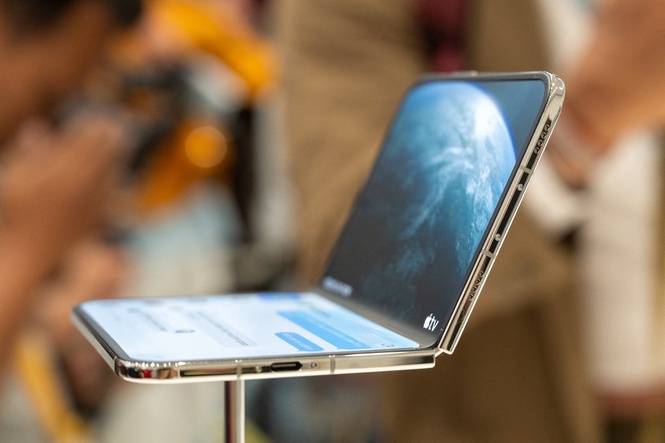
And there are plenty of surprising things that happen between open and closed, too. You can for instance stand the phone up like a little tent, so that its outside display is facing towards you, or bend it over like a tiny laptop; the phone senses and adapts to both so that you don’t need to think about it very much.
Overall, the whole hardware and software experience is so deeply integrated that the folding nature of the phone stops feeling strange very quickly. Within a few minutes of using it, it just felt sort of inevitable, and like I wanted one.
There is of course a bigger question hovering over the iPhone Duo, the same one as before: why? Not so much why would you make a folding phone as why would you buy one – do you really need all that extra screen, and the ability to use two apps at once, and everything else, especially when it will cost you at least $1,999, or the same in pounds?
That’s hard to know from a few minutes of use in the entirely unnatural surroundings of Apple’s demo area. The second, third and fourth impressions are more important than the first ones, especially of something that costs so much.
But those first impressions are very impressive indeed. I still don’t know why I would want to fold my iPhone – but I know now that I very much do want to fold it.
Apple is about to bring a huge change to your iPhone
Apple event – live: iPhone Duo unveiled as firm’s first foldable phone
Here’s Apple’s most dramatic iPhone redesign ever
Apple launches new Watch that will listen to your life
Here’s the brand new iPhone 18 Pro
From releasing pathogens to nuclear weapons: How AI could end humanity in five years