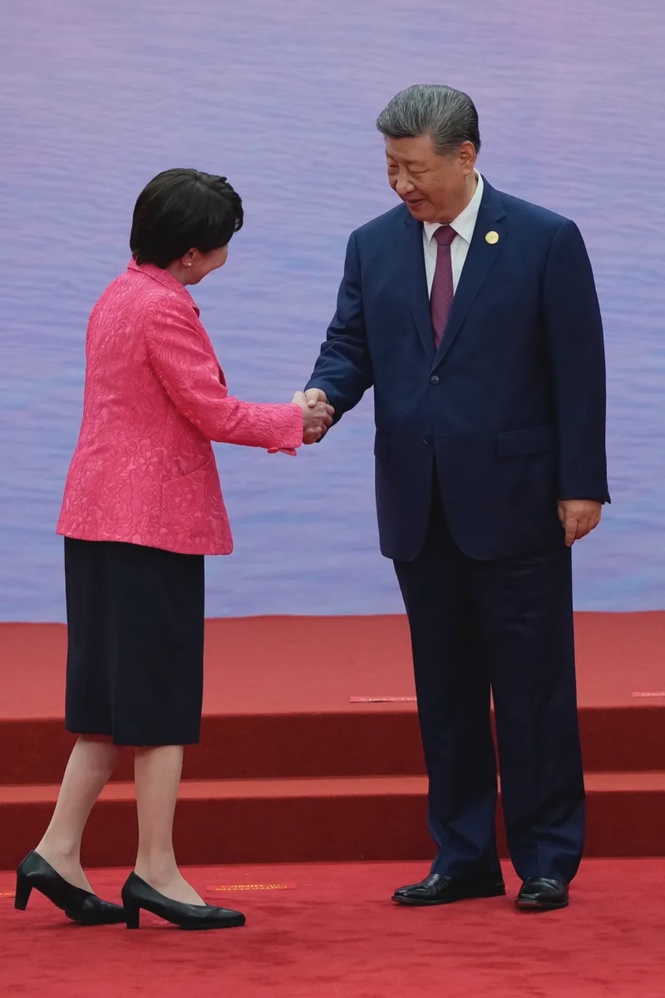
Japanese Prime Minister Sanae Takaichi shook hands with Chinese President Xi Jinping at the Asia-Pacific Economic Cooperation (APEC) welcome banquet in Shenzhen on the evening of November 18, their first face-to-face encounter since her remarks on Taiwan plunged relations into a freeze that has lasted more than a year.
Tokyo had scripted the moment in advance. Yet everything around the handshake, from a low-key welcome at the airport to Beijing's unchanged demands and Japan's anxious watch over a summit of the US, Chinese and Russian leaders, showed how far Asia's two largest economies remain from a real thaw.
Tokyo Scripted Takaichi's First Words To Xi
Xi, this year's APEC host, greeted each leader in person before the dinner, which US President Donald Trump and Russian President Vladimir Putin also attended. When her turn came, Takaichi spoke first. She said a few words after the handshake, and Xi answered only with a smile, the South China Morning Post reported.
Her team had left little to chance. People close to Takaichi told Japanese broadcaster FNN that the Japanese side had decided beforehand what expression she would wear and how she would open her greeting. After the handshake, a Japanese government official said, "For a start, it is a good thing."
The two leaders shook hands again on November 19 before the summit's main session, this time for about 10 seconds. Takaichi spoke to Xi, who appeared to listen in silence, Kyodo News reported. Takaichi later said she had thanked Xi for the invitation and congratulated him on hosting APEC. There was no one-on-one meeting.
A Retired Diplomat Met Her On The Tarmac
The smiles at the banquet stood in contrast to Takaichi's arrival earlier that day. She was received at Shenzhen Bao'an International Airport by protocol staff from China's foreign ministry, a lower level of reception than other major leaders were given. Her greeter was Zhang Qiyue, a retired former Chinese ambassador to Greece, while most leaders were met by serving ministerial-level officials from Guangdong province, The Standard reported. Xi personally welcomed Trump at the airport.
According to Japanese media, a Japanese foreign ministry official complained that the reception was "rude," and others on the Japanese side called it "the reality of Japan-China relations right now."
In public, Tokyo played it down. Chief Cabinet Secretary Minoru Kihara said Xi had greeted Takaichi at the dinner and shaken her hand, which amounted to "the customary hospitality of the host, as in past years." Asked about the modest airport ceremony, he said Japan was "in no position to comment on another country's protocol," according to Kyodo.
Beijing Still Demands Tokyo Correct Its Taiwan Stance
The mood was very different when Takaichi and Xi first met, on the sidelines of the APEC summit in Gyeongju, South Korea, in October 2025. Xi said at the time that the two countries should be partners, not threats to each other.
Days later, on November 7, 2025, Takaichi told Japan's parliament that a Taiwan contingency could amount to a "survival-threatening situation," the legal trigger that allows Japan to exercise collective self-defense. Beijing saw the remark as interference in its internal affairs and demanded a retraction, then advised its citizens against travel to Japan and tightened export controls on critical minerals, Kyodo News noted. China claims Taiwan as its own territory, a claim Taipei rejects.
China's foreign ministry has kept up the pressure since. In December 2025, it called on Japan to reflect on and correct its mistakes. In March this year, it urged Tokyo to stop going further down the wrong path.
Takaichi has not retracted her remarks. Asked in Shenzhen whether Japan would intervene in a Taiwan conflict, she declined to answer a hypothetical question and said there had been "no change whatsoever" to the position Japan set out in 1972, Reuters reported. In the 1972 Japan-China Joint Communique, Tokyo said it "fully understands and respects" Beijing's position on Taiwan.
Japan Feared Being Sidelined By Trump, Xi And Putin
The Shenzhen trip was the first visit to China by a Japanese prime minister since Shinzo Abe went in 2019. Tokyo hoped APEC would open a path back to high-level dialogue with Beijing, while keeping a close eye on contacts among the US, Chinese and Russian leaders.
Japanese officials worried that the three powers might bargain over the international order and spheres of influence over the heads of other countries. Trump, Xi and Putin held their first-ever trilateral meeting at Shenzhen's Kylin Villa on November 19, discussing nuclear arms control and the war in Ukraine, but the talks produced no major breakthroughs, ITV News reported.
Before flying to China, Takaichi attended the Quad leaders' meeting of Japan, the US, Australia and India in the Philippines and spoke briefly with Trump in Manila. Tokyo also arranged in advance for a phone call once the three-way summit ended, Jiji Press reported.
That call took place on the night of November 19 and lasted about 20 minutes, with Trump on the line from Air Force One, according to Reuters. Takaichi said Trump gave her a detailed account of his talks with Xi and Putin but did not disclose specifics. "We will lift the relationship between Japan and the US, now the allies that trust each other most, to even greater heights," she told reporters.
You've read it. Now join the conversation — follow us on X, Facebook and IG. Editor: Penny Wang