.png)
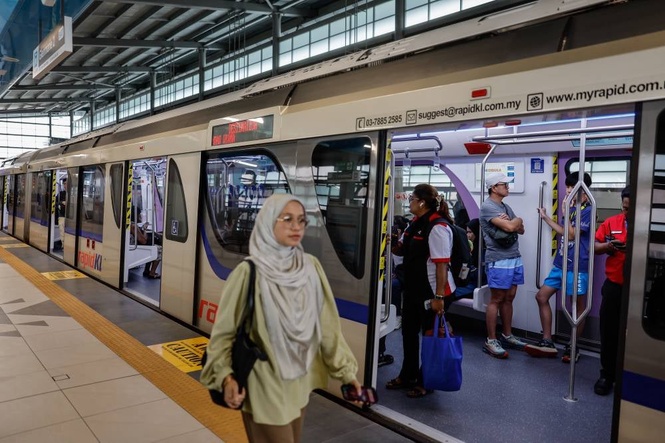
SHAH ALAM - The operation of the Light Rail Transit 3 (LRT3) Shah Alam Line has delivered significant benefits to students of Universiti Teknologi MARA (UiTM) Shah Alam by improving daily mobility and helping reduce traffic congestion around the campus area.
Higher Education Minister Datuk Seri Dr Zambry Abd Kadir said the availability of the UiTM Shah Alam Station is expected to ease travel for students while lowering transportation costs for movement across the Klang Valley.
"I saw how excited many students were, and this certainly provides relief to those who face traffic congestion when travelling to campus every day, especially as this area continues to develop rapidly,” he said.
He was speaking after launching the Semiconductor@UiTM initiative at the Tuanku Abdul Halim Mu’adzam Shah Engineering Complex, UiTM Shah Alam. Also present was UiTM vice-chancellor Professor Datuk Dr Shahrin Sahib@Sahubuddin.
Prime Minister Datuk Seri Anwar Ibrahim, when launching the LRT3 Shah Alam Line last Sunday, announced free fares for all passengers using the service from June 29 until July 31.
The Shah Alam Line comprises 20 stations: Bandar Utama, Kayu Ara, BU11 (Bandar Utama 11), Damansara Idaman, Subang, Glenmarie 2, Kerjaya, Stadium Shah Alam, Dato’ Menteri, UiTM Shah Alam, Section 7 Shah Alam, Bandar Baru Klang, Pasar Klang, Jalan Meru, Jambatan Kota, Taman Selatan, Seri Andalas, Klang Jaya, Bandar Bukit Tinggi and Johan Setia.
Meanwhile, Zambry said UiTM is also stepping up efforts to strengthen Malaysia’s position as a global semiconductor hub through the launch of the strategic Semiconductor@UiTM initiative.
He described the initiative as evidence of the university’s commitment to translating government allocations into the development of a highly skilled talent ecosystem aligned with international industry standards.
"UiTM has demonstrated strong capability and commitment in utilising the RM20 million government allocation to build infrastructure, expertise and a learning ecosystem that meets the demands of the country’s semiconductor industry.
"This investment is a major step in translating government policy into human capital development with a high impact on the national economy,” he said.
Zambry noted that the initiative aligns with the aspirations of the National Semiconductor Strategy (NSS), aimed at ensuring Malaysia continues to produce competent technical talent to meet future industry demand.
With upgraded facilities and an industry-aligned curriculum, he said UiTM is now positioned to become a leading centre for producing globally competitive graduates in Electrical and Electronics Engineering (E&E).
Beyond technical training, the initiative also emphasises cross-learning between academia and industry to provide students with practical exposure to current technologies and direct engagement with key players in the global semiconductor supply chain.
He added that Malaysia’s semiconductor industry currently contributes 13 per cent of the global market and generates more than RM300 billion annually for the country.
According to Zambry, UiTM’s achievement is expected to serve as a benchmark for other universities in supporting the growth of Malaysia’s high-technology sector and ensuring long-term economic sustainability.
Earlier, Zambry led a Ministry of Higher Education delegation on a ride aboard the LRT3 from Stadium Shah Alam Station to UiTM Shah Alam Station before officiating the Semiconductor@UiTM initiative. - BERNAMA