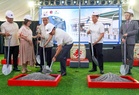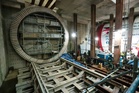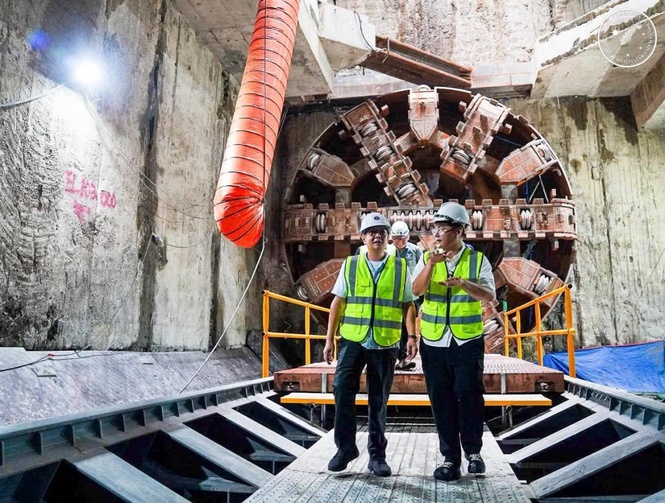
MANILA, Philippines — President Ferdinand Marcos Jr. and Transportation Secretary Giovanni Lopez inspected on Wednesday the breakthrough of the Metro Manila Subway Project’s (MMSP) tunnel boring machine (TBM), marking the completion of the southbound tunnel connecting the North Avenue and Quezon Avenue Stations.
Lopez said the President had directed the Department of Transportation (DOTr) to expedite the construction of large-scale railway projects.
Once the MMSP becomes operational, residents and commuters using the Quezon Avenue Station will benefit from the project, as the rail line will complement the Metro Railway Transit (MRT)-3, Lopez quoted the President as saying.
“We are here at Quezon Avenue because the tunnel boring machine has already broken through and emerged. That is why we are here—to celebrate the breakthrough of the tunnel boring machine,” the Chief Executive said.
“We were a little out of breath because we climbed 35 meters. You can see that our Subway Project is gradually taking shape. Once this is completed, those living here will be very fortunate, because they will have the subway, they will have the MRT, and they will have many routes available to them,” he added.
Lopez said the President described what they witnessed as part of a “very important day today because we are commemorating the breakthrough of the tunnel boring machine here in Quezon Avenue.”
Marcos and Lopez personally inspected the tunnel boring machine breakthrough, going 35 meters below ground level to see firsthand the progress of the project.
The DOTr chief, meanwhile, stressed that the railway projects will help ease traffic in the metropolis and adjacent provinces by encouraging vehicle owners to use public transport instead.
“You know, all of us have been victims—or continue to be victims—of traffic, especially here in Metro Manila or at least Greater Manila. The DOTr still believes that one real solution to resolving traffic, especially severe traffic, is what we call the mass public transportation system, and the best mass public transportation system is our railways,” Lopez said.
Once the subway becomes operational, along with the existing rail line and the North-South Commuter Railway (NSCR), the top DOTr official said that there would no longer waste time in traffic and “in some measure, the quality of life of every Filipino will improve.”
The MMSP’s Contract Package 102 (CP102) comprises the Quezon Avenue and East Avenue Stations, including the tunnels connecting North Avenue Station to Quezon Avenue Station and Quezon Avenue Station to East Avenue Station, according to the transportation agency.
Moreover, it said that once the entire underground rail line is fully operational, travel time from Valenzuela City to Ninoy Aquino International Airport Terminal 3 is expected to be reduced by around 41 minutes from the current one hour and 30 minutes.
In addition, some trains will travel from Valenzuela all the way to Calamba via the NSCR, it added.
Financed by the Japan International Cooperation Agency (JICA), the 33-kilometer, 17-station MMSP was projected to serve around 519,000 passengers daily in its opening year, with a design capacity able to accommodate over 1 million passengers without increasing the number of train sets.
The President and Lopez were joined by JICA Chief Representative Takashi Baba, Japan Chargé d’Affaires ad interim Ono Sho, and Nishimatsu-DMCI Joint Venture Project Director Osamu Iwata.