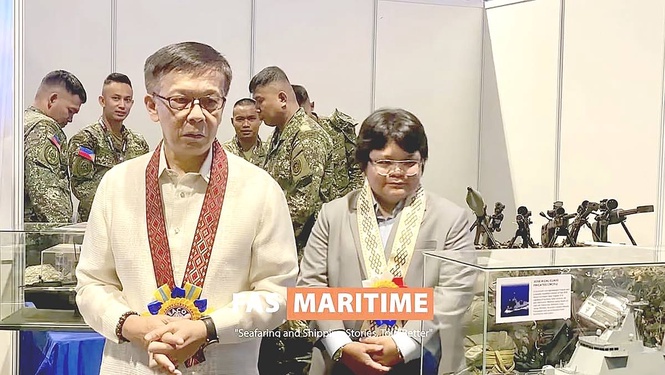
THE country’s leading maritime stakeholders for shipping, shipbuilding, tourism and defense gathered in the largest maritime exhibition in a joint commitment to renew strategic partnerships and sustain the future of the blue economy.
The Blue Economy Annual Trade and Conference (Beacon) 2026, which concluded last Thursday, Oct. 1, showcased the latest innovations in maritime defense, shipbuilding, logistics, and tourism with over seven thousand visitors for the three-day convention and exhibition.
It also emphasized various government efforts to strengthen and protect the position of Filipino seafarers in the global maritime industry.
Labor Secretary Francis Tolentino said Filipino seafarers and the local maritime industry must benefit from the continued expansion of the ocean economy, particularly as rapid advances in technology and the transition toward greener maritime operations reshape jobs and skills requirements.
He echoed the persisting observations of local and international maritime industry experts — the urgent need to upskill and reskill seafarers to keep up with the evolving shipping innovations such as digitalization and the shift to decarbonized ships.
Meanwhile Migrant Workers Secretary Hans Leo Cacdac advocated for the ethical recruitment, decent working conditions, mental health support, and emergency and crisis response assistance for Filipino seafarers.
He said these efforts are part of a people-centered approach to maritime development that prepares seafarers for the industry’s evolving needs.
“A sustainable blue economy must also be a people-centered economy. It must be an economy that provides decent jobs, develops skills, promotes innovation, conserves our marine resources, and prepares our people to meet future maritime industry needs,” Cacdac said.
Beacon is organized by The Maritime League in partnership with the Department of Transportation (DOTr). It ran alongside a three-day international ship and boat show at the headquarters of the Philippine Navy and the Philippine Coast Guard, as well as a networking event at the Manila Yacht Club.
“When we established Beacon Expo, our vision was clear — to create a national platform where the maritime community could come together under one roof. It reflects our belief that no single organization can build maritime excellence alone — we succeed through partnerships,” said Vice Admiral Eduardo Ma Santos, chairman and president of the Maritime League Inc.
“Beacon brings decision makers together. It creates an environment where ideas become partnerships that translate into solutions benefitting the entire maritime ecosystem,” said Rear Admiral Margarito Sanchez Jr., AFP (ret), trustee and treasurer of the Maritime League.
Record-high attendance of seafarers
Beacon lived up to its reputation of being the largest maritime exhibition and conference of the country.
According to SEAker LIVE PULSE Analytics, total attendance across the two-day event reached an impressive 7,453 seafarers and visitors from an initial expectation of 5,000.
Of this total, 6,543 attendees entered through SEAker Gate Pass QRs, while approximately 910 were walk-in attendees.
The LIVE PULSE data showed a deeper look into the 6,543 digitally recorded attendees.
Able Bodied Seaman emerged as the #1 rank, with 1,365, followed by Never Been Onboard at 1,267, Deck Cadet at 939, and Engine Cadet at 405.
The system recorded an extraordinary 158 different ranks, demonstrating the diversity of maritime professionals and aspiring seafarers who came through the event.
Vessel-experience analytics likewise showed a broad maritime background among attendees. Cruise Ship experience ranked highest at 1,284, followed by General Cargo at 1,021, Bulk Carrier Passenger at 918, and Ro-Ro/Passenger at 743.
Across the database, SEAker detected experience spanning 58 different vessel types.
Seaker is a digital infrastructure that connects maritime employers, maritime educators, and seafarers into a single, verified network.