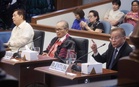
THE impeachment trial of Vice President Sara Duterte continues to be an interesting site for observing language at work. Beyond the political and legal questions before the Senate impeachment court, the proceedings have repeatedly reminded us that trials are also linguistic events. People must choose the languages in which to speak, interpret what others say and attach precise meanings to words that may mean something rather different outside the courtroom.
One such issue arose during the testimony of Gina Acosta, a former employee of the Office of the Vice President, who chose to answer questions in Cebuano or Bisaya. The choice attracted attention when Sen. Erwin Tulfo questioned why Acosta appeared to have difficulty speaking Filipino, referring to transcripts of previous congressional hearings in which she had apparently answered questions in Filipino and English. Acosta explained that she could understand Filipino but found it difficult to speak. Eventually, the impeachment court’s presiding officer, Sen. Francis Escudero, instructed the lawyers questioning her to use one language, preferably Filipino, with translation provided when necessary.
The prosecution subsequently suggested that Acosta’s apparent difficulty with Filipino may have been a strategy. That, however, is an interpretation of her behavior, and determining her motivation is beyond what linguistic observation alone can establish. What linguistics can tell us is that multilingual ability is rarely an all-or-nothing matter. Knowing a language is not simply a matter of either knowing or not knowing it, and a person may understand a language very well while having considerably greater difficulty speaking it.
Linguists distinguish, among other things, between receptive and productive competence. Receptive competence involves understanding what one hears or reads, while productive competence involves producing language through speaking or writing. Neither should we automatically assume that because somebody has previously spoken a language, that person must possess equal proficiency in it across situations. Language proficiency is affected by domain, topic, interlocutor and communicative task. Ordering food in Filipino, having a conversation with colleagues in Filipino and answering legally consequential questions before an impeachment court in Filipino make very different linguistic demands.
None of this tells us why Acosta chose Cebuano, nor does it establish whether claims made about her language choice are correct. Those questions concern the particular facts of her testimony. The episode nevertheless illustrates a larger sociolinguistic point: Multilingual speakers do not necessarily possess identical levels of competence, confidence or communicative ease in every language they use. This matters enormously in a multilingual country like the Philippines, where shifting among languages is an ordinary part of communicative life.
Interestingly, even before the presentation of witnesses, language had already become an issue in the impeachment proceedings. Prosecutors advocated allowing both Filipino and English, partly so that witnesses could express themselves naturally and the public could more easily understand the proceedings. The Acosta episode demonstrated how much more complicated this becomes once the multilingual reality of the Philippines enters the courtroom. The question is not merely whether a witness “knows” Filipino, English or Cebuano, but which linguistic resources allow that witness to understand questions accurately and formulate answers with sufficient precision in a high-stakes setting.
Language in the impeachment trial, however, has not only been about which language people use. More recently, it has also been about what particular words mean. When retired Sandiganbayan Presiding Justice Amparo Cabotaje-Tang testified for the prosecution, part of her testimony concerned distinctions among three expressions that may appear almost synonymous in ordinary conversation: “unexplained wealth,” ”hidden wealth” and “ill-gotten wealth.” They belong to the same general semantic field, but they are not synonyms.
Under Republic Act 1379, unexplained wealth concerns property acquired by a public officer during incumbency that is manifestly out of proportion to the officer’s salary, other lawful income and income from legitimately acquired property. The law provides circumstances under which a prima facie presumption may arise. Here, we encounter still more terminology requiring careful interpretation. “Prima facie” essentially concerns what appears sufficient on its face at that stage; it does not mean that a matter has necessarily been conclusively established. The presumption contemplated by the law may be rebutted through a satisfactory explanation showing lawful acquisition. Thus, “unexplained” cannot simply be treated as a synonym for “illegal.”
“Hidden wealth,” meanwhile, raises another semantic issue. In ordinary language, “hidden” may make us imagine money physically concealed somewhere. In the legal discussion during the trial, however, the relevant idea included property beneficially owned by a public official but registered in another person’s name. “Ill-gotten wealth” shifts our attention to yet another question: how the wealth was acquired. The term concerns wealth obtained through unlawful means. The three expressions therefore direct attention to different aspects of wealth: whether its lawful source can be satisfactorily accounted for, whether its true ownership has been concealed and whether it was acquired through unlawful means.
Another apparently simple word in Cabotaje-Tang’s testimony is worth remembering: “omission.” Asked about assets omitted from a statement of assets, liabilities and net worth, she did not simply equate an omission with unexplained wealth. An omission is first an absence of information from a required declaration, and its legal significance depends on the applicable law, evidence and circumstances. This distinction may appear pedantic, but precisely this kind of semantic precision becomes crucial when legal terminology enters public discourse.
As specialized words travel from the courtroom to television, newspapers and social media, distinctions can easily disappear. An allegation can begin to sound like an established fact, a presumption like proof, unexplained wealth like illegal wealth, and an omission like concealment. Yet each substitution adds meaning that was not necessarily contained in the original expression. Linguistically, these are not trivial differences because changing the lexical category through which we describe something can also change the conclusions that listeners believe they are entitled to draw from it.
The Acosta and Cabotaje-Tang episodes may initially appear unrelated. One concerns a witness speaking Cebuano instead of Filipino, while the other concerns definitions of legal terminology. Yet both demonstrate the same fundamental principle: linguistic precision matters. In the first case, we must pay attention to the language through which meaning is expressed and recognize the complexity of multilingual competence. In the second, we must pay attention to the precise meanings carried by words and resist treating related terms as interchangeable.
An impeachment trial ultimately turns on constitutional standards, evidence and the judgments of those assigned by the Constitution to hear the case. Linguistics cannot decide those questions, but it can remind us how easily conclusions can change when linguistic distinctions are ignored. In a proceeding where every answer may matter, we should therefore pay attention not only to what people say, but also to what language they say it in, what their words actually mean and what conclusions those words do — and do not — permit us to make.
Ariane Macalinga Borlongan is a public intellectual, language scholar and migrant advocate. He is one of the leading researchers on English in the Philippines and one of the pioneers of migration linguistics. He is the youngest to earn a doctorate in linguistics, at age 23, from De La Salle University, and has had several teaching and research positions in Germany, Japan, Malaysia, the Philippines, Poland and Singapore. He is currently associate professor of sociolinguistics at the Tokyo University of Foreign Studies.