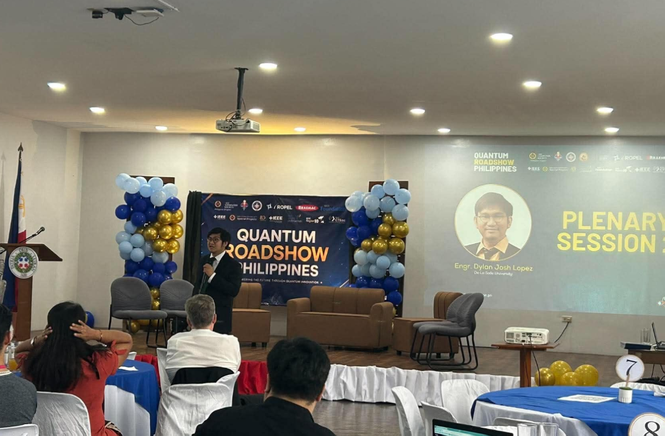
THE Quantum Roadshow Philippines culminated yesterday, August 21, at the University of the Philippines Diliman (UPD) following a five-day program that began Monday at Colegio de San Juan de Letran in Manila and continued at Bulacan State University.
The roadshow, led by the Department of Science and Technology (DOST), was organized as a precursor to the country's second Quantum Information, Science and Technology Conference (QISTCon), scheduled for Nov. 9-11 in Cebu City.
Organizers said the education gap analysis conducted during the roadshow will feed into a national white paper intended to guide future initiatives in quantum education and research.
The opening at Letran focused on three areas: quantum engineering education and research, the development of quantum supply chains in Asia, and the next generation of connectivity through quantum internet technologies.
The program also included a panel on the Philippine quantum landscape and a workshop examining gaps in quantum education.
The initiative reflects a growing push to develop quantum capabilities in the Philippines before the technology reaches wider commercial deployment.
Quantum technologies use properties of matter and light that are not available to conventional computing and communications systems. Quantum computing could eventually address certain problems beyond the practical capabilities of classical computers, while quantum communications could enable new approaches to secure data transmission. Quantum sensors are also being developed for applications ranging from navigation to scientific measurement.
The roadshow involved the Quantum Computing Society of the Philippines, the Institute of Electrical and Electronics Engineers (IEEE) Philippine Section, Bulacan State University, UP Diliman, Colegio de San Juan de Letran, DOST PROPEL, BRAEMAC, IEEE Computer Society Special Projects, IEEE Communications/Microwave Theory and Techniques/Antennas and Propagation Philippine Section, IEEE Young Professionals, IEEE Foundation, IEEE Region 10 and the IEEE Consumer Technology Society Philippine Section.
Quantum Computing Society of the Philippines President Bobby Corpus has said the Philippines could participate in the emerging quantum economy by developing expertise in areas such as quantum software, algorithms, cybersecurity and communications rather than attempting to compete immediately in the capital-intensive development of quantum hardware.
The event at Letran followed a memorandum of agreement involving the school, the IEEE Computer Society Philippine Chapter, the Quantum Computing Society of the Philippines and DOST PROPEL.
Letran was initially identified as the pilot location for the roadshow. The program subsequently moved to Bulacan State University and UP Diliman, making the three institutions the first venues in what organizers intend as a broader national effort.
The discussions also examined quantum supply chains, an issue that has become increasingly important as governments seek to establish domestic capabilities in quantum hardware, software and supporting technologies.
Quantum computing requires specialized components, including advanced control electronics, cryogenic systems and precision measurement equipment. Building a competitive ecosystem therefore involves more than developing quantum processors and requires universities and industries capable of supplying research, engineering and technical talent.
The communications component of the roadshow examined the development of quantum networks and the potential for quantum internet technologies. Such networks are expected to complement rather than simply replace existing communications infrastructure, with applications including quantum key distribution and links between quantum computers and sensors.
The roadshow brought together researchers, educators, government scientists and industry representatives for discussions on quantum engineering education, research, supply chains and quantum communications. DOST's quantum research activities in several universities and government institutions, but does not yet Asia such as those in Singapore and Malaysia.