For BN and the GST, it seems like a case of “till death do us part”—but why?
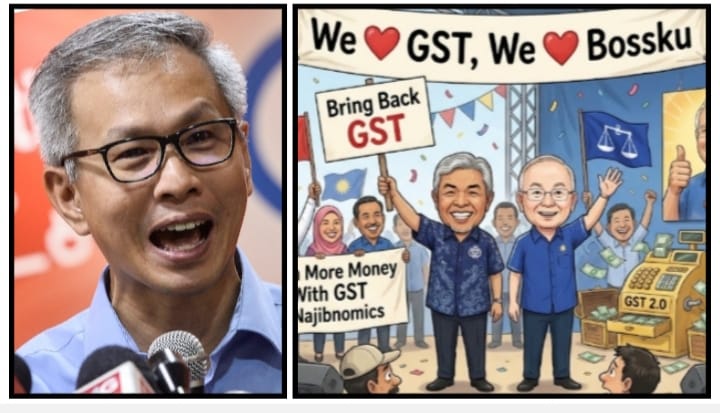
Fresh from the controversy over the Pardons Board meeting minutes, former DAP lawmaker Tony Pua has now trained his guns on Barisan Nasional (BN) chief Ahmad Zahid Hamidi, who has pledged to reintroduce the Goods and Services Tax (GST) if the coalition returns to power.
While GST may be rightly hailed as a more efficient revenue collector than the current Sales and Services Tax (SST), Pua was quick to point out how the refund process became a real pain in the neck under the Najib Razak administration.
For context, the thorny tax issue hit the headlines recently after Zahid, speaking at the 4th general assembly of the 30th MCA central delegates, boldly announced that BN would reinstate GST if it reclaims Putrajaya.
But here's what critics will be asking: BN and its so-called “blue wave" may seem unstoppable now, but isn’t Zahid being overconfident in using GST as an election pledge?
Unsurprisingly, his remarks echoed those of MCA president Wee Ka Siong, who stated that his party and UMNO have consistently advocated reviving GST to minimise revenue leakages, curb the “black economy,” and eliminate double taxation and the cascading effect associated with SST.
“Did they forget to mention that eradicating rampant corruption in the country is a more effective method to plug revenue leakages?”
True, GST is a popular tax collection mechanism and is used by many governments worldwide.
But why did the UMNO leader and his MCA counterpart seem reluctant to dwell on its downsides—especially given its not-so-illustrious history in this country?
And why did they appear not too keen on rebutting allegations that GST may benefit the big taukes at the expense of those in the lower-income groups?
Could it be that, with Putrajaya seemingly within their sights now, it may have slipped their minds that the said taxation system was one of the single biggest reasons attributed to BN’s historic downfall in the 2018 general election?
While GST may seem like the silver bullet for the country's financial constraints, what the ordinary man on the street will want to know is this:
"Will GST really help to bring down overall costs and promise better living standards for the rakyat—or will it make matters worse?"
The thing is, before promoting GST as an election manifesto, shouldn't its proponents first pledge that the huge tax revenue collected and parked in the Consolidated Revenue Account will be properly governed and utilised—and not diverted elsewhere?
So, can UMNO and MCA guarantee that the extra GST revenue will actually go toward building more hospitals, improving medical care, and offering better employment terms for doctors and healthcare workers?
Can they also ensure quality education for all, improved public services, and stronger safety nets for poor households who are now forced to share the tax burden?
And will there be a commitment that the extra billions will not be used to fund more mega-projects, meaningless skyscrapers, and inflated contracts?
Even worse, what if unscrupulous cartels abuse GST to raise prices to reap excessive profits? Won't the already hard-pressed rakyat end up footing the bill?
As some might recall, when Najib first introduced the 6% GST in 2015, the impact was almost immediate, with the people’s purchasing power plunging and small businesses struggling with accounting and compliance costs.
Weren't some even allegedly forced to shut down their generations-old family businesses altogether?
The harsh reality is that GST does not spare anyone—from poor kampung folks to unborn babies (through prenatal costs) right up to the deceased (for coffins and funeral expenses). No one escapes!
Then there's the elephant in the room…
Did BN conveniently forget that its previous administration allegedly failed to refund billions in GST claims to businesses in a timely manner—causing many to bleed from poor cash flow?
Surely the BN leadership must be aware, too, of shocking allegations by some business owners that they have yet to receive their refunds!
Can BN then guarantee that this time around, it will be more efficient and fair, with business refunds disbursed within a reasonable timeframe—say, two weeks?
Or, God forbid, will the same “ghosts” come back to haunt the people for the second time and inflict even more misery?
Still, what the curious public may be wondering is this: why exactly do UMNO and MCA appear bent on reviving GST before they even regain Putrajaya?
Why all the fanfare?
Is it because GST genuinely offers tangible economic benefits to everyone, or are they merely riding the wave of nostalgia and euphoria over Najib's “homecoming”—further emboldened by their three prized state election scalps in Johor, Negeri Sembilan, and, most recently, Melaka?
Well, politicians may have a short memory but not the people, especially when it comes to the ballot box.
Ultimately, though, as Zahid and his “blue wave” surge relentlessly toward Putrajaya, one question looms large: Will resurrecting GST signal BN’s triumphant return—or will it prove to be a naive political gamble that ends up handing an unexpected lifeline to Anwar and his floundering PH coalition?
Main information source: Malaysiakini and The Sun.
JK Joseph (jtkingsworld@gmail.com) is a content creator under the Newswav Creator programme, where you get to express yourself, be a citizen journalist, and at the same time monetize your content & reach millions of users on Newswav. Log in to creator.newswav.com and become a Newswav Creator now!
The User Content (as defined on Newswav Terms of Use) above including the views expressed and media (pictures, videos, citations etc) were submitted & posted by the author. Newswav is solely an aggregation platform that hosts the User Content. If you have any questions about the content, copyright or other issues of the work, please contact creator@newswav.com.