
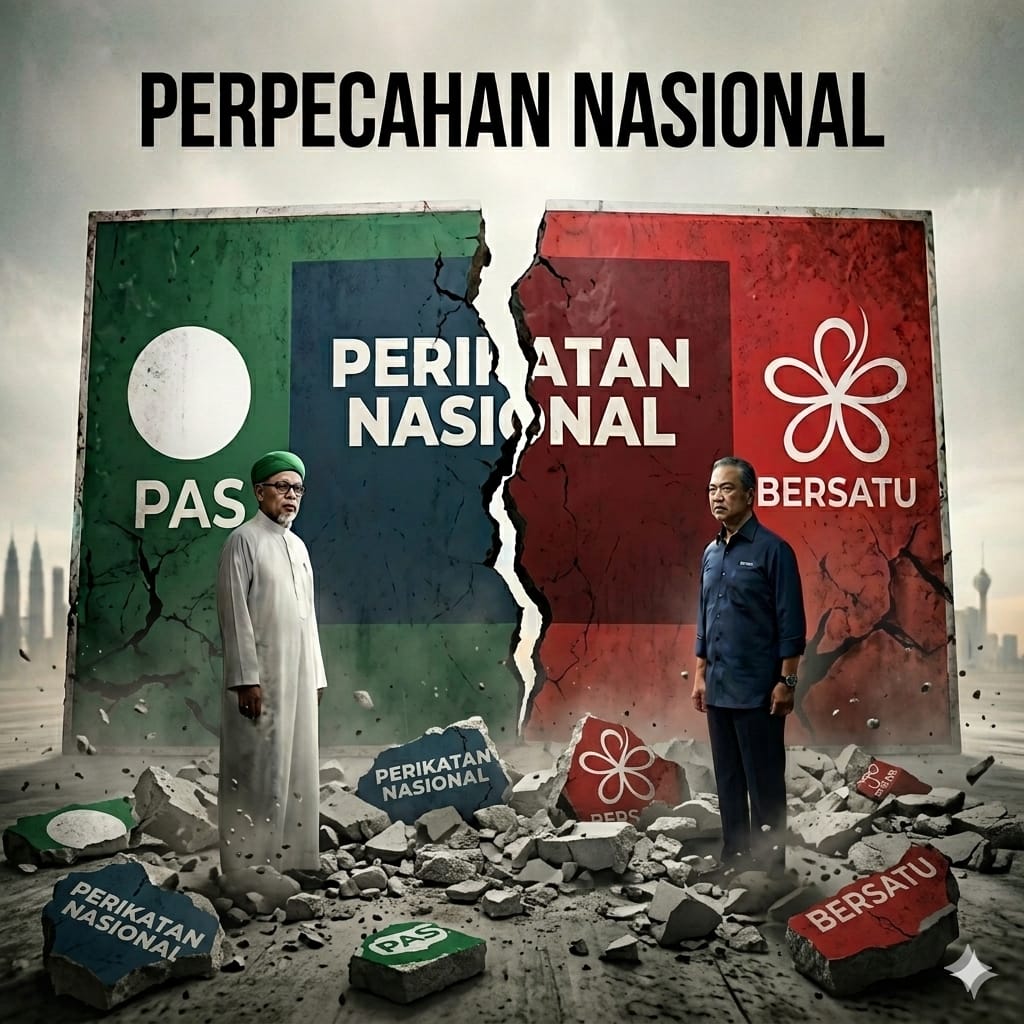
For much of the past two general elections, Perikatan Nasional (PN) successfully positioned itself as Malaysia’s most formidable opposition coalition. Built upon the combined strengths of PAS, Bersatu, Gerakan and several smaller allies, PN managed to attract millions of voters seeking an alternative to both Pakatan Harapan (PH) and Barisan Nasional (BN).
Today, however, the coalition faces what could be its greatest existential crisis.
What began as disagreements over leadership, electoral strategy, and coalition direction has now evolved into an open power struggle between PAS and Bersatu. Political analysts increasingly warn that if the conflict remains unresolved, PN may enter the 16th General Election (GE16) severely weakened, fragmented, and vulnerable to electoral rejection.
Universiti Kebangsaan Malaysia political scientist Dr Jamaie Hamil believes the consequences could be devastating. According to him, the conflict benefits neither PAS nor Bersatu and risks destroying the very brand value that made PN attractive to voters.
The situation has become particularly serious because the dispute is no longer confined to internal disagreements. PAS has openly severed ties with Bersatu for the upcoming Johor and Negeri Sembilan state elections, raising fundamental questions about whether PN still functions as a genuine coalition.
Jamaie argues that voters are unlikely to place their trust in a coalition whose major components cannot cooperate among themselves. In politics, unity is often viewed as a prerequisite for governing credibility. When coalition partners openly challenge one another, voters naturally question whether they can govern effectively if given power.
The stakes are enormous.
PN currently governs Kelantan, Terengganu, Kedah and Perlis. Yet Jamaie warns that continued infighting could place many parliamentary and state seats at risk, potentially allowing PH and BN to regain ground in states previously considered PN strongholds. BN, in particular, stands to gain the most from a split in the Malay vote.
Even more concerning for PN is the perception that the coalition may already be disintegrating from within.
While PAS remains PN’s largest parliamentary bloc with 43 MPs, Bersatu has traditionally provided much of the coalition’s leadership structure, strategic direction, and national-level visibility. The Opposition Leader position, coalition management, and much of PN’s federal political machinery have largely revolved around Bersatu figures.
Without effective cooperation between the two parties, PN’s ability to function as a unified opposition force becomes increasingly questionable.
The tensions have become even more visible following allegations by Bersatu information chief Tun Faisal Ismail Aziz. He accused PAS of gradually consolidating control within PN after a recent leadership reshuffle that saw influential Bersatu leaders Datuk Radzi Jidin and Dato' Seri Azmin Ali removed from the coalition’s Supreme Council.
According to Tun Faisal, the changes significantly strengthened PAS’ voting influence while reducing Bersatu’s representation in PN’s highest decision-making body.
His accusations reveal a growing fear within Bersatu that PAS is no longer interested in partnership, but rather dominance.
Political analyst Dr Mohamad Hafis Amat Simin believes the conflict represents something far deeper than ordinary coalition disagreements.
He describes the current situation as a struggle over leadership, influence, and the future identity of Malaysia’s opposition movement itself.
The emergence of Parti Wawasan Negara under Dato' Seri Hamzah Zainudin has further complicated matters. Hamzah’s growing influence, coupled with PAS’ apparent recognition of his leadership role, creates the possibility of competing centres of authority within the opposition camp.
This raises an uncomfortable question: Is PN evolving into a PAS-led coalition, or is it fragmenting into multiple rival camps competing for the same voter base?
Perhaps the most revealing observation comes from political analyst Associate Professor Dr Syaza Shukri, who argues that Bersatu needs the PN brand more than PAS does.
Unlike PAS, which has spent decades building grassroots machinery and a loyal support base, Bersatu remains a relatively young political party. The PN logo provides Bersatu with legitimacy and credibility derived from its association with more established parties.
PAS, on the other hand, has increasingly demonstrated that it can stand on its own, particularly in the Malay-majority east coast and northern states where its support remains exceptionally strong.
This asymmetry may explain why PAS appears increasingly confident in charting its own course.
Yet there is a danger for PAS as well.
While PAS may survive independently, the collapse of PN would likely split opposition votes and hand a significant advantage to BN and PH. Malaysian political history has repeatedly shown that divided coalitions often lose not because of external enemies, but because of internal rivalries.
The greatest threat facing PN today may not come from Dato' Seri Anwar Ibrahim’s government or Barisan Nasional’s machinery. It may come from within its own ranks.
If PAS and Bersatu fail to find common ground, GE16 could mark not the rise of a new opposition coalition, but the beginning of the end of Perikatan Nasional as Malaysians know it.
And if that happens, the real winners may not be PAS or Bersatu - but BN and PH, who could once again become the default choices for voters seeking political stability.
By: Kpost
Information Source:
Nst , Fmt , TheRakyatPost
Kpost (ckhorsk@gmail.com) is a content creator under the Newswav Creator programme, where you get to express yourself, be a citizen journalist, and at the same time monetize your content & reach millions of users on Newswav. Log in to creator.newswav.com and become a Newswav Creator now!
The User Content (as defined on Newswav Terms of Use) above including the views expressed and media (pictures, videos, citations etc) were submitted & posted by the author. Newswav is solely an aggregation platform that hosts the User Content. If you have any questions about the content, copyright or other issues of the work, please contact creator@newswav.com.

