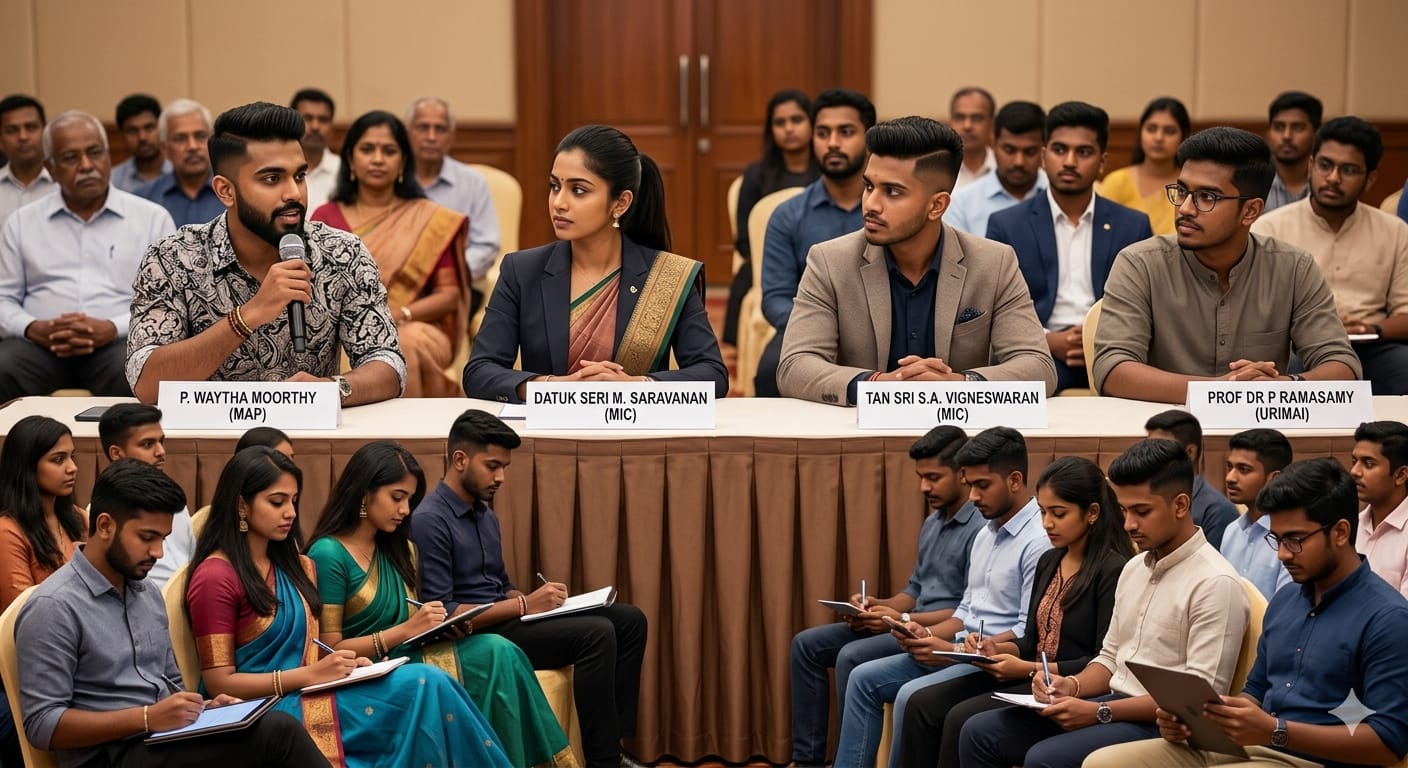
Malaysian Indian politics, few figures embody the turbulent struggle for minority rights quite like P. Waytha Moorthy.
From leading the historic HINDRAF protests in 2007 to serving as a federal minister, Waytha has spent nearly two decades navigating the difficult terrain of ethnic representation, economic inclusion, and political relevance.
His latest press conference in Kuala Lumpur has once again placed him at the centre of national debate.
This time, however, the conversation is not about street protests or government appointments.
It is about what he calls a simple principle of equality a principle he illustrated through what many are now calling the "1 ringgit formula."
Using Malaysia's public healthcare system as an example, Waytha argued that if all Malaysians can receive treatment under the same system regardless of race, then similar principles of fairness should apply to economic opportunities, business participation, and national development.
At the same time, he made another surprising proposal.
He called for Indian political parties and leaders to unite under a single umbrella, potentially led by the Malaysian Indian Congress (MIC).
The combination of these two ideas has sparked intense discussion.
To supporters, it is a pragmatic and mature strategy.
To critics, it is a contradiction bordering on political desperation.
The truth may lie somewhere in between.
The Supportive View: A Masterclass in Pragmatism
Supporters of Waytha Moorthy see his latest remarks as one of the most sophisticated reframings of the Indian community's economic concerns in recent years.
Rather than demanding special treatment, they argue that he is asking for consistency.
The Power of the "1 Ringgit Healthcare" Blueprint
The strength of the analogy lies in its simplicity.
Malaysia's public healthcare system operates on the principle that citizens receive treatment regardless of ethnicity.
A Malaysian Indian, Malay, Chinese, Kadazan, or Orang Asli patient pays the same nominal fee and receives care under the same framework.
Waytha's question is straightforward:
If equality can exist in healthcare, why should it not exist in economic participation?
Why should access to government contracts, business opportunities, financing, entrepreneurship programmes, or institutional support be viewed differently?
Supporters argue that this shifts the debate away from accusations of racial entitlement and toward a broader discussion about systemic fairness.
Instead of asking for handouts, the argument becomes one of equal participation.
In that sense, the "1 Ringgit formula" is less about healthcare and more about creating a measurable benchmark for inclusion.
Building a Unified Political Voice
Supporters also defend his call for Indian political consolidation.
The reality of Malaysian politics is that Indian representation is fragmented across multiple parties.
MIC, PKR, DAP, Gerakan, MAP, and various smaller movements all claim to represent Indian interests.
The result is often a divided voice.
Advocates of Waytha's proposal argue that a community comprising roughly seven percent of the population cannot afford endless fragmentation.
By consolidating political influence under a common platform, they believe the Indian community could become a more effective negotiating bloc within national politics.
In practical terms, this could transform Indian voters from passive participants into a potential kingmaker constituency capable of influencing coalition decisions.
Whether one agrees with the strategy or not, supporters view it as political realism rather than nostalgia.
The Critical View: A Revisionist Contradiction
Not everyone is convinced.
Critics view Waytha's latest position through a very different lens.
To them, the proposal raises serious questions about consistency and credibility.
The MIC Irony
Perhaps the most controversial aspect of his remarks is his apparent willingness to place MIC at the centre of any future unity effort.
For many Malaysians, this represents a remarkable reversal.
After all, HINDRAF's rise was built largely on dissatisfaction with MIC's performance and its perceived inability to address the concerns of working-class Indians.
The movement challenged MIC's dominance and positioned itself as an alternative voice for marginalized communities.
Today, Waytha appears willing to acknowledge MIC's institutional strength and nationwide network.
Critics argue that this is more than pragmatism.
They see it as an ideological U-turn.
Some suggest it reflects the limitations of smaller political movements that struggle to build sustainable grassroots machinery over time.
Others believe it signals recognition that MIC, despite its diminished influence, remains the only Indian-based party with a truly national organisational structure.
Either way, the shift has not gone unnoticed.
Strategic Retreat or Long-Term Planning?
Another criticism concerns MAP's decision not to focus heavily on upcoming state elections.
Supporters describe this as strategic resource management.
Critics describe it as retreat.
By avoiding electoral tests in states with significant Indian voter populations, opponents argue that MAP risks becoming politically irrelevant before the next general election arrives.
They also point to Waytha's increasingly critical stance toward the current administration, suggesting that his campaign may be driven as much by political rivalry as by structural reform.
Whether that criticism is fair remains open to debate.
But it illustrates the skepticism surrounding his latest initiative.
Reactions Across the Political Divide
Waytha's remarks have generated responses from multiple corners of the political landscape.
The reactions reveal deeper disagreements about how minority communities should pursue influence in modern Malaysia.
The Establishment View: Moving Beyond Ethnic Silos
Many Indian leaders within multiracial parties such as PKR and DAP reject the idea of returning to ethnic-based political umbrellas.
Their argument is simple.
Malaysia's future lies in multiracial policymaking rather than communal bargaining.
From this perspective, economic advancement should come through national reforms that benefit all disadvantaged groups rather than through ethnic bloc politics.
Supporters of this view argue that relying on a single ethnic champion has historically produced limited results and risks trapping communities within outdated political frameworks.
To them, Waytha's proposal represents a step backward rather than forward.
The MIC Perspective: Validation With Reservations
Within MIC circles, reactions have been more nuanced.
Some party veterans view Waytha's remarks as a delayed acknowledgment of realities they have long argued.
MIC remains the largest Indian political organisation in the country, with decades of institutional experience and nationwide infrastructure.
From their perspective, calls for unity are welcome.
However, they also caution that unity cannot be built solely around electoral convenience.
Several MIC leaders have suggested that genuine cooperation requires long-term commitment rather than temporary alliances formed ahead of elections.
In other words, while they welcome the conversation, they remain cautious about the motives behind it.
Beyond the Politics
Regardless of where one stands politically, Waytha's intervention raises an important question.
Why are Malaysian Indians still discussing economic inclusion after decades of representation across multiple parties and governments?
This is not merely a question for MIC.
Nor is it solely a question for PKR, DAP, MAP, or any other political organisation.
It is a question about outcomes.
For years, politicians have spoken about empowerment, transformation, and opportunity.
Yet concerns about educational access, entrepreneurship, economic mobility, and social advancement continue to surface within many segments of the Indian community.
The persistence of these concerns suggests that representation alone may not be enough.
Participation matters.
Results matter.
Economic integration matters.
That is ultimately the core message behind Waytha's "1 Ringgit formula."
Final Thoughts
Waytha Moorthy is attempting to challenge what he describes as the illusion of political promises.
His argument is that communities should judge governments not by speeches, announcements, or symbolic appointments, but by measurable outcomes.
The "1 Ringgit formula" may be simplistic.
His call for unity under an MIC-led umbrella may be controversial.
And his political calculations may be questioned by both allies and opponents.
Yet he has succeeded in doing one thing.
He has forced a conversation about whether Malaysia's economic structures are delivering meaningful inclusion for one of the country's most vulnerable minority communities.
Whether his proposal represents a masterstroke of political pragmatism or an act of desperation ahead of GE16 remains to be seen.
But by introducing a simple benchmark for fairness and reopening the debate on Indian political unity, Waytha Moorthy has once again ensured that the conversation cannot be ignored.
And perhaps that, more than anything else, was the objective.
Annan Vaithegi examine Malaysian politics through the lens of history, community aspirations, and the promises that remain unfulfilled long after the election banners come down.
Annan Vaithegi (annanvaithegi@icloud.com) is a content creator under the Newswav Creator programme, where you get to express yourself, be a citizen journalist, and at the same time monetize your content & reach millions of users on Newswav. Log in to creator.newswav.com and become a Newswav Creator now!
The User Content (as defined on Newswav Terms of Use) above including the views expressed and media (pictures, videos, citations etc) were submitted & posted by the author. Newswav is solely an aggregation platform that hosts the User Content. If you have any questions about the content, copyright or other issues of the work, please contact creator@newswav.com.