

Ever since PMX Dato Seri Anwar Ibrahim launched his new campaign of Madani governance in Jan 19th 2023, the Unity Government under his leadership has introduced numerous government initiatives that had benefitted the people.
Coming into power since November 2022, ( almost 3 years) it would be time to have a snap review on what achievements this Madani government has done so far.
Narrowing down the initiatives and policies that made the most significant impact on Malaysians , I chose those that have the most impact on businesses, economy, cost of living, livelihood and well being of Malaysians.
Three major achievements of the Madani government that have the most significant impact.
They are:
1. RON95 Regularisation Policy.
2. FDI- Foreign Direct Investments.
3. Ringgit Appreciation.
The RON95 Regularisation (or Subsidy Rationalisation) policy is a cornerstone of Malaysia's fiscal reform strategy under the MADANI government. By shifting from a "blanket" subsidy—where everyone, including the wealthy and foreigners, benefits—to a "targeted" system, the government manages to fix long-standing economic leakages.
How money is saved and diverted to help the lower income group.
In just three months, the Malaysian government has managed to save RM800 million from it's new fuel subsidy policy. This is unprecedented. The targeted savings is RM8 billion per year.
Master Stroke.
How did this savings come about?
It was a master stroke. By regularisation and reducing the subsidy of fuel to foreigners.
‘ No previous governments has ever done that. They have discussed for decades, but not bold enough to implement. The Madani government dare to do it ’ says PMX.
How it works.
Simple. By restricting the use of subsidized RON95 fuel to foreigners and curbing diesel smuggling. For decades our cheap petrol have been smuggled to neighbouring countries and also enjoyed by foreigners. This new policy prevents that leakage. Subsidized fuel is only for Malaysian citizens.
How the leakage is plugged.
Before:
Everyone including foreigners can enjoy subsidized rate petrol on RON 95.**
After :
Restrict the subsidy to only eligible Malaysian citizens ( 18 years above with valid M'sian license)
** Retail price of RON95/97 and diesel are adjusted weekly based on floating method. Prices set weekly is based on global crude oil price movement, ringgit fluctuations and other economic factors. These indices are monitored and the retail price of petrol will be set by the Government . See below link.
RON95 petrol is mainly used for low end vehicles, ie. 1.3 litre and below.
High end petrol RON97 cost - RM3.24/ litre is used mainly for higher end vehicles requiring higher octane fuel.
RON95 - is:
Mainly used by low and middle income citizens.
About 18 million will benefit.
Subsidized rate - RM1.91/litre. Unsubsidized - RM2.60/litre.
Control : The system of control to ensure this implementation is through the use of Malaysian IC Mykad. Without this one cannot pump. RON95 petrol at petrol station.
a. Significant Fiscal Savings
The primary benefit is the reduction of the national subsidy bill, which had become unsustainable.
Cost Reduction: Prior to reform, the RON95 subsidy alone cost the government roughly RM20 billion annually.
Projected Savings: By excluding the top 15% of income earners (T15) and foreigners, the government saves between RM2.5 billion and RM4 billion annually. These savings help the government stay on track to meet its budget deficit target (aiming for 3.8% of GDP).
Ending Cross-Border Leakages: Low fuel prices in Malaysia (among the cheapest in the world) encouraged smuggling into neighboring countries like Thailand and Singapore.
Excluding Non-Citizens: The new policy ensures that government funds only benefit Malaysian citizens, as foreigners are now required to pay the market price.
Reinvestment in Public Welfare
Instead of "burning" money on fuel for those who don't need help, the government can redirect those billions into high-impact social sectors:
b. Cash Assistance:
Funding for programs like Sumbangan Tunai Rahmah (STR) and SARA has been increased to provide a safety net for the B40 and M40 groups.
c. Infrastructure: Savings are channeled into upgrading public schools, rural clinics, and public transportation networks. ( eg: RTS- M'sia/ S'pore & PG - PTMP)
d. Improving National Credit Ratings:
Fiscal discipline is a key metric for international investors and credit rating agencies (like S&P and Moody’s). Malaysia stands at Stable for Outlook. Rating is between BBB+ and A-.
e. Investor Confidence:
By reducing long-term liabilities and demonstrating a commitment to fiscal responsibility, the government strengthens the Ringgit and attracts foreign direct investment (FDI).
2. FDI Foreign Direct Investment.
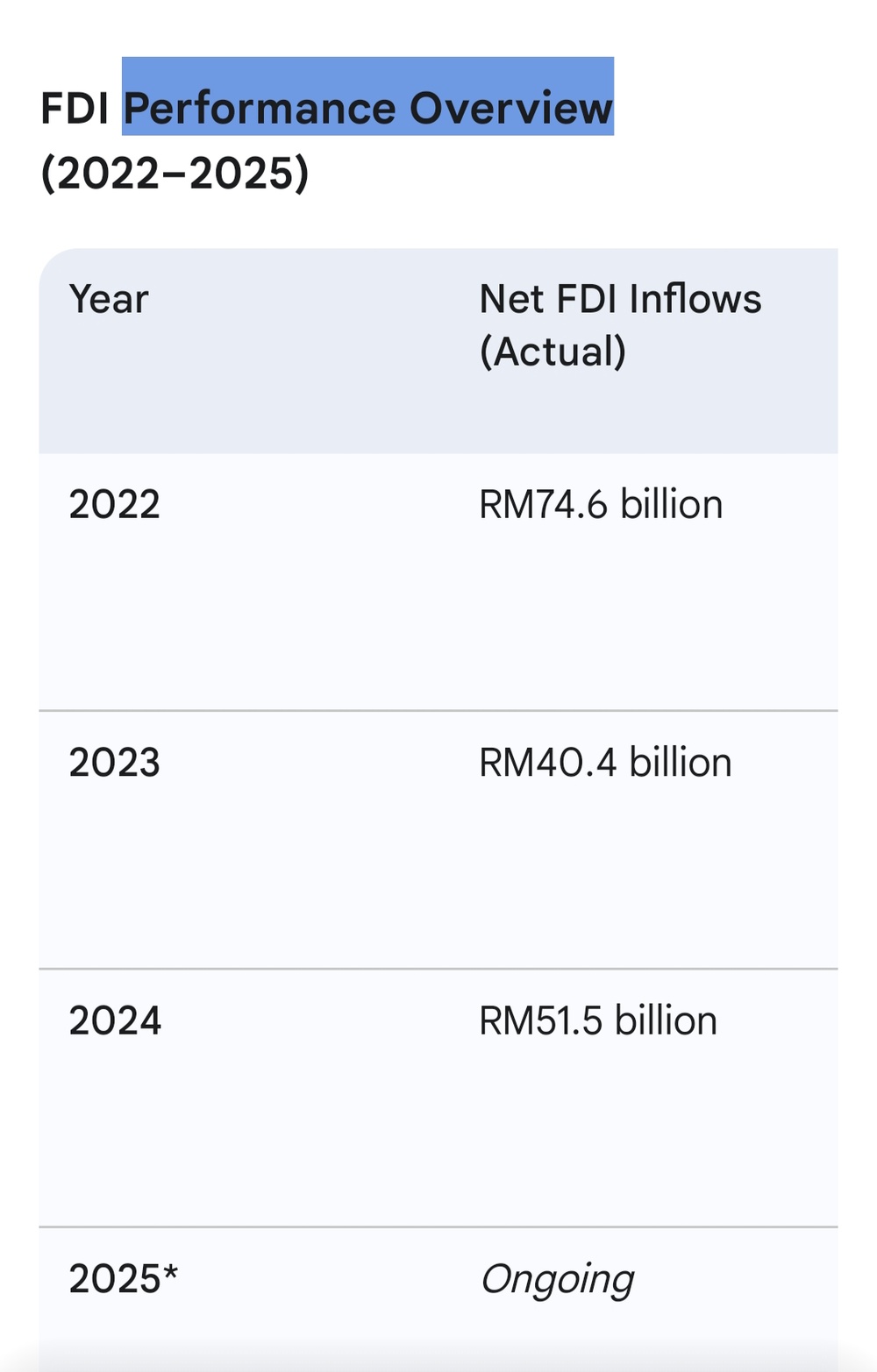
https://www.dosm.gov.my/portal-main/search?keyword=FDI&theme=231
As of January 2026, the data for 2025 shows that Malaysia experienced a "blockbuster" year for foreign investment, largely driven by the digital economy and a surge in the services sector.
There are two ways to look at the 2025 figures: Approved Investments (future commitments) and Net FDI Inflows (actual cash that entered the country).
1. Approved Foreign Investments (The "Headline" Number)
For the first nine months of 2025 (9M 2025), Malaysia recorded a massive surge in investor interest.
- Total Foreign Investment (FI): RM150.8 billion (an increase of 47.5% compared to the same period in 2024).
- Total Approved Investments (FI + Domestic): RM285.2 billion, which is on track to break historical records.
- Main Driver: The Services Sector saw a staggering 122% jump, primarily due to the "Data Center wave" and cloud infrastructure projects from global tech giants.
2. Quarterly Net FDI Inflows (Actual Realized Cash)
According to the Department of Statistics Malaysia (DOSM), the actual cash flow into the country was volatile but showed a strong recovery toward the end of the year:
- Q1 2025: RM15.6 billion
- Q2 2025: RM1.6 billion (A sharp temporary dip due to equity liquidations and timing of project disbursements).
- Q3 2025: RM8.5 billion (A strong rebound as larger equity injections resumed).
3. Who is Investing and Where?
Top Investor Countries (2025):
- Singapore: RM52.7 billion (Leading in real estate and data centers).
- China: Significant contributor to manufacturing and EV sectors.
- USA: Concentrated in the semiconductor (E&E) and cloud services sectors.
Top Performing Sectors:
- Information & Communications: RM99.8 billion (Data centers, cloud computing, and 5G infrastructure).
- Manufacturing: RM93.8 billion (Electrical & Electronics (E&E), Chemicals, and Electric Vehicles).
- Real Estate: RM56.6 billion (Driven by industrial parks and JS-SEZ developments).
Top Investment States:
- Johor: The clear leader (over RM91 billion), benefiting from the Johor-Singapore Special Economic Zone (JS-SEZ).
- Selangor & Kuala Lumpur: Hubs for services and corporate headquarters.
- Pulau Pinang: Remains the "Silicon Valley of the East" for semiconductor manufacturing.
The year 2025 solidified Malaysia’s position as a regional AI and Data Center hub. While 2024 was about "announcing" deals (Google, Microsoft, AWS), 2025 was the year these projects moved into the approved and groundbreaking phase, leading to the 47% surge in foreign commitments.
Promoting Environmental Sustainability
While the immediate goal is fiscal, there is a secondary environmental benefit.
Lower Consumption: Market pricing for high-income groups encourages more efficient fuel use and the adoption of electric vehicles (EVs) or public transport. This aligns with Malaysia’s goal to achieve carbon neutrality by 2050.
3. Ringgit Appreciation.
This is the most significant achievement for year 2025. Within one year our government achieved a 9% appreciation against the USD. ( RM4.046 vs USD) It is one of Asia's top currency performer for the year.
Local businesses sectors that benefitted are those that deal in USD denominated currency trade like: Aviation, Consumers, Automotive, Utilities, Healthcare.
These companies are going to see profits in terms of forex exchange gains if the ringgit continue to appreciate.
Conclusion.
Together these three positive factors are leading drivers of Malaysia's charge into 2026 and beyond.
With a robust economy and Visit Malaysia Year to achieve 40 million visitors, the country will expect to get a boost to the tourism industry. With political stabilty, ongoing major infrastructure projects, peaceful and harmonious environment, Malaysia may finally achieve it's long illusive dream of a developed nation under the Madani government.
Jack Ung (jack.uct1953@gmail.com) is a content creator under the Newswav Creator programme, where you get to express yourself, be a citizen journalist, and at the same time monetize your content & reach millions of users on Newswav. Log in to creator.newswav.com and become a Newswav Creator now!
The User Content (as defined on Newswav Terms of Use) above including the views expressed and media (pictures, videos, citations etc) were submitted & posted by the author. Newswav is solely an aggregation platform that hosts the User Content. If you have any questions about the content, copyright or other issues of the work, please contact creator@newswav.com.

