By Mihar Dias October 2026
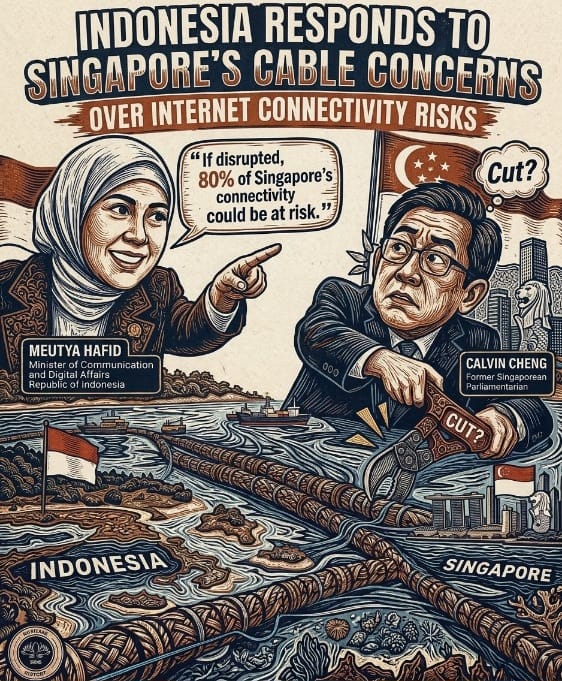
Every few years, someone with a smartphone and a lot of confidence rediscovers geopolitics, and the rest of us pay for it in secondhand embarrassment. This week's rediscovery comes from Singapore, where a former Member of Parliament shared an infographic claiming that around 90 per cent of Indonesia's international internet traffic passes through the island. He then added a single, pregnant word: “Cut?”https://newswav.com/A2610_6oqc3x?s=A_tZ8xK3t&language=en
A question mark, you see, is how modern statesmen say "I'm only asking questions" while holding the scissors.
We have all heard about Iran waving its hand over the undersea cables of the Middle East. That is at least a threat with a navy and a grudge behind it. What we have here is a man with a Wi-Fi connection and a graphic design template, proposing to disconnect a nation of some 267 million internet users. Indonesia has a population 47 times that of Singapore.https://newswav.com/A2610_6oqc3x?s=A_tZ8xK3t&language=en
Picking that fight is like a goldfish squaring up to the aquarium, then reminding everyone how much of the water it provides.
Naturally, the clarification arrived promptly. Singapore, we were assured, is a civilised, law-abiding society and would never do such a thing. Lovely. So the question was rhetorical, the infographic was educational, and the scissors were decorative. Next time perhaps lead with the civilisation and skip the "Cut?" It saves everyone a news cycle.
Then came the reply from Indonesia's Communications and Digital Minister, Meutya Hafid, who responded with the one thing the original post lacked: a map. Most of the cables landing in Singapore, she pointed out, did not materialise from thin air. They run through Indonesian waters. Sever them, and roughly 80 per cent of Singapore's connectivity capacity goes dark too. https://newswav.com/A2610_6oqc3x?s=A_tZ8xK3t&language=en
Let that sink in, preferably over a slow connection. The grand plan to punish Indonesia involves cutting the cable that Singapore is also hanging from. It is the geopolitical equivalent of sawing off the branch you are sitting on, and live-tweeting the sawing for engagement.
She also noted, rather gently, that global tech companies set up in Singapore partly because there is a vast Indonesian market next door. https://newswav.com/A2610_6oqc3x?s=A_tZ8xK3t&language=en Remove the market, and the investors might wonder why they are paying Singapore prices for the privilege of serving a neighbourhood that has stopped answering. Data centres do not sit in a place out of sentiment. They sit where the customers are, and the customers are somewhere south, annoyed.
And yes, the timing is exquisite. This all unfolds as Jakarta moves to hold back more of its natural gas for domestic use. Strange, isn't it, how the countries with the supplies suddenly develop an interest in their own people first? Nobody was cutting anything, of course. But if you were a country that depends on a neighbour's gas, a neighbour's waters and a neighbour's customers, a quiet, boring, grateful tone might be the sensible register for the week.
Here is the part that should embarrass all of us in this region. The sea around us is already crowded with real risks: anchors dragging across cables, ageing infrastructure, and the sort of state-level mischief that keeps security analysts awake. Cables are the plumbing of modern life. They carry hospital records, remittances, school lessons and the kampung auntie's video call to her grandchildren in Melbourne. Treating them as a bargaining chip, even as a joke, is like treating the water mains as a punchline in a neighbourly dispute.
The Indonesian minister, to her credit, ended on the grown-up note: digital infrastructure is a shared interest, to be protected collectively. It is a sentence so sensible that it almost feels out of place on social media.
Singapore built itself into a marvel precisely by being the smartest, most careful operator in the room. That reputation took decades. It should not be put at risk by one post, one question mark and one man's urge to be provocative at the expense of a neighbour 47 times his size.
So here is my suggestion for the next infographic: "Everyone's Internet Depends on Everyone Else's." It is less dramatic, and it has the advantage of being true. Add a question mark if you must. Just make it “Behave?”
Mihar Dias (mihardias@gmail.com) is a content creator under the Newswav Creator programme, where you get to express yourself, be a citizen journalist, and at the same time monetize your content & reach millions of users on Newswav. Log in to creator.newswav.com and become a Newswav Creator now!
The User Content (as defined on Newswav Terms of Use) above including the views expressed and media (pictures, videos, citations etc) were submitted & posted by the author. Newswav is solely an aggregation platform that hosts the User Content. If you have any questions about the content, copyright or other issues of the work, please contact creator@newswav.com.