.jpg)
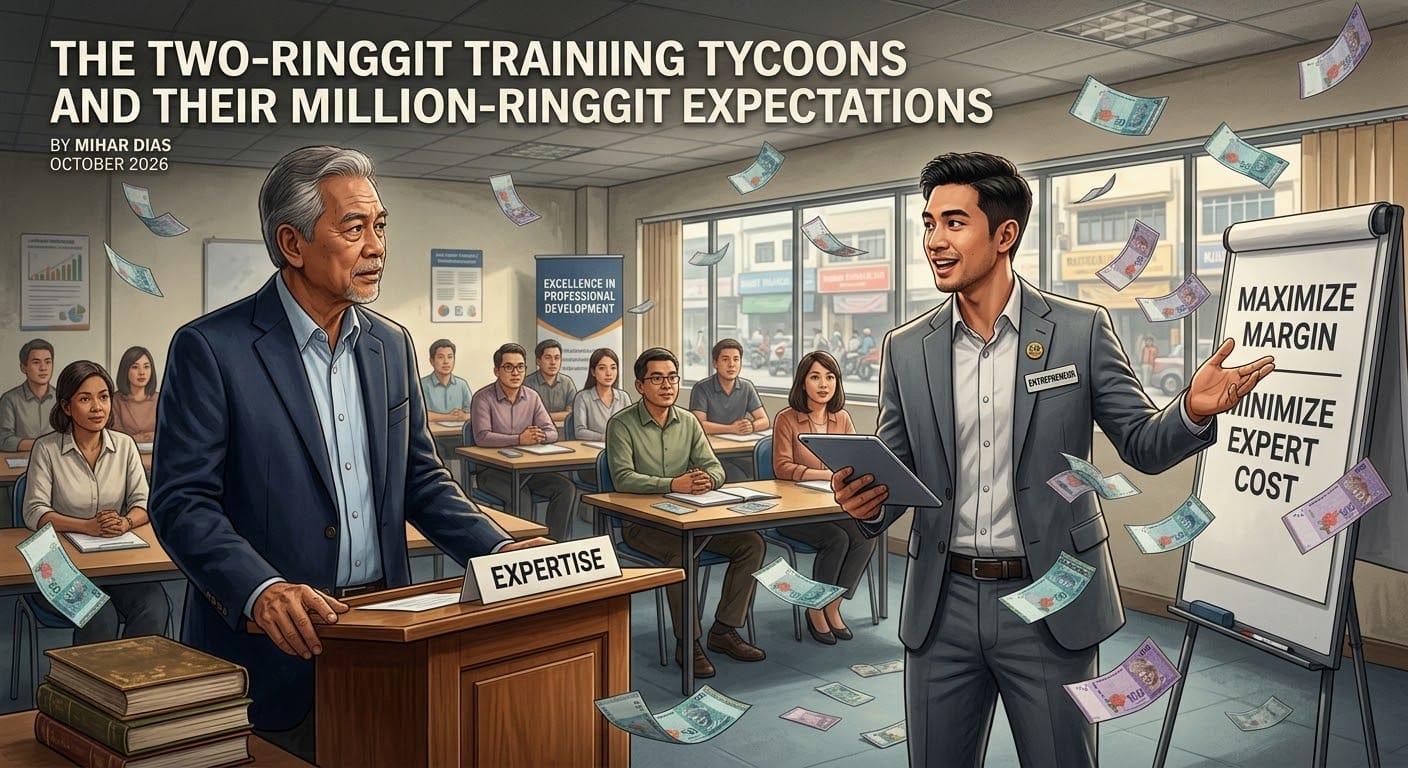
By Mihar Dias October 2026
There is a new breed of entrepreneur in Malaysia who has discovered the secret of business success. You do not need a factory, expensive machinery, a large workforce or even a proper office. All you need is a laptop, a telephone, a modest address in a low-cost commercial building, perhaps a spare bedroom at home, and a database of people who can be persuaded to attend a training programme.
Welcome to the wonderful world of training-event entrepreneurship, where the business model is simple: sell expertise at premium prices, acquire it at bargain-basement rates, and hope nobody asks too many questions about the difference.
Recently, I was offered a four-hour workshop with the following fee structure: RM2,000 for 1–15 participants, RM2,500 for 15–20, and RM4,000 for 21 participants.
I politely explained that my professional fee was based on RM1,000 an hour, a rate I have not revised since the 1980s. After more than five decades in consulting, teaching and management development, I thought this was a reasonable starting point for a discussion.
Apparently, the more pressing question was how many participants the organiser could enrol.
My professional experience, apparently, was less important than the seating capacity of the classroom.
Let us do some elementary arithmetic, a discipline that occasionally gets lost in the excitement of entrepreneurship.
Suppose 20 participants pay RM500 each. The organiser collects RM10,000. The lecturer receives RM2,500. That leaves RM7,500 before venue rental, refreshments, materials, marketing, administration and other expenses.
At RM800 per participant, revenue rises to RM16,000, leaving RM13,500 before those costs.
I am not suggesting that the balance is pure profit. Organising a programme involves legitimate expenses and commercial risks. But I would be fascinated to know how some organisers calculate the value of the person whose knowledge, reputation and experience constitute the very product being sold.
Perhaps there is a secret formula known only to the industry. The lecturer supplies five decades of experience; the organiser supplies a registration link. Both are then expected to regard themselves as equal partners in the creation of value.
One wonders whether the same business philosophy applies elsewhere. Would a restaurant owner tell a chef that his remuneration depends on how many customers can be persuaded to book a table? Would a construction company ask an engineer to accept a fee determined primarily by the number of people attending the opening ceremony?
In the training business, however, the lecturer can sometimes be treated as an inconvenient overhead rather than the principal attraction.
The most entertaining part is the assumption that quality can be purchased by the kilogram, like potatoes at the wet market. Four hours of instruction are four hours of instruction, whether delivered by someone who has spent decades working with executives or someone who has just discovered PowerPoint.
Experience, apparently, is optional. The certificate is compulsory.
And what of the trainer's preparation? A good workshop is not simply four hours of talking. It involves designing the programme, developing exercises, tailoring examples, anticipating questions and translating experience into practical learning. Participants are not paying merely for the sound of a lecturer's voice. They are paying for what that voice knows.
Of course, organisers must make money. Nobody expects entrepreneurs to operate as charitable institutions. A commercially viable programme benefits everyone, including the trainer. But a sustainable business depends on a fair exchange of value, not on squeezing the supplier until the product becomes indistinguishable from everything else on the market.
There is also a peculiar irony in an industry that teaches organisations to value human capital while negotiating as though human expertise were an expendable commodity.
Perhaps these two-person enterprises with their modest offices have discovered a revolutionary management principle: maximise the margin, minimise the expertise, and let the participant discover the difference after paying.
The lecturer, meanwhile, is expected to bring the intellectual capital, the professional credibility and the decades of accumulated experience, preferably at a price that leaves sufficient money for the organiser to print a handsome certificate bearing the words Excellence in Professional Development.
My RM1,000 hourly rate has remained unchanged since the 1980s. Whether that makes me expensive or extraordinarily patient is a matter for the reader to decide.
But I have learnt one thing over half a century in management consulting: organisations rarely obtain lasting value by undervaluing the people who create it.
Perhaps the next training workshop should begin with a compulsory opening module for the organisers themselves.
Its title could be “How to Make Money Without Mistaking Cheapness for Value.”
Four hours should be sufficient.
My fee, of course, would be RM4,000.
After all, some lessons are best learnt from experience.
Mihar Dias (mihardias@gmail.com) is a content creator under the Newswav Creator programme, where you get to express yourself, be a citizen journalist, and at the same time monetize your content & reach millions of users on Newswav. Log in to creator.newswav.com and become a Newswav Creator now!
The User Content (as defined on Newswav Terms of Use) above including the views expressed and media (pictures, videos, citations etc) were submitted & posted by the author. Newswav is solely an aggregation platform that hosts the User Content. If you have any questions about the content, copyright or other issues of the work, please contact creator@newswav.com.