.jpeg)

Recently, a video of a standup comedy routine performed in New York’s The Comedy Cellar became viral on social media, with many Malaysians taking exception to its joke on the disappearance of Malaysia Airlines Flight MH370. The standup routine, depicting the rivalry between Malaysia and Singapore since the latter’s secession was branded as ‘tasteless’ by many, causing a controversy that propelled the comedian, Jocelyn Chia into infamy.
In fact, it even devolved into a diplomatic incident as Singapore’s Minister of Foreign Affairs Vivian Balakrishnan ended up apologising to Malaysia for Chia’s “horrendous comments” and stressed that she “certainly does not speak for Singaporeans”. It was later revealed that Chia was born in Boston and held joint American-Singaporean citizenship until adulthood, upon which she chose to become an American citizen.
Even to this day, Chia’s standup routine is a hotly debated topic. Several leaders across the political aisle have condemned the insensitive remarks, while many Malaysians are urging for action to be taken against her.
With that being said, what sort of legal action can our country take against Chia? Well, read on below to find out.
Removal of offensive posts from social media platforms
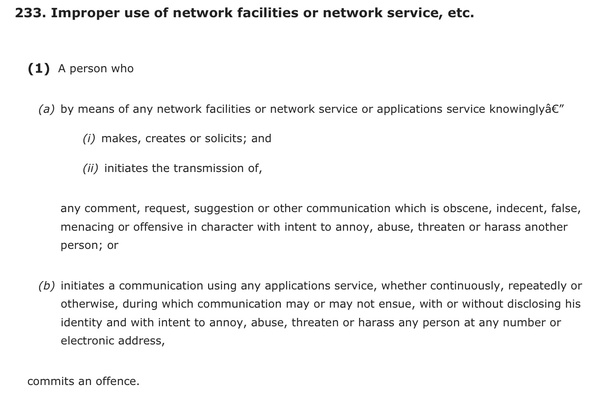
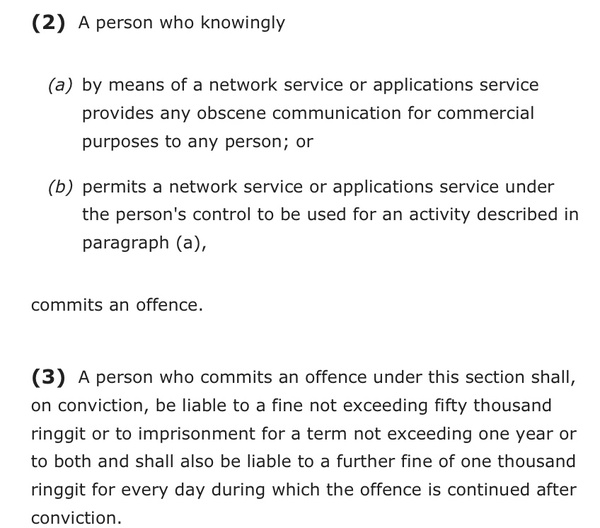
First off, the Malaysian Multimedia and Communications Commission (MCMC) can request social media sites to take down or erase content from their platforms. This is in line with Section 233(2) of the Communications and Multimedia Act 1998 which prohibits knowingly using a network service or applications service to provide obscene communication to a person for commercial purposes or permitting a network service or applications service under the person’s control to be used for that purpose.
In the case of Chia, the video of her standup routine has been removed from TikTok recently after the platform considered it as being against its community guidelines. As reported by The Star, a TikTok representative confirmed that the video was removed as it falls under the hate speech category and depicted discriminatory content.

However, it is unknown whether MCMC played a part in the video’s removal from TikTok. Chia had previously removed the original video at the Comedy Cellar’s request and reposted it to her TikTok account without the latter’s branding before it was taken down.
Regardless, the video’s content makes Chia liable under Section 233(2) of the Communications and Multimedia Act 1998 for obscene communications. Should she be convicted under the provision, Chia may face up to a fine of up to RM50,000 or up to 1-year imprisonment or both. Furthermore, she may also be liable to a further fine of RM1,000 each day during which the offence is continued after conviction.
Intentional insult to provoke a breach of peace and statements conducing to public mischief
Besides that, Chia’s viral video may also make her liable under Section 504 and 505(c) of the Penal Code for intentional insult with intent to provoke a breach of the peace and statement conducing to public mischief respectively. Indeed, Inspector-General of Police Datuk Seri Acryl Sani has asserted that the police are investigating Chia under these two Penal Code provisions as well as Section 233 of the Communications and Multimedia Act 1998.
Accordingly, Section 504 of the Penal Code is as below:
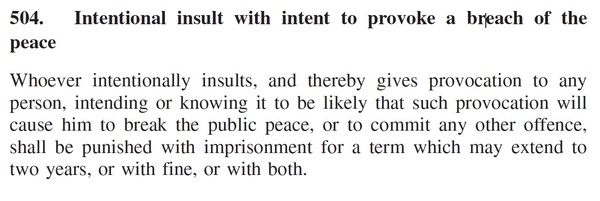
Based on the above provision, Chia’s words during her standup routine are arguably in line with what is considered an offence under Section 504. Hence, should she be convicted under this Act, Chia faces up to 2-year jail, a fine or both.
Meanwhile, Section 505(c) reads as below:
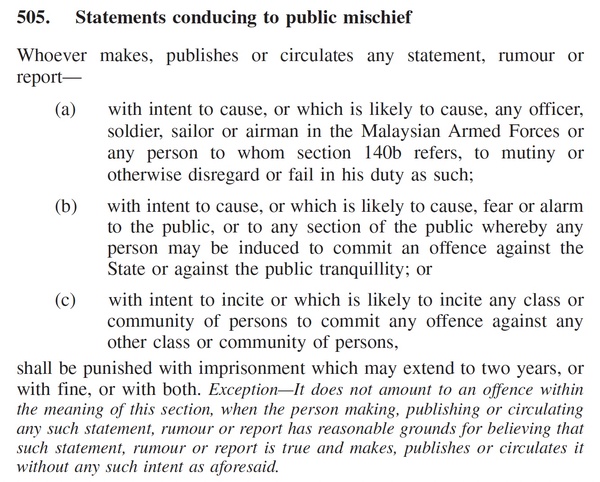
Similarly, Chia’s words in the viral video can also be argued to be in line with what Section 505(c) prescribes as an offence for statements conducing to public mischief. Accordingly, should she be convicted under this provision, the comedian faces up to 2-year jail, a fine or both.
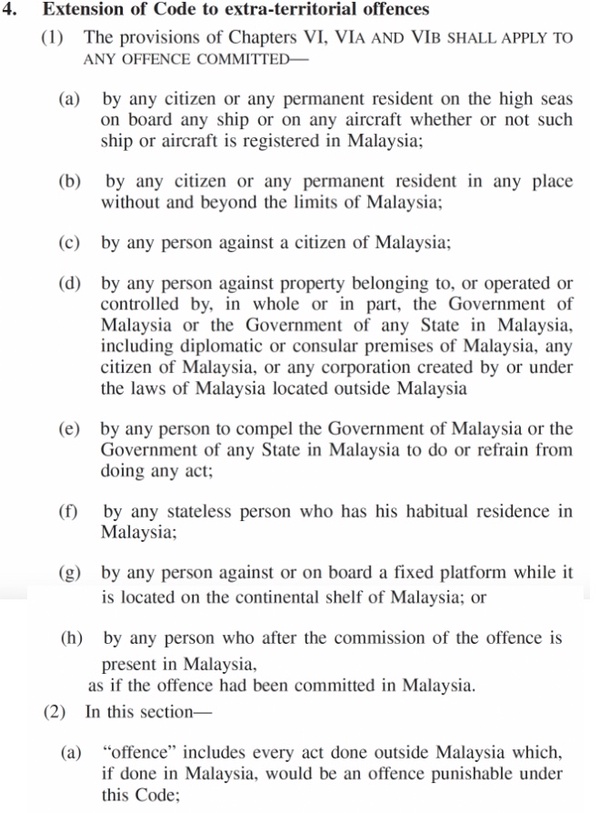
With all of that in mind, it is worth noting that all of the above is just academic as Chia is not a Malaysian citizen or a permanent resident nor was the act committed while in our country. Hence, no action can be taken against her as Section 504 and 505(c) of the Penal Code, as well as Section 233 of the Communications and Multimedia Act 1998 have no extra-territorial jurisdiction.
In the Penal Code, Section 504 and 505(c) are provisions of its Chapter XXII, which are not provisions prescribed as extra-territorial offences.
This is defined under Section 4 of the Penal Code below:
Similarly, Section 4 of the Communications and Multimedia Act 1998 prescribes that any extraterritorial application of the legislation is only applicable to persons outside of Malaysia if the person is a licensee under the Act, or provides relevant facilities or services under the Act. Both definitions are not applicable to the US-comedian, hence she may not be charged under the Act too.
In relation to the Royal Malaysia Police’s (PDRM) recent action of seeking Interpol’s assistance to find out Chia’s full identity and current whereabouts, it may all be for nought. The judgement in the case of Public Prosecutor v. Rajappan Chinna Kounder [1986] 1 CLJ 175 explains it best below:
"On the issue of extra-territorial offences, it is useful to see the position both in international law and municipal law (domestic law).
"According to an established principle of international law crimes and criminal acts are matters for the State, within whose territory the criminal acts are committed, irrespective of the nationality of the offenders. International law also recognises that a State has the power to punish its nationals or its permanent residents for criminal acts committed by them outside its territory. But to translate this principle into municipal law (i.e. the domestic law of the State) a clear provision must be made to this effect in its municipal law."

This was further stressed in the judgement of the case of Amin Rayan v Menteri Dalam Negeri & ORS [2015] 8 CLJ 165 below:
“our domestic law provides for the operation of our law beyond our territorial limits only to offences under the Official Secrets Act, the Sedition Act, and to offences under Chapters VI, VIA, and VIB of the Penal Code. Our law does not extend to other offences committed beyond our territorial limits, even if it is an offence committed in Malaysia. The law of a requesting state may provide for its jurisdiction differently. But in relation to the corresponding offence in Malaysia, we need to look at our law. If there is no corresponding offence in Malaysia, then requisition must be refused, regardless of whether the requesting state has local or extraterritorial jurisdiction. Thus, the key to unravel a requisition for the return of a criminal fugitive is the corresponding offence in Malaysia which must have extraterritorial effect.”
Moving forward, let this incident be a reminder to all Malaysians and those residing in our country to be mindful of our words and what we post on social media. As the eternal quote from Erma Bombeck read, “There is a thin line that separates laughter and pain, comedy and tragedy, humour and hurt”.
For more insights into the Malaysian legal system such as this, do make sure to follow us on Facebook and Instagram or visit our official website. You can also read our articles on the popular Malaysian news aggregator app Newswav here.
About us
Ahmad Danial Iswatt & Luqman is an esteemed law firm that delivers best-in-class legal solutions to individuals, businesses and legal entities in Malaysia and beyond. We offer ease of mind to our wide range of clients by dismantling complex legal challenges with novel solutions through exceptional legal advisory and representation.
Our distinguished partners of diverse backgrounds and expertise have achieved significantly favourable results in all levels of courts in Malaysia, from high-profile civil and criminal litigation proceedings to complex cases in which the outcomes have become binding precedents for the laws of the country. Backed by a growing team of exceptional lawyers and capable support staff, we aspire to be at the forefront of the legal sphere to satisfy our clients’ dynamic demands and ever-increasing complexity.
ADIL Legal is a content creator under the Newswav Creator programme, where you get to express yourself, be a citizen journalist, and at the same time monetize your content & reach millions of users on Newswav. Log in to creator.newswav.com and become a Newswav Creator now!
The User Content (as defined on Newswav Terms of Use) above including the views expressed and media (pictures, videos, citations etc) were submitted & posted by the author. Newswav is solely an aggregation platform that hosts the User Content. If you have any questions about the content, copyright or other issues of the work, please contact Newswav.