

The Health Ministry's official website was inaccessible early this morning, with online users claiming it had been hacked after a Google search preview displayed the message: "HACKED BY MUSHR00W," alongside the well-known Anonymous slogan, “We are Legion. We do not forgive. We do not forget. Expect us.”
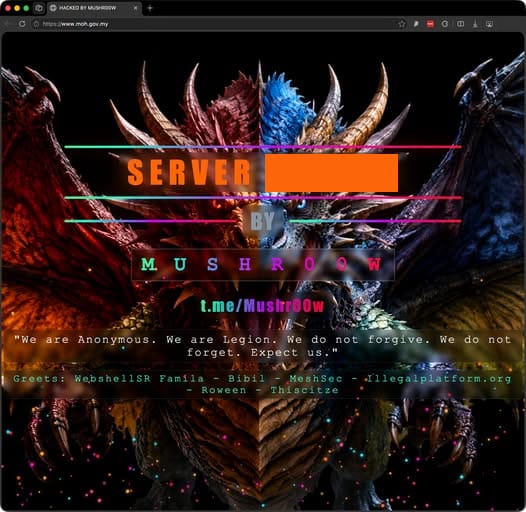
Malaysia's Ministry of Health (KKM) has officially confirmed that its website, www.moh.gov.my, was the victim of a cyberattack, putting an end to speculation after the portal became inaccessible early this morning.
In a statement posted on its official Facebook page, KKM acknowledged that its website had been hacked and said it was taking immediate action to address the incident. The ministry advised the public to avoid accessing the website for the time being, refrain from clicking any suspicious links or downloading files, and instead rely on its official social media channels for health-related information while the issue is being resolved.
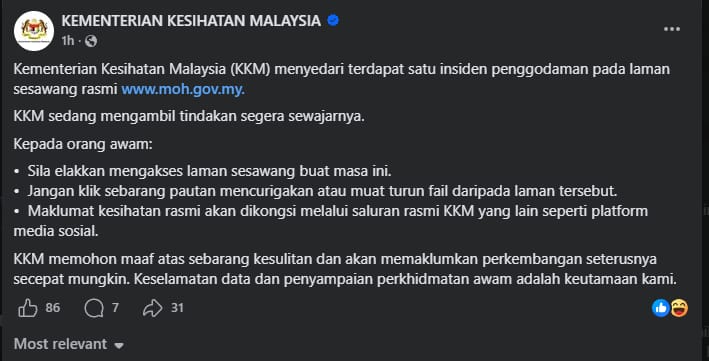
While KKM has assured the public that the security of data and the continuity of public services remain its top priorities, the incident raises a larger question: Why do government systems continue to fall victim to cyberattacks?
This is far from the first cybersecurity incident involving Malaysia. In recent years, the country has experienced several high-profile breaches, including the 2017 leak of personal data belonging to more than 46 million mobile phone subscribers, one of the largest data breaches in the nation's history. In 2021, reports also emerged of personal information from the National Registration Department allegedly being offered for sale online.
These incidents demonstrate that cyber threats are not isolated events but an ongoing challenge. Every successful attack, whether it involves website defacement, leaked databases, or ransomware, erodes public confidence in the government's ability to safeguard sensitive information.
A website defacement may not necessarily mean attackers have stolen confidential data. However, if hackers were able to gain enough access to alter a ministry's public-facing website, it inevitably raises concerns about whether other systems could also be vulnerable.
As Malaysia continues its digital transformation, cybersecurity can no longer be treated as an afterthought. Government agencies manage enormous amounts of sensitive information, from healthcare records to identity data and financial information. Protecting these systems requires continuous investment in security infrastructure, regular penetration testing, timely software updates, stronger authentication measures, and a highly skilled cybersecurity workforce.
The Health Ministry has promised to provide further updates as investigations continue. Hopefully, this incident will not only be resolved quickly but also serve as a catalyst for strengthening the country's cyber defences. Malaysians deserve confidence that the digital services they rely on every day are secure, resilient, and prepared against increasingly sophisticated cyber threats.
Beru (teckligod@gmail.com) is a content creator under the Newswav Creator programme, where you get to express yourself, be a citizen journalist, and at the same time monetize your content & reach millions of users on Newswav. Log in to creator.newswav.com and become a Newswav Creator now!
The User Content (as defined on Newswav Terms of Use) above including the views expressed and media (pictures, videos, citations etc) were submitted & posted by the author. Newswav is solely an aggregation platform that hosts the User Content. If you have any questions about the content, copyright or other issues of the work, please contact creator@newswav.com.
