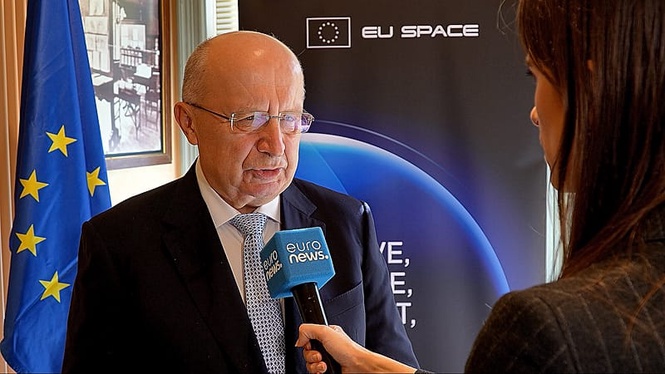
The European Commissioner for Defence and Space Andrius Kubilius said that Palantir Technologies is "a great company" in a wide ranging interview with Euronews' Europe Today touching on space and defence**.**
"Developments with AI for intelligence, for managing the data, are very crucial for modern warfare doctrines," he said on the sidelines of the second EU Access to Space Summit in Brussels on Wednesday.
Palantir Technologies has been panned by various human rights organisations and European governments for its use in military operations, mass surveillance, and immigration enforcement, among other issues.
Despite this, the presidents of Poland and Lithuania — Karol Nawrocki and Gitanas Nausėda — met with the company's CEO Alex Karp in the margins of the United Nations General Assembly this week in New York.
Media reports and official statements from both leaders touted deeper integration with the company, particularly regarding defence and operations with the North Atlantic Treaty Organisation (NATO).
Asked by Euronews whether this burgeoning partnership was wise for Europe’s eastern flank, Kubilius said he did not know what had been discussed or agreed upon by the leaders and Karp.
He said, however, that AI is becoming “the new normal” in the development of defence doctrines and is considered “crucial”, while stressing that Europe should develop its own capabilities.
Denmark-Greenland-US agreement means annexationist tension 'resolved'
After ten months of talks, the governments of Copenhagen, Washington and Nuuk signed a deal on Tuesday finalising the Greenland conundrum in New York City.
US President Donald Trump claims the agreement gives him "permanent control" over the Arctic island and sets out plans for the US to reopen two more military bases.
Kubilius said the Danish government are trumpeting the success of the deal, particularly as it "removes some kind of language" used by the American authorities that the Europeans interpreted as "totally unacceptable".
"The language was that, you know, we remember very well, that Greenland should belong to United States and so on and so because of security reasons. So now those issues are resolved," he said.
Trump has previously said that "we need Greenland" and "we are going to do something [there] whether they like it or not", while previously not ruling out taking the country by force.
Less 'influence' from EU member states needed for sanctions policy
A day after the news broke that France successfully lobbied for the removal of one individual from the EU's latest sanctions package against Russia, Kubilius said that what's needed now is a rethink into how the measures are approved.
Latvia — as well as other Baltic nations such as Lithuania — fervently opposed the de-listing of two individuals from the sanctions package against Moscow for it's full-scale invasion of Ukraine.
The episode has exposed deep divisions into how the sanctions packages are delivered, while Latvian Prime Minister Andris Kulbergs is concerned for the precedent it sets.
Kubilius said the episode demonstrates member states should have less sway in the final vote. "Sanctions policy in Europe should be strengthened and made more effective," he said.
"There should be less of individual member states' influence to influence on sanction lists as it happens, and that is why I am very much in favour of what German government is proposing."
Kubilius is referring to a push spearheaded by Berlin to accelerate the tempo and efficiency of decision-making in the bloc's common foreign and security policy, namely when it comes to sanctions.
The proposal suggests modifying how sanctions are approved, from unanimous support to qualified majority.